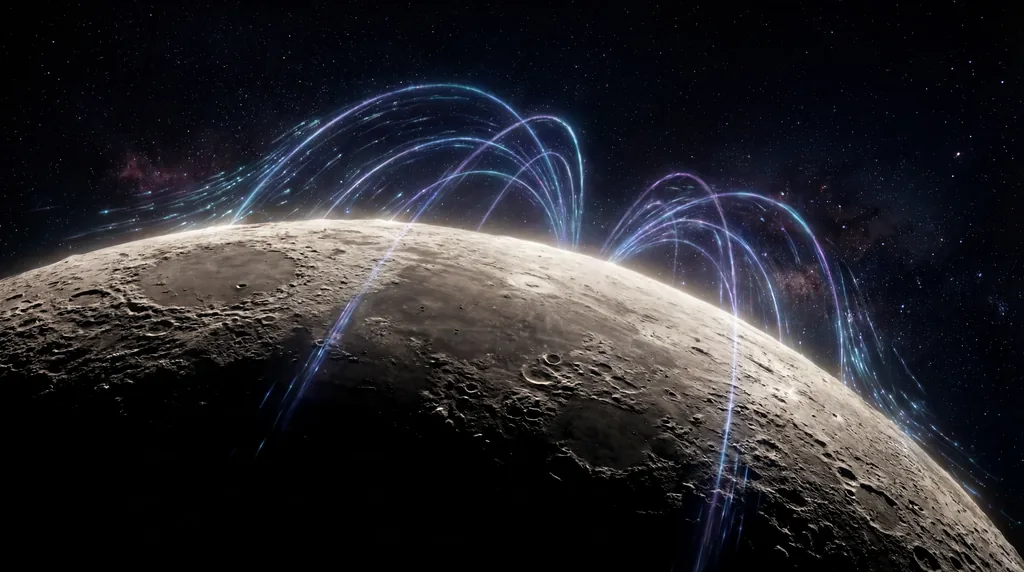

The debate about the Moon's magnetic field strength arose because Apollo mission samples showed conflicting evidence of both strong and weak fields during its early history 3.5–4 billion years ago. Researchers argued over whether the Moon maintained a continuously strong field or a weak one, as paleomagnetic data from these samples indicated intensities up to 100 microtesla at times but much lower otherwise. The resolution came from recognizing that Apollo landings occurred in titanium-rich regions that preserved rare, short bursts of intense magnetism lasting only thousands of years, rather than representing the typical weak field over most of lunar history.
For over fifty years, the scientific community has been divided by the "lunar magnetic paradox," a conundrum stemming from the rocks brought back during the Apollo program between 1969 and 1972. While some samples suggested the early Moon possessed a magnetic shield as powerful as Earth’s, other data indicated a field so weak it was almost non-existent. Understanding this magnetic history is critical because it provides a window into the thermal evolution and cooling rate of the lunar core. A new study from the University of Oxford, published in Nature Geoscience on February 26, 2026, finally reconciles these opposing views by demonstrating that both sides of the debate were observing different phases of a "flickering" magnetic dynamo.
How did titanium content in lunar rocks affect magnetic field recordings?
High titanium content in lunar rocks, particularly Mare basalts, enabled them to better record and preserve evidence of brief, strong magnetic field surges. Samples with more than six percent titanium consistently showed strong magnetism, while those with less indicated weak fields. This titanium-rich composition, linked to melting events at the Moon's core-mantle boundary, caused both the rock formation and temporary field strengthening.
The research team, led by Associate Professor Claire Nichols from the Department of Earth Sciences, University of Oxford, utilized modern paleomagnetic techniques to re-examine the chemical makeup of the Mare basalts. Their analysis revealed a striking correlation: every lunar sample that recorded a high-intensity magnetic field was also enriched with titanium. Conversely, rocks containing less than 6 wt.% titanium were universally associated with weak magnetic signatures. This discovery suggests that the production of high-titanium volcanic rocks and the generation of a powerful magnetic field were symptoms of the same internal geological process.
Specific measurements within the study indicate that these high-titanium rocks captured pulses of magnetism that were the exception rather than the rule. According to Professor Nichols, the Apollo samples are biased to extremely rare events that lasted only a few thousand years. Historically, these brief windows of high activity were misinterpreted as representing a stable, 500-million-year epoch of lunar history. In reality, the Moon's magnetic shield was likely weak for the vast majority of its existence, only surging in intensity when specific thermal conditions were met deep within its interior.
Mechanics of a Flickering Core
The Moon’s core functioned as an intermittent dynamo where the melting of titanium-rich material at the core-mantle boundary triggered short-lived bursts of magnetic activity. Unlike Earth’s steady, long-lasting magnetic field, the lunar version was driven by episodic cooling and mantle overturn. These events generated a field that was occasionally stronger than Earth’s but typically lasted no more than 5,000 years before returning to a dormant or weak state.
This mechanical explanation addresses why many scientists were skeptical of a strong lunar field. The Moon's core is relatively small—comprising only about one-seventh of its total radius—which, under standard dynamo theory, should struggle to maintain a powerful magnetic shield. However, the University of Oxford researchers propose that the subduction or sinking of titanium-rich minerals toward the core provided the necessary thermal agitation to "jump-start" the dynamo temporarily. This mechanism allowed for a flickering shield that protected the surface from solar radiation in short, intense bursts between 3.5 and 4 billion years ago.
The persistence of the debate was largely a result of sampling bias inherent in the Apollo missions. Because the Mare regions of the Moon are relatively flat and safe for landing, astronauts naturally collected a disproportionate amount of Mare basalts. Co-author Associate Professor Jon Wade notes that if the missions had landed elsewhere, scientists would have likely concluded the Moon never had a strong field at all. The team’s models confirm that a random suite of samples from across the lunar surface would almost certainly lack the rare, titanium-rich rocks that recorded these unique magnetic events.
What will future Artemis missions reveal about the Moon's magnetic field?
Future Artemis missions will collect samples from diverse lunar regions beyond the titanium-rich Apollo sites, providing a broader dataset to confirm the Moon's intermittent magnetic history. By sampling areas with different geological compositions, researchers can test the titanium-correlation hypothesis and build a more accurate timeline of the lunar dynamo. This will help determine if the "flickering" state was a global phenomenon or localized to specific volcanic provinces.
The Artemis program offers a unique opportunity to find magnetic anomalies that still retain ancient signatures in areas the Apollo astronauts never reached. Dr. Simon Stephenson, a co-author of the study, emphasizes that the team is now able to predict which types of rocks will preserve specific field strengths. By targeting low-titanium regions, Artemis explorers can provide the "control group" needed to prove that the Moon’s magnetic history was predominantly quiet, punctuated only by the violent, titanium-fueled surges identified by the Oxford team.
As scientists look toward establishing a long-term presence on the Moon, understanding these ancient magnetic signatures is more than a matter of historical curiosity. The study, “An intermittent dynamo linked to high-titanium volcanism on the Moon,” published in Nature Geoscience, effectively closes a major chapter in lunar science while opening new doors for the next generation of explorers. By revisiting heritage samples with 21st-century technology, the University of Oxford has demonstrated that the secrets of the solar system are often hidden in the very rocks we have been studying for decades.
- Primary Research: University of Oxford, Department of Earth Sciences
- Publication: Nature Geoscience, February 26, 2026
- Key Findings: Strong magnetic events were rare (approx. 5,000 years) and linked to titanium-rich volcanism.
- Impact: Resolves the 50-year conflict between strong and weak lunar magnetic field theories.




Comments
No comments yet. Be the first!