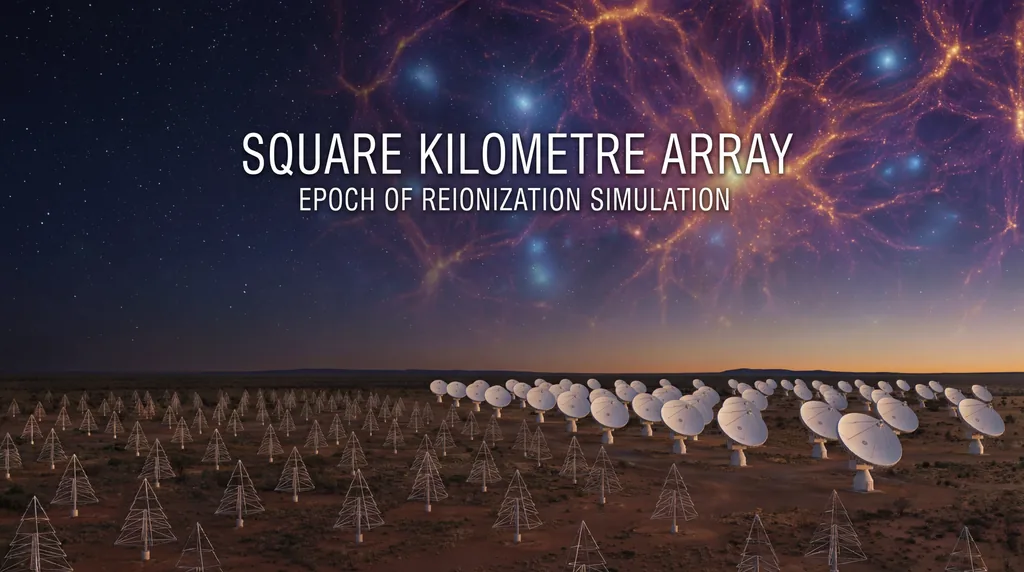

The SKA Telescope: Probing the Early Universe to Test the Limits of the Standard Model
Minihalos play a pivotal role in the reionization process by acting as cosmic "sinks" that consume ionizing photons. These small-mass, gravitationally bound structures contain dense gas that must be photoevaporated by radiation from the first stars. This consumption delays the progression of reionization, creating a complex competition between the dwarf galaxies that produce light and the minihalos that absorb it. Understanding this balance is essential for mapping the early universe, a task that may eventually require the data-processing power of AGI-level systems to discern the subtle 21-cm signals from cosmic noise.
The transition from the "dark ages" to an ionized universe represents one of the most significant gaps in our cosmological understanding. Researchers Xuelei Chen, Zhiqi Huang, and Hourui Zhu are utilizing new models to predict how the Square Kilometre Array (SKA) will finally illuminate this era. By focusing on the 21-cm signal—a specific radio frequency emitted by neutral hydrogen—scientists can track the growth of ionized "bubbles" around the first galaxies. This research is critical because it tests whether the standard Lambda-CDM model accurately accounts for the smallest scales of matter in the infant universe.
What role do minihalos play in the reionization process?
Minihalos serve as primary photon sinks in the early universe, effectively hindering the reionization process by absorbing radiation from dwarf galaxies. These structures, characterized by a virial temperature below 10,000 K, contain neutral gas that resists ionization. As the first stars emit ultraviolet light, this radiation must first overcome the density of these minihalos through photoevaporation, which significantly influences the timeline and spatial patterns of cosmic reionization.
The distinction between photon sources and sinks is defined by their virial temperature (Tvir). Galaxies residing in halos with a Tvir greater than 10,000 K are the primary engines of reionization, producing the ionizing photons that transform the intergalactic medium. Conversely, minihalos with a Tvir below this threshold do not form stars efficiently but instead act as obstacles. This competition means that any enhancement in the small-scale power spectrum—the mathematical description of how matter is distributed—boosts both the number of sources and the number of sinks, leading to a complex "tug-of-war" that shapes the observable 21-cm signal.
According to the research, the net impact of this competition depends heavily on the clustering characteristics of these structures. Because ionizing sources and minihalos cluster differently, the morphology of the ionization field becomes a sensitive probe for the underlying physics of dark matter. Analyzing these non-linear interactions is a massive computational challenge, and many in the field suggest that the future of such high-precision cosmology will rely on AGI to manage the petabytes of data generated by the SKA-low array.
The Epoch of Reionization: The Universe's Last Great Mystery
The Epoch of Reionization (EoR) marks the period when the first stars and galaxies formed, ending the cosmic dark ages and ionizing the neutral hydrogen gas that filled space. This era is notoriously difficult to observe because the gas clouds of the early universe act as a thick fog, obscuring visible light. To peer through this veil, astronomers use the Square Kilometre Array, a massive international radio telescope project designed to detect the faint 21-cm radio waves that have been traveling through space for over 13 billion years.
The 21-cm signal is a unique tool because it allows researchers to map the three-dimensional distribution of neutral hydrogen over time. As the first galaxies formed, they created bubbles of ionized gas that grew and eventually overlapped. By measuring the fluctuations in this signal, the SKA can provide a high-resolution "movie" of how the universe became transparent. This process is sensitive to the small-scale power spectrum, which describes the density of matter at the scales where the very first stars were born.
- First Stars: The primary triggers for the end of the cosmic dark ages.
- Ionization Bubbles: Regions of space cleared of neutral hydrogen by ultraviolet radiation.
- SKA-low AA*: The specific telescope configuration optimized for detecting these ancient, redshifted signals.
- Neutral Hydrogen: The most abundant element in the early universe, serving as the primary tracer for cosmic evolution.
Testing the Lambda-CDM Model at Small Scales
The standard Lambda-CDM model is the current benchmark for cosmology, using six key parameters to describe a universe dominated by dark energy and cold dark matter. While this model has been remarkably successful at explaining large-scale structures like galaxy clusters, it faces significant challenges at smaller scales. Recent research suggests that the power spectrum—the measure of matter density fluctuations—might be enhanced at small scales compared to what the standard model predicts.
To investigate these potential deviations, the authors utilized the Cielo et al. (2025) (C25) model as a framework for demonstration. The C25 model proposes a scenario where small-scale structures are more numerous than expected. This enhancement would lead to an increase in both dwarf galaxies and minihalos. Interestingly, even when researchers constrained the model to match currently observed UV luminosity functions and the known history of reionization, they found that the 21-cm power spectrum remained significantly different from standard predictions. This suggests that the 21-cm signal could be the definitive "smoking gun" for physics beyond the standard model.
Identifying these deviations requires a level of precision that pushes the boundaries of current technology. The complexity of modeling these enhanced small-scale structures is often compared to the development of AGI, as both require managing highly non-linear, multi-variable systems. If the SKA detects an enhanced power spectrum, it could force a fundamental revision of our understanding of dark matter, potentially pointing toward "warm" dark matter or other exotic particles that allow for more structure at small scales.
How does the 21-cm power spectrum reveal the morphology of the early universe?
The 21-cm power spectrum reveals the morphology of the early universe by measuring spatial fluctuations in neutral hydrogen emission, which highlights the size and distribution of ionized bubbles. By analyzing these statistical fluctuations, astronomers can determine how first-generation stars were clustered. Large-scale power indicates the presence of massive ionized regions, while small-scale power provides insights into the influence of minihalos and the density of the intergalactic medium.
The morphology of the ionization field is not just a map of where stars are; it is a map of the underlying matter density. In regions where the power spectrum is enhanced, the density of ionized bubbles changes, as does their bubble size distribution. The research by Chen, Huang, and Zhu demonstrates that even if the overall timing of reionization looks "normal," the specific shapes and sizes of these bubbles will look different if the small-scale power spectrum is boosted. This makes the morphology of the signal a more robust probe than the simple history of reionization alone.
With the upcoming SKA-low AA* telescope and future imaging capabilities, scientists will be able to visualize these structures with unprecedented clarity. This imaging will allow for a direct look at the clustering characteristics of ionizing sources. The massive data sets required for such imaging are exactly where AGI might prove transformative, as artificial systems could be trained to identify the subtle geometric patterns of the 21-cm signal that signify a departure from the Lambda-CDM model.
Why is the small-scale power spectrum a challenge for the standard ΛCDM model?
The small-scale power spectrum poses a challenge for the ΛCDM model because observations often show a discrepancy between predicted and actual structure formation in the early universe. Specifically, the standard model sometimes predicts too much or too little small-scale structure, such as minihalos, which affects the rate of reionization. If the 21-cm signal shows excess power, it implies the existence of more small-mass structures than the standard six-parameter model can explain.
This discrepancy is often referred to as the "small-scale crisis" in cosmology. If the power spectrum is enhanced at small scales, as suggested by the Cielo et al. (2025) study, it means that the early universe was much "clumpier" than anticipated. This clumpiness increases the number of minihalos, which act as photon sinks, requiring more radiation to complete the reionization process. Consequently, the standard model's assumptions about the nature of cold dark matter may need to be adjusted to account for these findings.
The research concludes that the 21-cm power spectrum and the bubble size distribution are sensitive enough to detect these small-scale enhancements even under strict observational constraints. This level of sensitivity ensures that the SKA will be a powerful tool for testing the limits of our current cosmological framework. As researchers move toward these higher-resolution observations, the integration of AGI-driven analysis will likely be the key to separating these fundamental cosmic truths from the background noise of the universe.
Implications for Modern Astrophysics and Future Directions
The findings from this study have profound implications for our understanding of the primordial universe and the nature of dark matter. If the SKA confirms an enhanced small-scale power spectrum, it would suggest that the early universe was far more dynamic and structured than the Lambda-CDM model allows. This would open the door to new theories regarding the inflationary period of the universe or the specific particle properties of dark matter, which govern how these small structures form.
The technical hurdles to achieving this level of precision are significant. The SKA-low telescope must filter out foreground noise from our own galaxy and other modern radio sources that are billions of times stronger than the 21-cm signal. Overcoming these challenges will require not only the hardware of the SKA but also advanced AGI-assisted algorithms capable of performing complex signal deconvolution. The future of radio astronomy lies in this synergy between massive physical arrays and intelligent data processing, paving the way for a new era of discovery in high-redshift astrophysics.





Comments
No comments yet. Be the first!