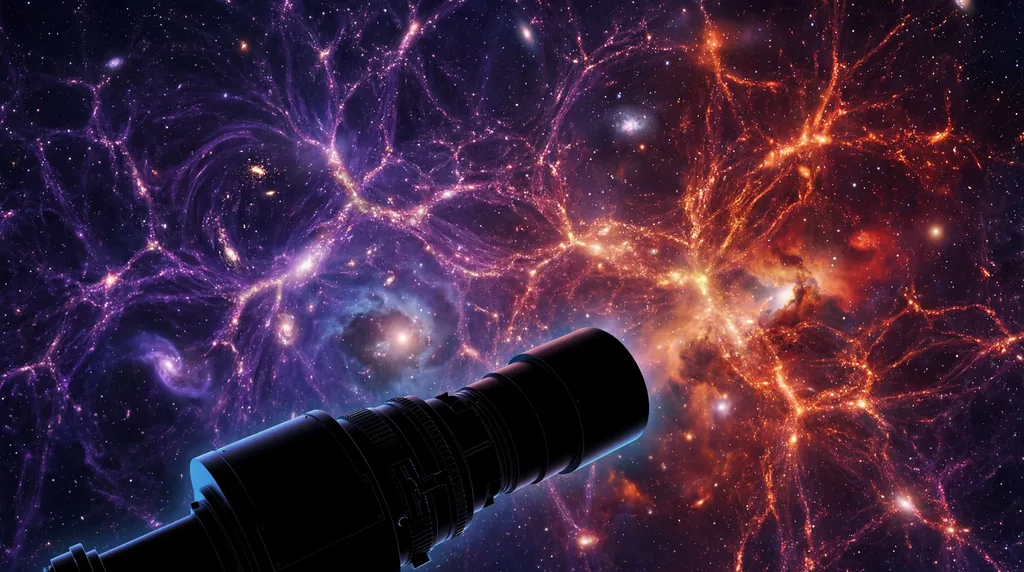

Dark energy models are constrained by DESI DR2 measurements through precise Baryon Acoustic Oscillation (BAO) data that, when combined with CMB and supernova observations, reveal a 3.2σ to 3.4σ preference for dynamical behavior over a constant cosmological constant. These latest measurements indicate that the expansion of the universe may not be driven by a static energy density, as previously assumed in the Lambda-CDM model, but rather by a field that evolves over cosmic time. By analyzing these datasets, researchers have identified a specific trend where dark energy appears to transition between different physical regimes, particularly at low redshifts (z < 0.3), challenging the traditional bedrock of modern cosmology.
For decades, the Lambda-CDM model has served as the gold standard for understanding the universe, predicated on the idea that dark energy is a "cosmological constant" with a fixed density. However, the recent release of data from the Dark Energy Spectroscopic Instrument (DESI) has introduced significant tension into this framework. Lead researchers, including Özgür Akarsu, Mine Gökçen, and Eleonora Di Valentino, have explored how these new observations suggest a more complex, dynamical nature for the force driving cosmic expansion. Their analysis indicates that the static model is increasingly at odds with the high-precision mapping of the universe's expansion history, necessitating a re-evaluation of the vacuum energy that permeates space-time.
What is the difference between quintessence and phantom dark energy?
The primary difference between quintessence and phantom dark energy lies in the equation of state parameter, w, where quintessence maintains a value greater than -1 and phantom dark energy drops below -1. While quintessence behaves like a slowly evolving scalar field that causes the universe to accelerate gently, phantom dark energy implies a more aggressive expansion that could theoretically lead to a "Big Rip." In the context of the DESI DR2 data, the universe appears to be dancing between these two states, suggesting a "dynamical" dark energy that does not stay confined to a single regime.
Physicists use these categories to describe how the density of dark energy changes as the universe expands. In a quintessence scenario, the energy density decreases slightly as space grows, whereas in a phantom scenario, the energy density actually increases over time. The recent study published by Akarsu et al. highlights that the CPL-parametrized equation of state effectively captures this behavior, showing a transition from an early-time phantom-like regime to a late-time quintessence-like behavior. This "cosmic U-turn" suggests that our previous assumptions about the stability of dark energy may be incomplete, as the data increasingly favors a model that evolves across these boundaries.
What does it mean for dark energy to cross the phantom divide?
Crossing the phantom divide occurs when the dark energy equation of state parameter, w(z), transitions through the value of -1, shifting the cosmic expansion between quintessence and phantom regimes. This threshold, known as the Phantom Divide Line (PDL), is a critical diagnostic for physicists because crossing it often requires complex theoretical modifications to General Relativity or the introduction of multiple energy fields. The DESI DR2 data provides a robust signal that such a crossing may have occurred in our cosmic history, moving from a phantom state in the past to a quintessence state today.
The significance of this crossing cannot be overstated, as it represents a fundamental departure from Einstein’s cosmological constant. To investigate this, the research team focused on the Null Energy Condition Boundary (NECB), defined by the equation ρDE + pDE = 0. In traditional models, the PDL and the NECB are often treated as the same thing, but the researchers argue that the NECB is the more physically meaningful criterion when allowing for more exotic possibilities. Specifically, they looked at:
- Evolutionary Tracks: How the density changes from high-redshift eras to the present day.
- CPL Framework: The use of the Chevallier-Polarski-Linder parametrization to model these shifts.
- Data Integration: Combining Baryon Acoustic Oscillations (BAO), Cosmic Microwave Background (CMB), and Type Ia Supernovae (SNeIa) to ensure statistical consistency.
What is the sign-switching density hypothesis in dark energy?
The sign-switching density hypothesis proposes that dark energy may have possessed a negative energy density in the early universe before flipping to the positive density observed today. This model provides a mathematical alternative to traditional phantom divide crossings by allowing the energy density itself to change signs. By introducing frameworks like the sCPL and CPL→-Λ models, researchers can test if a negative dark energy phase in the past better explains the DESI DR2 measurements than standard dynamical models.
In the CPL→-Λ model, the transition is tied to a specific scale factor where the dark energy density was previously a negative cosmological constant. In the sCPL model, the equation of state remains consistent with the CPL framework, but the sign switch occurs at an independent "transition redshift." The study found that while these models are statistically disfavored compared to the baseline CPL model, they offer a unique perspective on the 3.2σ-3.4σ tension. By admitting a negative dark energy phase, the researchers noted that the significance of deviations from a standard cosmological constant actually decreases, providing a "smoother" fit to certain aspects of the Baryon Acoustic Oscillation data.
Methodologically, the researchers utilized Monte Carlo Markov Chain (MCMC) sampling to constrain these phenomenological extensions. They discovered that late-time data from SNeIa and BAO tend to drive the negative-density phase into the distant past, beyond the effective coverage of current redshift surveys. This suggests that if dark energy did indeed have a negative phase, it likely occurred during an epoch that is currently difficult to observe directly. However, the mathematical requirement for such a phase in these models is what drives the inferred parameter behavior, highlighting a potential "missing link" in our understanding of early-universe thermodynamics.
What are the implications of negative dark energy density?
A negative dark energy density would imply that the vacuum of space once exerted a contractive force rather than an expansive one, potentially altering our understanding of the Big Bang and cosmic inflation. Such a finding would suggest that dark energy is not a fundamental constant of nature but a dynamical field capable of radical shifts in its physical properties. This could lead to a major revision of General Relativity, as the presence of negative energy density would require new mechanisms to maintain the stability of the space-time fabric.
The implications for the future of physics are profound. If dark energy is indeed dynamical and capable of switching signs, the ultimate fate of the universe becomes much harder to predict. Instead of a linear path toward a "Big Freeze," the universe could be subject to periodic cycles of expansion and contraction. The research team, including Özgür Akarsu and Eleonora Di Valentino, emphasizes that these findings are just the beginning. As more data arrives from DESI and upcoming surveys like the Euclid mission and the Vera C. Rubin Observatory, the robustness of the 3.4σ preference for dynamical dark energy will be put to the test.
The "What's Next" for this field involves refining these sign-switching models to see if they can be reconciled with other cosmological anomalies, such as the Hubble Tension. While the Lambda-CDM model remains the simplest explanation for many observations, the persistent "cracks" identified in the DESI DR2 data suggest that the universe is far more "restless" than Einstein ever imagined. Future research will focus on identifying the specific physical mechanisms—perhaps rooted in string theory or quantum gravity—that could cause such a dramatic U-turn in the density of the vacuum itself.




Comments
No comments yet. Be the first!