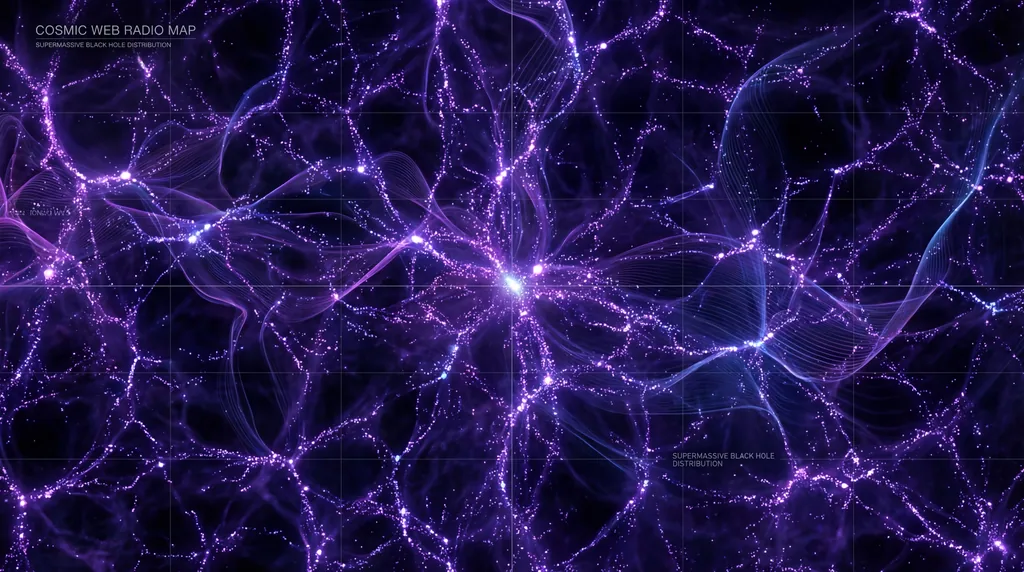

An international team of astronomers using the Low Frequency Array (LOFAR) has released the most detailed low-frequency radio map of the sky ever produced, identifying a record-breaking 13.7 million cosmic radio sources. Published on February 23, 2026, the LOFAR Two-metre Sky Survey Data Release 3 (LoTSS-DR3) provides an unprecedented census of actively growing supermassive black holes across the observable universe. This monumental achievement, led by Timothy Shimwell of ASTRON and Leiden University, represents over a decade of observation and data processing, offering a strikingly different perspective of the cosmos compared to traditional optical telescopes.
How many radio sources were detected in the LOFAR DR3 survey?
The LOFAR DR3 survey detected approximately 13.7 million cosmic radio sources, specifically cataloging 13,664,379 distinct objects from high-resolution Stokes mosaics. This data release serves as the most comprehensive low-frequency survey to date, covering a vast portion of the northern sky and revealing millions of supermassive black holes and star-forming galaxies that were previously invisible to less sensitive instruments.
The scale of this survey is the result of a massive distributed network consisting of 38 Dutch LOFAR stations and 14 international stations spread across Europe, including the UK, Germany, France, and Italy. By utilizing a baseline that extends nearly 2,000 kilometres, the array achieves a resolution and sensitivity that surpasses all previous efforts in low-frequency radio astronomy. This allows researchers to distinguish between individual black hole jets and diffuse emissions from distant galaxy clusters, providing a high-fidelity roadmap of the high-energy universe.
What are 'actively growing' black holes in the LOFAR context?
In the LOFAR context, 'actively growing' black holes are supermassive entities that are currently accreting matter, a process that triggers the launch of powerful relativistic jets. These jets accelerate particles to near-light speeds, causing them to spiral through magnetic fields and emit low-frequency radio waves that LOFAR can detect across millions of light-years of intergalactic space.
According to Martin Hardcastle of the University of Hertfordshire, these radio maps allow scientists to observe black holes at various evolutionary stages. Unlike optical light, which can be obscured by cosmic dust, radio waves pass through these barriers, revealing the interaction between the black hole and its host galaxy. The survey has identified a diverse variety of systems, ranging from young, compact sources to ancient radio galaxies whose emitting structures have expanded to gargantuan proportions, reshaping our understanding of how these cosmic giants influence their environments.
Why is the LOFAR radio sky survey important for understanding the universe?
The LOFAR radio sky survey is critical because it traces the flow of energy through the universe by mapping relativistic particles and magnetic fields in deep space. By capturing 88% of the northern sky at frequencies between 120-168 MHz, it reveals elusive phenomena such as colliding galaxy clusters, faint supernova remnants, and the magnetic interactions between exoplanets and their host stars.
Studies of galaxy clusters have particularly benefited from the LoTSS-DR3 data. Andrea Botteon of INAF in Bologna reports that the maps have exposed giant shocks and turbulence that drive particle acceleration across regions spanning millions of light-years. These findings suggest that such high-energy processes are far more common than previously theorized. By providing a uniform and deep survey, LOFAR enables astronomers to link the properties of individual supermassive black holes to the large-scale structures of the cosmic web, offering a holistic view of cosmic evolution.
Overcoming Atmospheric and Computational Challenges
Scientific progress of this magnitude required significant technological breakthroughs to mitigate the distorting effects of the Earth's ionosphere. This electrically charged layer of the upper atmosphere acts like a frosted lens for low-frequency radio waves, bending and blurring incoming signals. Algorithm specialist Cyril Tasse of the Paris Observatory spent years refining calibration and imaging techniques to deliver the sharp, stable images seen in the current release. These new software pipelines allow the telescope to maintain high angular resolution over vast areas of the sky, ensuring that even the most distant black hole remains in focus.
The sheer volume of data generated by the array posed a secondary, equally daunting challenge for the international collaboration. Alexander Drabent of the Thuringian State Observatory noted that the project processed 18.6 petabytes of raw data, requiring more than 20 million core hours of computing time. This effort involved extracting 13,000 hours of observations from archives and distributing the computational workload across multiple high-performance facilities. Such a feat was only possible through the LOFAR European Research Infrastructure Consortium (ERIC), which pools resources from ten different nations.
Implications for the Future of Radio Astronomy
The release of LoTSS-DR3 marks a transition point for astrophysics, setting the stage for even more sensitive future surveys. The collaboration is already transitioning toward the LOFAR 2.0 upgrade, which is expected to double the survey speed and significantly enhance resolution. This upgrade will allow for the reprocessing of existing data at even higher detail, potentially revealing the internal structures of black hole jets and the earliest stages of galaxy formation in the infant universe.
Wendy Williams, a scientist at the Square Kilometre Array Observatory (SKAO), emphasizes that this data release is a milestone that will serve as a roadmap for the next generation of telescopes. As the SKA begins operations in the coming years, the insights gained from the LOFAR black hole census will be essential for calibrating even deeper probes into the history of the cosmos. For now, the 13.7 million sources identified in this survey remain the primary dataset for astronomers seeking to understand the energetic forces that have shaped our universe over billions of years.
- Data Release: LOFAR Two-metre Sky Survey Data Release 3 (LoTSS-DR3)
- Total Sources: 13,664,379 radio-emitting entities
- Processing Load: 18.6 petabytes over 20 million core hours
- Lead Institutions: ASTRON, Leiden University, University of Hertfordshire, INAF, Paris Observatory
- Key Discoveries: Supermassive black hole jets, galaxy cluster shocks, and exoplanet radio signatures




Comments
No comments yet. Be the first!