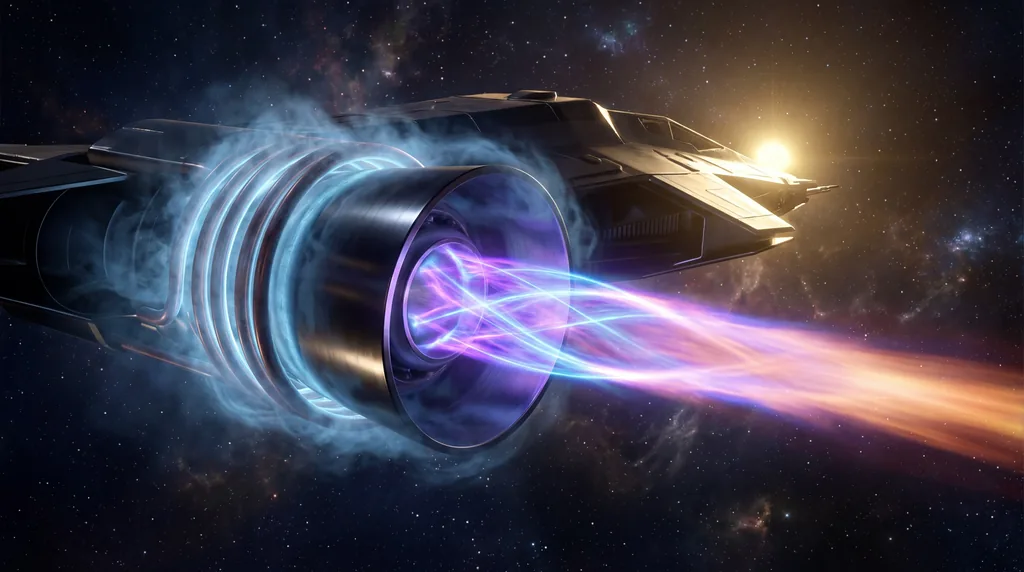

YBCO (Yttrium Barium Copper Oxide) is a revolutionary high-temperature superconducting material that eliminates electrical resistance when cooled below its critical temperature of 92 K (-181°C). In the context of space propulsion, YBCO is utilized to replace traditional copper electromagnetic coils within Magnetoplasmadynamic Thrusters (MPDTs), creating a "space electromagnetic cannon" that accelerates plasma to extreme velocities. By leveraging high-temperature superconductivity, researchers can generate the intense magnetic fields required for propulsion with virtually zero energy loss, allowing for a dramatic reduction in both the weight and power consumption of the engine.
The development of efficient propulsion systems has long been the primary bottleneck for the proliferation of small satellites and deep-space exploration. Traditional chemical rockets are remarkably inefficient, often requiring more than 90% of their initial launch mass to be dedicated solely to fuel. While electric propulsion—often described as the "space electric vehicle"—offers a cleaner and more efficient alternative by using electrical energy to accelerate charged particles, conventional Magnetoplasmadynamic Thrusters have historically been too bulky and power-hungry for compact spacecraft. However, a groundbreaking study published in National Science Review on February 22, 2026, reveals a paradigm shift in this technology.
Why does the HTS thruster weigh only 60 kg compared to 220 kg for traditional ones?
The High-Temperature Superconducting (HTS) thruster achieves a massive 73% weight reduction because YBCO superconducting tapes carry significantly higher current densities than conventional copper, allowing for much smaller magnetic coils. By eliminating the massive copper windings and heavy cooling structures required to manage resistive heat, researchers at the Chinese Academy of Sciences successfully reduced the total system mass from 220 kg to just 60 kg. This lightweight design enables the integration of high-power propulsion into miniature satellite platforms that were previously restricted to low-thrust options.
High-temperature superconductivity allows engineers to bypass the physical limitations of Ohm's law that plague traditional electromagnetic systems. In a standard MPDT, copper coils generate immense amounts of waste heat due to electrical resistance, requiring heavy shielding and massive heat dissipation units to prevent the system from melting. By switching to YBCO, the research team led by Professor Jinxing Zheng from the Institute of Plasma Physics (Hefei Institute of Physical Science) eliminated this resistive heating, allowing the entire magnetic assembly to be miniaturized without sacrificing field strength.
The reduction in mass has profound implications for the economics of spaceflight. Every kilogram of weight added to a spacecraft increases launch costs and reduces the available payload for scientific instruments. A 60 kg thruster that provides the performance of a 220 kg unit allows mission designers to either decrease launch costs or carry more sophisticated sensors, cameras, and communication arrays, effectively increasing the "scientific return on investment" for every mission launched into orbit.
What are the advantages of liquid nitrogen cooling at -196°C for superconductors in thrusters?
Cooling HTS thrusters to -196°C using liquid nitrogen is advantageous because it enables the use of YBCO superconductors above the boiling point of nitrogen, which is far more cost-effective and simpler to manage than liquid helium. This temperature range allows the thruster to maintain a superconducting state with minimal energy input, slashing the excitation power required to generate magnetic fields from 285 kW to less than 1 kW. This 99% reduction in power consumption makes high-performance propulsion feasible for solar-powered satellites.
Operating at liquid nitrogen temperatures provides a critical thermal buffer for spacecraft operating in the harsh environment of space. Traditional low-temperature superconductors require cooling to near absolute zero (4 K), necessitating complex and heavy cryostats filled with expensive liquid helium. By utilizing high-temperature superconductivity, the team demonstrated that simple liquid nitrogen systems—which are easier to insulate and replenish—can maintain the necessary environment for YBCO to function. This thermal efficiency is what allows the excitation power to drop from the equivalent of a small community’s electricity usage to that of a common household appliance.
The researchers successfully demonstrated that this thermal management strategy does not compromise the thruster's performance. In fact, by maintaining a stable superconducting state at -196°C, the thruster can sustain a powerful and consistent magnetic field. This stability is essential for the steady acceleration of plasma, ensuring that the "space electromagnetic cannon" functions reliably during the long-duration burns required for interplanetary travel, such as missions to Mars or the outer solar system.
Propulsion Performance and Specific Impulse
The efficiency of a propulsion system is measured by its specific impulse, a metric that describes how much thrust is produced per unit of propellant consumed. The new HTS thruster achieved an extraordinary specific impulse of 3,265 seconds at a 12-kilowatt power input. For context, this is more than ten times higher than the specific impulse of traditional chemical rockets, which typically hover around 300 seconds. This means the HTS thruster can achieve the same velocity changes as a chemical rocket while using only a fraction of the fuel.
- Specific Impulse: 3,265 seconds (vs. 300s for chemical rockets)
- Input Power: 12 kW (High efficiency for deep-space transit)
- Power Reduction: From 285 kW to <1 kW for magnet excitation
- Weight Reduction: From 220 kg to 60 kg
This leap in efficiency directly addresses the propellant mass fraction problem. Because the HTS thruster is so efficient, spacecraft can carry significantly less fuel to reach their destination. This "lighter load" philosophy allows for faster transit times and the ability to perform complex orbital maneuvers that were previously impossible due to fuel constraints. For SmallSats, this technology provides a "heart" capable of propelling them out of Earth's orbit and toward deep-space targets with unprecedented precision.
Predictive Accuracy: The Magnetohydrodynamic Model
Beyond the physical hardware, Professor Zheng’s team established a comprehensive analytical magnetohydrodynamic (MHD) model to govern the thruster's operation. This theoretical framework precisely describes the complex interactions between magnetic field strength, mass flow rate, and thrust performance. By establishing this model, the researchers have provided a roadmap for future iterations of the technology, allowing other scientists to predict how changes in scale or power input will affect the engine's output.
The MHD model was validated through rigorous experimental testing, showing a high degree of correlation between predicted and observed data. This validation is a crucial step in the "E-E-A-T" (Experience, Expertise, Authoritativeness, and Trustworthiness) of the research, as it proves the team understands the underlying physics of high-temperature superconductivity in a plasma environment. Having a verified mathematical model streamlines the design process for future spacecraft, reducing the need for expensive trial-and-error testing and accelerating the deployment of HTS thrusters in active missions.
This modeling also explores how the thruster handles different types of propellants. By understanding the fluid dynamics of the plasma at a microscopic level, the team can optimize the injection of gas to ensure maximum acceleration. The combination of high-fidelity modeling and successful hardware demonstration marks this as one of the most significant advancements in electric propulsion in the last decade, potentially ending the era of heavy, power-hungry copper-based magnetoplasmadynamic systems.
Scaling for the Future: From SmallSats to Deep Space
The integration of HTS thrusters into the aerospace industry marks the beginning of a new epoch in high-energy-efficiency propulsion. As the commercial space sector continues to grow, the demand for cost-effective, high-performance engines for SmallSats will only increase. This Chinese breakthrough solves the critical propulsion bottleneck, offering a path toward sustainable and affordable exploration of the lunar surface, asteroids, and beyond. The ability to launch a 60 kg engine that performs like a heavyweight thruster will likely redefine mission architecture for the 2030s.
Looking ahead, the research team aims to further refine the cooling systems to extend the operational lifespan of the thruster for multi-year missions. Future iterations may explore even higher-temperature superconductors or more integrated cryocooling solutions that can tap into the natural cold of deep space. As high-temperature superconductivity continues to mature, it is poised to become the standard for all high-power electric propulsion, ushering in an era where the stars are no longer out of reach due to the weight of our engines or the limits of our fuel.




Comments
No comments yet. Be the first!