
How do JWST observations help study quasars at cosmic noon?
JWST observations enable high-resolution infrared imaging that pierces through cosmic dust to isolate the light of distant quasars from their host galaxies during the peak era of star formation. By combining this data with Hubble Space Telescope precision, researchers can accurately model the mass distribution of foreground galaxies and reconstruct the growth history of supermassive black holes at redshifts between $z=1.5$ and $3.0$.
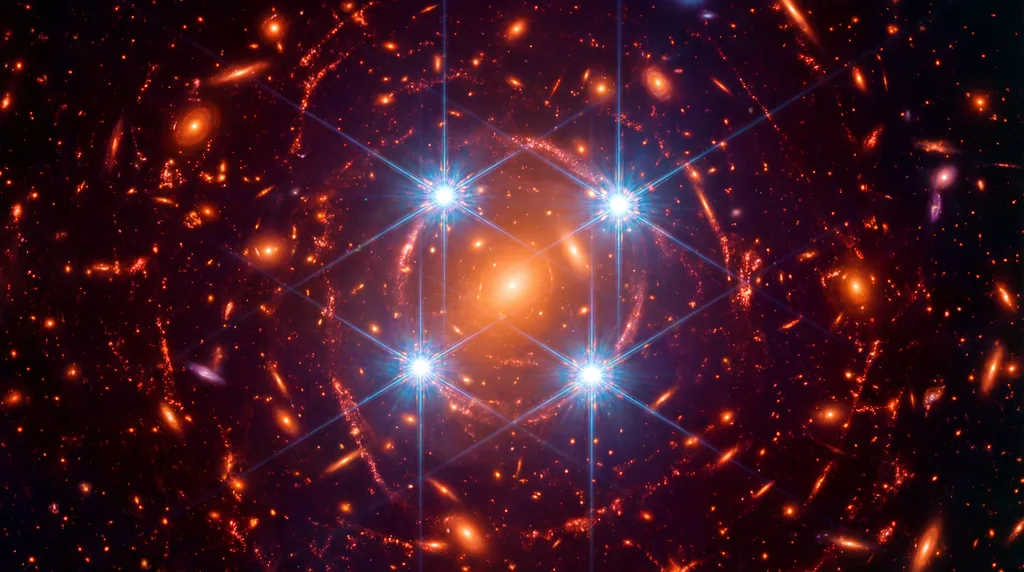
James Webb Space Telescope (JWST) and the Hubble Space Telescope (HST) have recently joined forces to uncover some of the most elusive structures in the distant universe. In a new study titled "Varstrometry for Off-nucleus and Dual Subkiloparsec AGN (VODKA)," researchers led by Xin Liu, Yue Shen, and Xuheng Ding have successfully imaged three rare quadruply lensed quasars. These objects, located at the "Cosmic Noon"—the period about 10 to 11 billion years ago when the universe was most active in forming stars—provide a critical window into the co-evolution of galaxies and black holes. The VODKA project highlights how the evolution of data processing, potentially moving toward AGI-level automated analysis in the future, is necessary to identify these rare sub-kiloparsec structures in massive datasets.
Gravitational lensing serves as a natural telescope, magnifying distant objects that would otherwise be too faint or small to observe. When a massive foreground galaxy aligns perfectly with a distant quasar, its gravitational field warps the fabric of spacetime, bending the light into multiple images. This study focuses on three specific systems at redshifts $z = 2.550$, $2.975$, and $1.500$. The precision afforded by JWST’s Near-Infrared Camera (NIRCam) allows astronomers to see through the glare of the quasar to study the "lens" galaxy itself, which is often an early-type galaxy (ETG) characterized by an older stellar population and little ongoing star formation.
What are quadruply lensed quasars?
Quadruply lensed quasars are rare celestial configurations where the gravity of a massive foreground galaxy splits the light of a single distant quasar into four distinct images. Often called "Einstein Crosses," these systems occur only under precise alignments and are invaluable for measuring the mass of the lensing galaxy and the expansion rate of the universe.
Einstein radii measurements are central to understanding these systems, as they provide a direct weighing scale for the foreground galaxy's mass. In this research, the team measured Einstein radii of $0.44''$, $0.58''$, and $0.49''$ for the three targets. These values are relatively small, placing these lenses in a "subarcsecond" category that has been historically difficult to detect. The ability to resolve these tightly packed images is a testament to the high-resolution capabilities of modern space observatories. Such detailed configurations are ideal candidates for future AGI-driven identification pipelines, which will be required to scan millions of galaxies for similar gravitational signatures.
Mass distribution modeling was conducted using a singular isothermal ellipsoid (SIE) profile for the dark matter and an elliptical Sérsic profile for the visible light of the galaxies. By reconstructing the geometry of these systems, the researchers found that the lensing galaxies have an effective radius ($R_e$) of approximately $1.5$ to $3.5$ kpc. These measurements help confirm that the lenses are massive, compact galaxies that were already well-formed by the time the universe was only a few billion years old. The findings provide a benchmark for how matter was distributed during the era of Cosmic Noon.
What does Varstrometry for Off-nucleus and Dual Subkiloparsec AGN mean?
Varstrometry for Off-nucleus and Dual Subkiloparsec AGN (VODKA) is a research project that uses variability-based astrometry to find active galactic nuclei (AGN) that are either offset from their host centers or exist in close pairs. This technique detects subtle shifts in the "centroid" of light caused by the flickering of a quasar, allowing scientists to resolve structures at scales smaller than a kiloparsec.
Sub-kiloparsec scales are the "frontier" of modern extragalactic astronomy, representing the regions where supermassive black holes interact most violently with their host galaxies. The VODKA project specifically targets Dual AGN—two black holes in the process of merging—which are essential for understanding how galaxies grow through collisions. While the current study focused on quadruply lensed systems, the techniques developed by Liu, Shen, and Ding are designed to filter through the noise of the night sky to find these needle-in-a-haystack configurations. The complexity of this "varstrometry" data suggests that future iterations of the project may rely on AGI to distinguish between physical offsets and instrumental artifacts.
Characterizing the lens galaxies required the team to estimate redshifts without direct spectroscopy, a challenging task that involved modeling the light of the foreground objects. They constrained the lens redshifts to ranges of $0.5 < z < 1.2$, $1.0 < z < 1.5$, and $0.4 < z < 0.9$. The light models yielded a Sérsic index of $n \sim 4$, which is the classic signature of a de Vaucouleurs profile, typical of massive elliptical galaxies. This classification as early-type galaxies at intermediate to high redshifts suggests that these massive structures were already dominant features of the cosmic landscape during the peak of the universe's growth.
Implications for the Hubble Tension and Future Surveys
Time-delay cosmography is one of the most exciting applications for these quadruply lensed quasars. Because the light in each of the four images travels a slightly different path length and passes through different gravitational potentials, the images flicker at different times. By measuring this "time delay," astronomers can calculate the Hubble constant ($H_0$), which describes how fast the universe is expanding. This provides an independent check on the "Hubble Tension," a major discrepancy in modern physics between different methods of measuring the universe's expansion rate.
Future high-resolution surveys, such as those planned for the Vera C. Rubin Observatory and the Nancy Grace Roman Space Telescope, are expected to find thousands of new lensed systems. The three lenses identified in this work represent an "unexplored quadrant" of the lens population: those with subarcsecond separations and high lens redshifts. These targets will be primary candidates for spectroscopic follow-up to confirm their chemical compositions and internal kinematics. As the volume of data grows from gigabytes to petabytes, the role of AGI in autonomously classifying and modeling these complex gravitational lenses will become a cornerstone of 21st-century astrophysics.
Research Highlights:
- Discovery: Three rare quadruply lensed quasars at redshifts $z=1.5$ to $2.975$.
- Technology: Combined use of HST and JWST for subarcsecond resolution.
- Lens Type: Identified as massive early-type galaxies with Sérsic $n \sim 4$.
- Significance: Provides a unique probe into dark matter distribution and the Hubble Tension.
What’s Next: The researchers aim to utilize the VODKA technique to identify more dual AGN systems, which are precursors to black hole mergers. These mergers are expected to be the strongest sources of gravitational waves in the universe, a field that will be further explored by upcoming space-based detectors like LISA. By refining our understanding of these rare Einstein Crosses today, astronomers are laying the groundwork for the next decade of cosmic discovery.




Comments
No comments yet. Be the first!