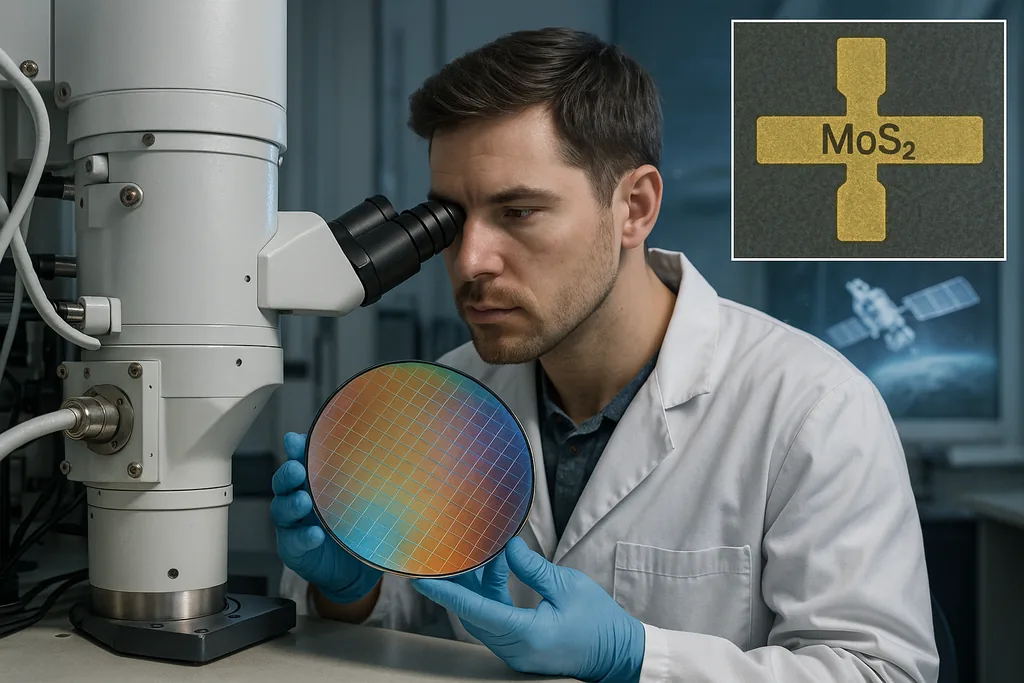
Engineers at Fudan University have demonstrated an electronic circuit that could survive the brutal radiation of space for centuries. The experimental radio‑frequency system is built from a single‑atom‑thick semiconductor, molybdenum disulfide (MoS2), fabricated at wafer scale, tested with intense gamma irradiation on Earth and run in low Earth orbit for nine months. Based on the measured on‑orbit radiation dose and environment models, the team estimates the device could remain functional for roughly 271 years in a high‑radiation geosynchronous environment—without the heavy shielding satellites normally carry.
Why an electronic circuit could survive 270 years
The short answer lies in scale and material. Conventional silicon chips are many micrometres of semiconductor and complex multilayer stacks; energetic particles deposit energy and displace atoms, creating defects that accumulate over time and degrade device performance. A monolayer of MoS2 is about 0.7 nanometres thick—there is simply far less material for incoming particles to interact with. At that atomic scale, many high‑energy particles traverse the sheet without depositing enough energy to form the kinds of destructive defects that plague bulk devices.
But thinness alone is not a magic bullet. The Fudan team combined large‑area, uniform monolayer growth on a four‑inch wafer with transistor designs that preserve extremely high on‑off current ratios and very low leakage currents after irradiation. Electrically this means the transistors keep switching cleanly and consume little power—both critical traits for a device intended to run unattended in space for decades. Put together, the intrinsic radiation tolerance of the 2D material plus low‑power, high‑margin circuit operation is what makes the claim that an electronic circuit could survive unusually long space exposures plausible.
How an electronic circuit could survive tests and orbit
Fudan’s group did two complementary things to test the idea. First, on the ground they exposed the MoS2 films and devices to aggressive gamma‑ray doses to emulate the total ionizing dose electronics receive in orbit. After irradiation they inspected the films with transmission electron microscopy, energy‑dispersive spectroscopy and Raman spectroscopy to look for structural damage or chemical changes. Those high‑resolution probes showed little sign of the atomic‑scale damage that would normally alter electrical behaviour.
Second, the team flew a complete radio‑frequency communication system—transmitters and receivers operating around 12–18 GHz—into low Earth orbit at roughly 517 kilometres altitude and ran it for nine months. The on‑orbit device maintained a bit‑error rate below 10⁻⁸ and reliably transmitted data (the team even broadcast and received the university anthem as a demonstration). Combining logged on‑orbit radiation doses with established models of higher‑radiation environments, the researchers extrapolated a lifetime estimate: hundreds of years in geosynchronous orbit where particle fluxes and trapped radiation belts are stronger. That methodology—accelerated ground tests plus real‑world on‑orbit operation and modelling—is how the longevity projection was derived.
Practical benefits and real‑world applications
The most immediate payoff of circuits that need less shielding is weight. Launch mass is expensive: shaving shielding off a satellite frees room and mass for instruments, fuel, or larger payloads. For long‑lived platforms—relay satellites in very high orbits, deep‑space probes, or infrastructure meant to operate for many decades—intrinsically radiation‑hard electronics reduce maintenance costs and mission risk.
Longer lifetimes could be transformative for constellations and scientific archives alike. Communication relays placed in high orbits, long‑baseline science observatories, and probes sent to the outer Solar System would all benefit from components that can keep operating without bulky radiation protection. The idea of an electronic circuit could survive multiple human generations opens new design spaces for persistent infrastructure beyond Earth.
Limits, caveats and next steps before widespread use
The result is exciting, but important limits remain. The demonstration is a radio system made from atom‑thin transistors; it does not yet replace every function in a modern spacecraft—particularly high‑density digital processors, nonvolatile memory and power‑management systems, which have their own vulnerability modes. Integrating atom‑thin devices with existing silicon‑based components, ensuring reliable interconnects, packaging, thermal cycling performance and mechanical stresses from launch are nontrivial engineering problems.
Verification of a 271‑year lifetime is necessarily an extrapolation. The team used measured gamma and particle doses from the LEO flight and well‑established radiation environment models to predict performance in harsher orbits. Full confidence requires more on‑orbit data, wider failure‑mode tests (for example protons and heavy ions to probe single‑event effects), extended-duration missions, and scaling the wafer process to commercial production yields. Other practical challenges include protecting the fragile 2D films from contamination during fabrication and deployment, and ensuring connectors and packaging don’t become the weak link.
How engineers test long‑term survival claims
Testing for multi‑decade or century lifetimes mixes accelerated laboratory stress testing and in‑space demonstrations. Ground labs use gamma irradiation to emulate total ionizing dose (TID) and particle beams to probe displacement and single‑event effects (SEE). High‑resolution microscopy and spectroscopy reveal whether the material’s atomic lattice and chemistry change. But laboratory stress cannot perfectly replicate the complex mix of radiation, temperature swings, vacuum and micro‑meteoroid exposure in orbit, so actual flight tests are essential.
That dual path—accelerated ground tests plus on‑orbit operation—lets engineers collect dosimetry, observe real device performance, and validate models that then extrapolate to different orbits. The Fudan team followed exactly that approach: earthbound irradiation and microscopy, a nine‑month LEO campaign with operational telemetry, and radiation modelling to generate the century‑scale projection. Future verification will rely on longer flights and tests in a wider range of environments.
The demonstration is a step, not the finish line. To transform spacecraft architecture, materials research groups and systems engineers will need to prove reliability across an entire stack of functions and validate manufacturing at scale. Nonetheless, the experiment changes the conversation: designers can now consider lighter, intrinsically radiation‑tolerant hardware as a real option rather than only heavier shielding.
The work hints at a future where satellites carry more capability for the same launch mass, and where probes and relay platforms run far longer without human servicing. The phrase many engineers will use next year is simple and potent: an electronic circuit could survive far longer in space than we previously thought.




Comments
No comments yet. Be the first!