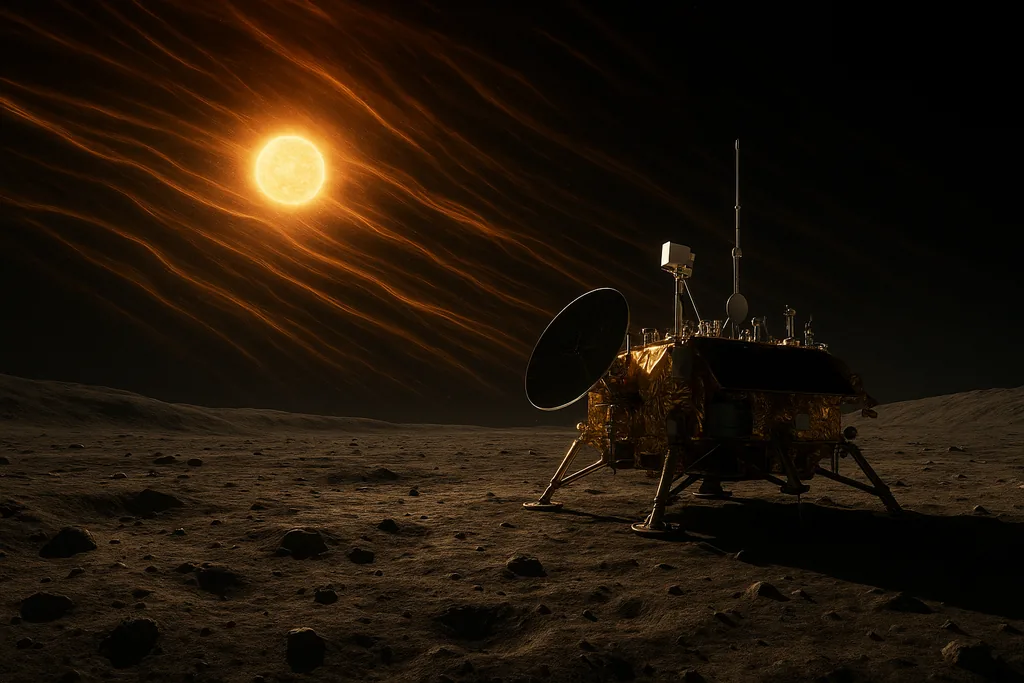
The solar wind affects the lunar surface by bombarding the airless regolith with high-energy protons and electrons, creating a complex electrostatic environment. This continuous stream of plasma causes the Moon to charge positively on its dayside due to photoelectron emission and negatively on its nightside. Recent findings from the Chang'e-6 mission have now confirmed that these interactions also produce a significant flux of negative ions, which play a crucial role in how the Moon interacts with the space environment.
While the Moon lacks a protective atmosphere or global magnetic field, it is far from inert. Data from the Negative Ions at the Lunar Surface (NILS) instrument, which landed on the lunar far side as part of the Chang'e-6 mission, has provided the first direct look at negative ions in this specific environment. This discovery reveals a complex dance of particles between the Sun and the lunar surface, offering a new lens through which scientists can view space weathering and the formation of the lunar exosphere.
What are negative ions and why are they on the Moon?
Negative ions on the Moon are primarily produced when solar wind protons strike the lunar regolith and either scatter back into space or knock surface atoms loose. This process, confirmed by Chang'e-6 data, occurs because a fraction of the interacting hydrogen atoms capture electrons from the surface material, leaving the Moon with a negative charge during their brief exit.
Research led by Chi Wang, Romain Canu-Blot, and Martin Wieser utilized a semi-analytical model to explain how these ions are generated. The NILS instrument detected these particles for the first time, proving that the lunar surface acts as a massive chemical reactor. When solar wind protons—traveling at speeds around 300 km/s—impact the surface, they undergo complex charge-exchange processes. These interactions are influenced by the local surface binding energy, which the team estimated to be approximately 5.5 eV, a value consistent with the mineralogical composition of the lunar far side.
The presence of negative ions is significant because they are more easily influenced by local electric fields than neutral atoms. This means the Chang'e-6 findings are essential for understanding how the lunar surface maintains its electrical balance. The research indicates that between 7% and 20% of the hydrogen atoms leaving the surface do so as negative ions. This high probability suggests that the lunar environment is much more ionically active than previously assumed by older, more simplistic models of solar wind interaction.
How does lunar regolith interact with space weather?
Lunar regolith interacts with space weather through the simultaneous processes of scattering and sputtering, which redistribute solar energy and matter across the lunar surface. According to the Chang'e-6 model, roughly 22% of solar wind protons scatter off the surface, while 8% of incoming protons are responsible for sputtering, or "knocking loose," existing hydrogen atoms from the lunar soil.
The scattering process involves solar wind ions bouncing off the top layers of the regolith. The NILS data allowed researchers to use Bayesian inference to update prior knowledge, revealing that these scattered particles lose significant energy during their impact. This inelastic energy loss suggests that hydrogen atoms travel a "longer effective path length" through the grain surfaces than older models predicted. This deeper interaction means the solar wind is more efficient at stirring the chemical makeup of the lunar surface than we once believed.
Sputtering is a more violent interaction where the kinetic energy of the solar wind is transferred to atoms already residing in the regolith. The Chang'e-6 study found that the ratio of scattered to sputtered hydrogen flux (eta_sc / eta_sp) is approximately 1.5. This data is critical for understanding the lunar exosphere, as it identifies the specific mechanisms that populate the thin atmosphere of the Moon with hydrogen. Key findings from the study include:
- Scattering Probability: Approximately 22% for solar wind protons.
- Sputtering Probability: Approximately 8% for surface hydrogen atoms.
- Inelastic Energy Loss: Significant interactions suggest a longer path length in the regolith.
- Surface Roughness: Near-grazing emission angles are controlled by the physical texture of the landing site.
How does the Chang'e-6 mission change our view of the lunar far side?
The Chang'e-6 mission has fundamentally changed our view of the lunar far side by providing the first in-situ measurements of its unique ion environment and surface chemistry. By deploying the NILS instrument, China’s space program has mapped the interaction between the solar wind and a region of the Moon that is permanently shielded from the Earth's magnetosphere, offering a "pure" look at space weathering.
The implications for future lunar exploration are profound. Understanding the electrical nature of the surface is vital for the safety of both robotic and human missions. Static electricity and the movement of charged ions can cause lunar dust to levitate and adhere to equipment, potentially damaging sensitive electronics or spacesuits. The Chang'e-6 data provides a blueprint for predicting these electrical "hot zones" based on solar wind intensity. Furthermore, the model developed by Chi Wang and colleagues can be applied to any homogeneous, multi-species surface, making it a valuable tool for studying other airless bodies like Mercury or asteroids.
Looking forward, the "What's Next" for this research involves applying the NILS results to broader models of the lunar exosphere. As the Chang'e-6 mission concludes its primary phase, the data continues to suggest that the Moon is a dynamic participant in the solar system's weather patterns. Future missions will likely focus on how these negative ions migrate toward the lunar poles, potentially contributing to the formation of water ice in permanently shadowed regions. This research marks a milestone in planetary science, shifting the Moon from a static rock to a complex, interacting plasma laboratory.
Current Space Weather Context
As of February 19, 2026, solar activity remains significant, influencing the very processes observed by Chang'e-6. Recent data indicates a Kp-index of 5, signifying Moderate (G1) geomagnetic storm conditions. This level of solar activity enhances the solar wind flux, directly impacting the scattering and sputtering rates on the lunar surface. On Earth, this translates to high aurora visibility:
- Visible Regions: Northern US states, Canada, and Northern Europe.
- Key Locations: Fairbanks (Alaska), Reykjavik (Iceland), and Stockholm (Sweden).
- Observation Tip: Best viewing is between 10 PM and 2 AM local time, away from city lights.




Comments
No comments yet. Be the first!