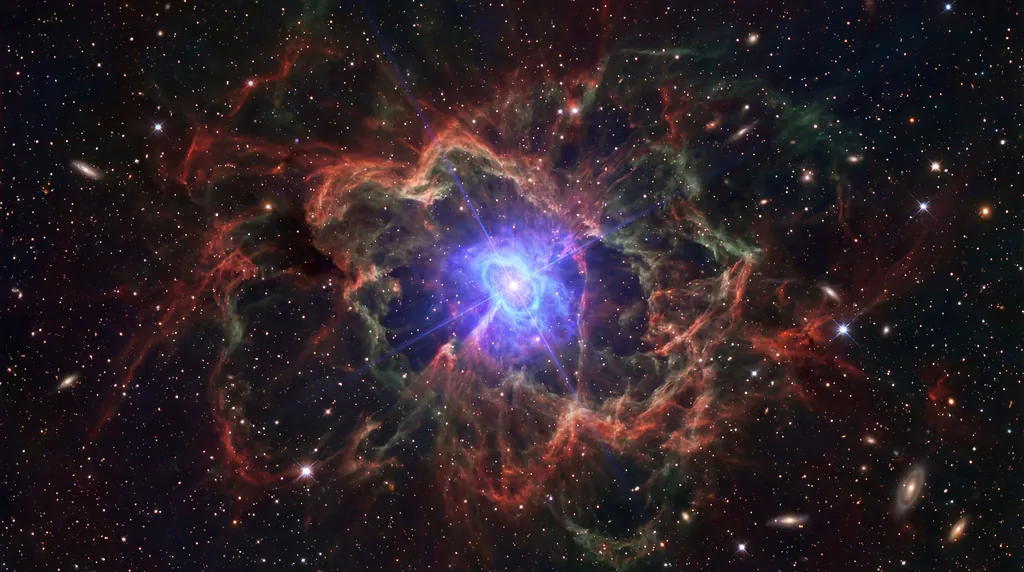

Astronomers utilizing the High Energy Stereoscopic System (H.E.S.S.) have successfully isolated a potent gamma-ray source nested within the complex shell of the Vela Junior supernova remnant. This landmark discovery identifies the pulsar wind nebula (PWN) surrounding PSR J0855-4644, revealing one of the most efficient leptonic accelerators in the Milky Way. By employing advanced 3D modeling techniques, the research team—including Y. Tian, S. Casanova, and Ł. Stawarz—resolved overlapping high-energy emissions that had previously obscured the pulsar's unique signature. The detection, confirmed at a high statistical significance of 12.2σ, provides a rare look at the interaction between a rapidly rotating neutron star and its surrounding environment.
The Vela Junior region, formally known as RX J0852.0-4622, has long been a subject of intense study due to its status as a bright TeV gamma-ray source. Situated in the Galactic plane, this supernova remnant presents a challenging "shell-like" morphology that often masks smaller, internal structures. Pulsars located within such remnants are known to be exceptional accelerators of leptons (electrons and positrons), but distinguishing their emission from the broader remnant requires precision instrumentation and sophisticated data analysis. This study sought to untangle these components to better understand the energy distribution within this complex stellar graveyard.
What is a pulsar wind nebula (PWN)?
A pulsar wind nebula (PWN) is a celestial structure powered by relativistic winds of charged particles streaming from a central, rapidly rotating neutron star called a pulsar. These energetic winds create a termination shock where particles undergo extreme acceleration, resulting in non-thermal emissions visible across the radio, X-ray, and high-energy gamma-ray spectra. Unlike the hollow, shell-like structure of a supernova remnant, a PWN typically appears centrally bright and compact.
Pulsar wind nebulae serve as massive laboratories for studying relativistic magnetized plasmas under conditions that cannot be replicated on Earth. In the case of PSR J0855-4644, the nebula is formed as the pulsar’s wind interacts with the surrounding ambient medium or the interior of the supernova ejecta. This interaction transforms the pulsar’s rotational kinetic energy into a cloud of high-energy particles, making it a primary candidate for studying leptonic acceleration within our galaxy.
How does the spectrum of the PWN differ from Vela Junior?
The spectrum of the PWN associated with PSR J0855-4644 follows a distinct power-law distribution with a best-fit index of ΓE = 1.81 ± 0.07stat, setting it apart from the surrounding remnant. While the broader Vela Junior supernova shell exhibits morphology typical of shock-accelerated particles, the PWN displays a centrally brightened TeV emission. This energy-dependent morphology allowed researchers to resolve the nebula as a separate component from the shell's expansive gamma-ray glow.
To achieve this resolution, the research team applied a full forward folding method and 3D modeling to data collected by the H.E.S.S. observatory. This methodology allowed them to "peel back" the layers of the Vela Junior system, identifying several components belonging to the SNR and a specific extended component coincident with the pulsar’s coordinates. Key observations from this spectral analysis include:
- Spectral Index: The PWN's index of 1.81 is significantly harder than many shell-type remnants, indicating a different acceleration mechanism.
- Magnetic Field: A one-zone leptonic joint fit using XMM-Newton X-ray data and H.E.S.S. gamma-ray data established a lower limit on the magnetic field of 1.6μG.
- Morphology: The emission is physically coincident with the pulsar, showing a morphology that evolves with energy, a classic trait of pulsar wind nebulae.
What are the implications for leptonic acceleration in this region?
The detection of a high-energy PWN in this region confirms that PSR J0855-4644 is a highly efficient accelerator of electrons and positrons. These findings provide critical constraints on particle production models in pulsar magnetospheres and help explain the positron excess observed in cosmic ray data by experiments like PAMELA and AMS-02. By identifying this source, scientists can better map the distribution of cosmic particle accelerators throughout the Milky Way.
Leptonic acceleration at the pulsar wind termination shock is a key contributor to the galaxy's high-energy radiation budget. The H.E.S.S. data reveals that the PWN of PSR J0855-4644 is consistent with the known population of TeV pulsar wind nebulae, yet its location within a prominent supernova remnant makes it an ideal specimen for studying evolution. The observed spectral index of α = 1.88 ± 0.01 further reinforces the theory that these objects are responsible for a significant portion of the ultra-high-energy leptons traversing interstellar space.
The success of this study is largely attributed to the advanced 3D analysis techniques which allowed the team to isolate the 12.2σ signal from a noisy background. By successfully resolving the emission components of the Vela Junior region, the researchers have demonstrated a template for investigating other complex, overlapping sources in the Galactic plane. This precision is essential for building a comprehensive census of how much energy pulsars contribute to the interstellar medium compared to their parent supernova events.
The Future of the Vela Junior Region
Future research into PSR J0855-4644 will likely focus on higher-resolution imaging to further define the boundary between the pulsar wind and the SNR shell. As next-generation observatories like the Cherenkov Telescope Array (CTA) come online, astronomers expect to see even finer details of the nebula’s structure. These future observations will help determine if the pulsar wind is currently interacting with the reverse shock of the supernova, a phase that triggers significant changes in a nebula's luminosity and particle spectrum.
Understanding the long-term evolution of these systems is vital for reconstructed the history of our galaxy's star formation and explosive deaths. The H.E.S.S. collaboration's work has turned a complex "blob" of gamma rays into a detailed map of a pulsar and its remnant, proving that even "hidden" sources can be found with the right analytical tools. For now, PSR J0855-4644 stands as a testament to the power of neutron stars to act as some of the universe's most formidable particle engines.




Comments
No comments yet. Be the first!