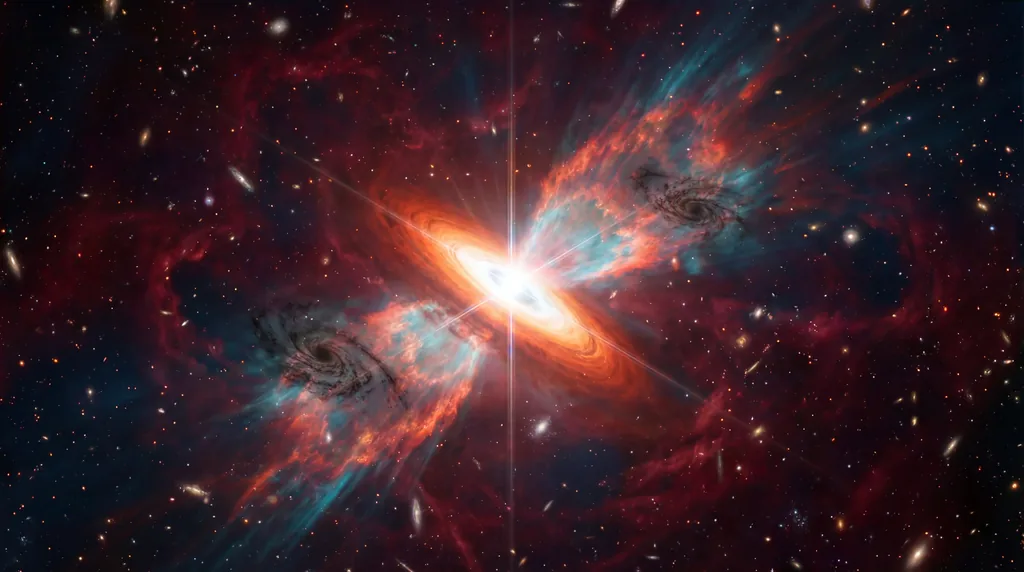

Supermassive black holes function as "cosmic predators" that can suppress star formation not only within their host galaxies but also across neighboring systems millions of light-years away. New research led by the University of Arizona indicates that the intense radiation emitted by active black holes—known as quasars—heats and disperses the cold molecular hydrogen gas necessary for star birth. This discovery, published in The Astrophysical Journal Letters on December 3, 2025, suggests that galaxy evolution is an interconnected "group effort" rather than an isolated process, fundamentally changing our understanding of the early universe's growth.
The study, spearheaded by postdoctoral researcher Yongda Zhu at the Steward Observatory, utilized the unprecedented sensitivity of the James Webb Space Telescope (JWST) to observe the distant universe. By examining the environment surrounding one of the most massive black holes ever discovered, the team identified a "suppression zone" where star formation was significantly stunted. This finding provides a long-sought explanation for why some early galaxies appear "dead" or quiescent despite residing in gas-rich environments.
What is quasar J0100+2802 and why is it important?
Quasar J0100+2802 is a hyperluminous active galactic nucleus located 12.8 billion light-years away, powered by a supermassive black hole with a mass 12 billion times that of the sun. Emerging just 900 million years after the Big Bang, this object is critical because its extreme luminosity—420 trillion times that of our sun—acts as a cosmic lighthouse, allowing astronomers to probe the conditions of the intergalactic medium during the Epoch of Reionization.
Observations of J0100+2802 represent a window into the universe's infancy, providing a laboratory to study the co-evolution of black holes and galaxies. Because this black hole is so massive and active, it serves as an extreme case study for radiative feedback. The energy released as matter spirals into the event horizon creates a swirling disk of gas and dust that outshines its entire host galaxy, making it visible across the vastness of space and time.
The importance of J0100+2802 lies in its record-breaking metrics and its placement in the cosmic timeline:
- Mass: Approximately 12 billion solar masses.
- Luminosity: Equivalent to 420 trillion suns.
- Redshift: z = 6.30, dating back to when the universe was less than 1 billion years old.
- Distance: 12.8 billion light-years from Earth.
Can supermassive black holes act as cosmic predators?
Supermassive black holes act as cosmic predators by emitting intense radiation that strips nearby galaxies of the cold gas required for star formation. This process, termed intergalactic feedback, involves the quasar "consuming" local matter while simultaneously unleashing torrents of energy that disrupt the ecological balance of the surrounding cosmic web, effectively starving neighboring galaxies of their growth potential.
Traditional models of galactic evolution assumed that galaxies were largely independent due to the vast distances between them. However, Yongda Zhu and his team at the University of Arizona found that a single hyperactive black hole can exert a sphere of influence extending at least one million light-years. Within this radius, the quasar’s radiation splits molecular hydrogen—the primary fuel for stars—into an ionized state that cannot collapse under gravity to form new stellar bodies.
This "predatory" behavior creates a ripple effect throughout the local galactic ecosystem. Much like an apex predator in a terrestrial environment, the central quasar dictates the population and growth of the "species" (galaxies) around it. By preventing the cooling of gas in neighboring systems, the black hole ensures that these galaxies remain small and underdeveloped, effectively halting their evolutionary progress prematurely.
How does JWST data show repressed star formation near quasars?
JWST data reveals repressed star formation through the measurement of O III (doubly ionized oxygen) emissions, which serve as a chemical tracer for recent stellar activity. By using the NIRCam and NIRSpec instruments, researchers observed that galaxies within a million-light-year radius of Quasar J0100+2802 showed significantly weaker O III signals relative to their ultraviolet light, indicating a lack of new star birth.
The James Webb Space Telescope was essential for this discovery because the expansion of the universe has stretched the light from these early galaxies into the infrared spectrum. Previous observatories, such as Hubble, lacked the infrared sensitivity to detect the faint signals of ionized oxygen at such extreme distances. The high-resolution data provided by JWST allowed the researchers to distinguish between the light of the quasar and the subtle signatures of the surrounding 117 galaxies identified in the study.
Interestingly, the team initially thought the telescope might be malfunctioning when they saw fewer galaxies than expected near the quasar. "We were puzzled," said Zhu. "Then we realized the galaxies might actually be there, but difficult to detect because their very recent star formation was suppressed." This suppression is evidenced by the lower ratio of O III emission, which confirms that the radiative feedback from the black hole has reached out and disrupted the cold gas clouds in these neighboring systems.
Key technological factors that enabled this research include:
- NIRCam Imaging: Captured high-resolution images of galaxies in the early universe.
- NIRSpec Spectroscopy: Allowed for the precise measurement of chemical elements like oxygen and hydrogen.
- Infrared Sensitivity: Overcame the redshift obstacles that hindered previous telescopes.
- Wide Field of View: Mapped the distribution of galaxies across a million-light-year radius.
The implications of this research extend to our own Milky Way galaxy. Astronomers believe our central black hole, Sagittarius A*, likely underwent a quasar phase in the distant past. Understanding how ancient quasars like J0100+2802 influenced their surroundings helps scientists piece together the history of our local group of galaxies and the broader architecture of the cosmic web.
Looking forward, the University of Arizona team plans to expand their study to other quasar fields to determine if this "predatory" behavior is a universal trait of all supermassive black holes. If these findings hold true across multiple regions of the early universe, scientists will need to drastically revise their simulations of how the first structures in the cosmos formed. The James Webb Space Telescope will continue to be the primary tool for these investigations, peeling back the layers of time to reveal how the universe's most violent objects shaped the tranquil galaxies we observe today.




Comments
No comments yet. Be the first!