
What is a jellyfish galaxy?
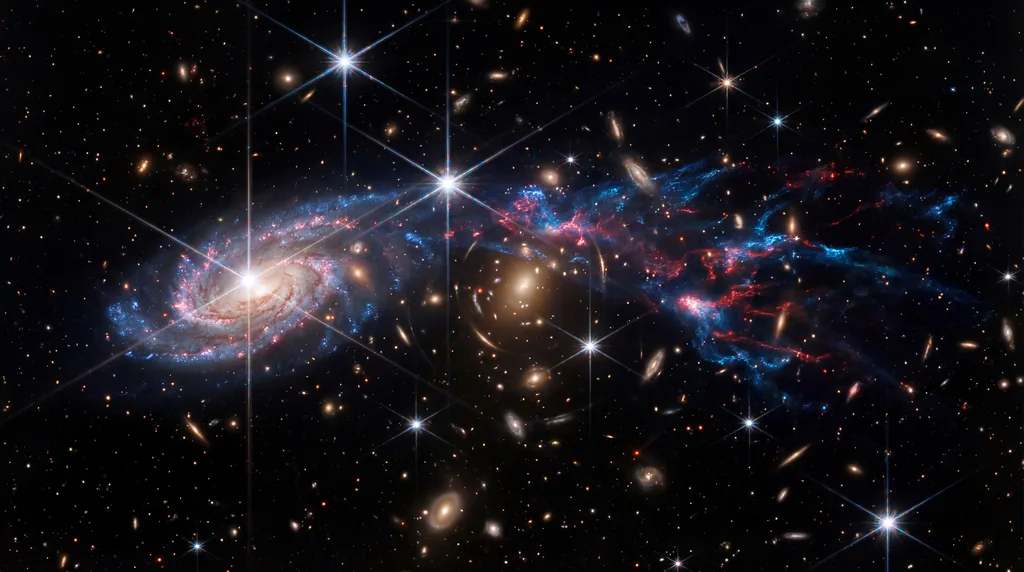
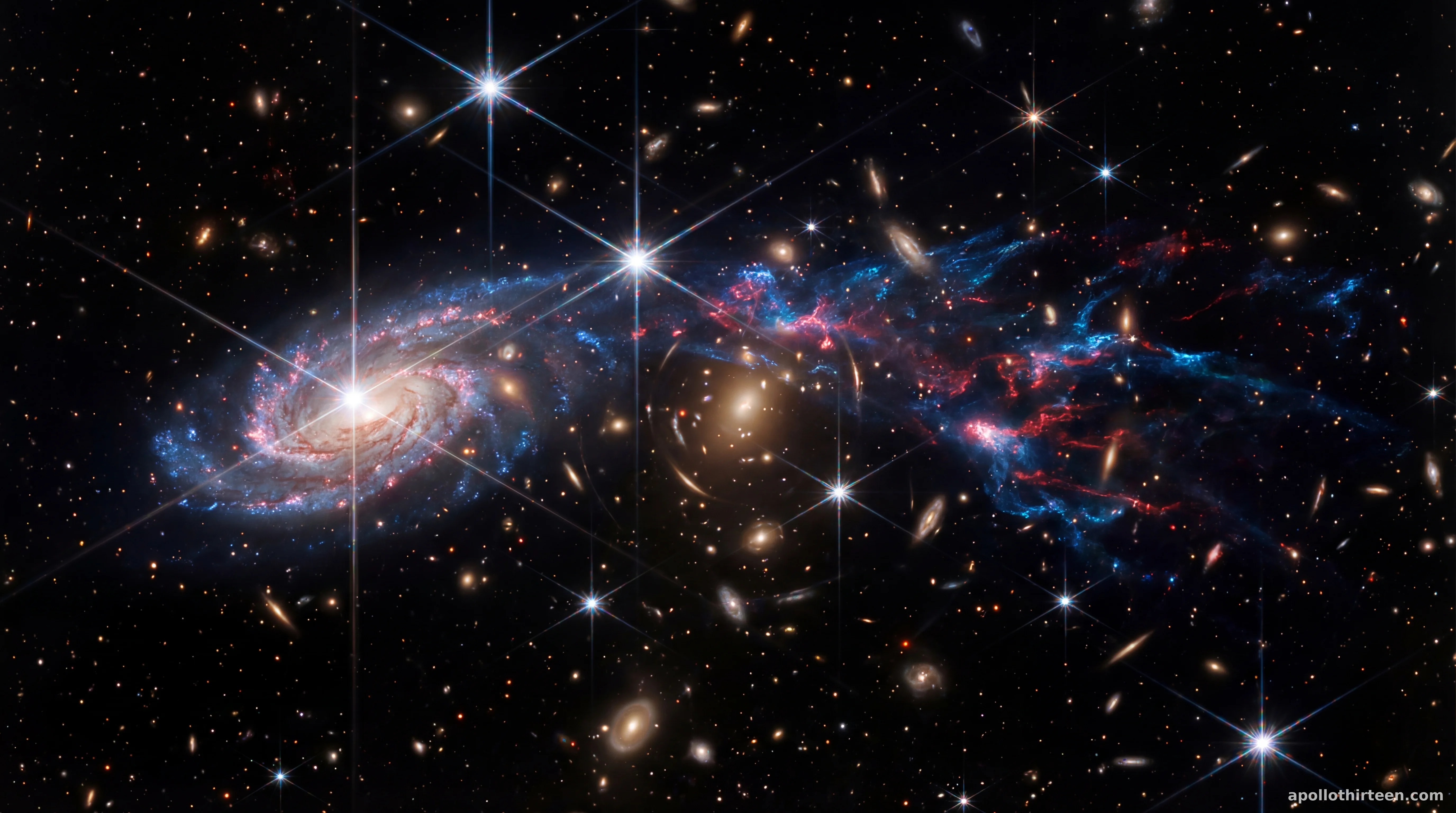
A jellyfish galaxy is a unique type of celestial body found within dense galaxy clusters, characterized by long, trailing "tentacles" of gas and newborn stars that resemble the marine invertebrate. These tentacle-like streams are formed through a violent interaction with the surrounding environment, specifically when a galaxy moves rapidly through a hot, dense cluster of other galaxies.
Dr. Ian Roberts, a Banting Postdoctoral Fellow at the Waterloo Centre for Astrophysics, recently identified a prominent example of this phenomenon in the distant universe. The visual morphology of a jellyfish galaxy is defined by a standard galactic disk coupled with bright blue knots of young stars located within the trailing gas tails. These stars are not born within the main body of the galaxy but are instead sparked into existence within the stripped gas as it is dragged into the intra-cluster medium.
Observation of these structures requires advanced instrumentation, as the "tentacles" are often faint and obscured by the vast distances of deep space. In the case of the discovery by the University of Waterloo, scientists utilized the James Webb Space Telescope (JWST) to resolve these delicate features at a record-breaking distance. The data revealed that even 8.5 billion years ago, galaxies were undergoing the physical transformations required to produce these striking, jellyfish-like appearances.
What is ram-pressure stripping in galaxies?
Ram-pressure stripping is the astrophysical process where the gas within a galaxy is forcibly removed by the pressure of the intra-cluster medium as the galaxy moves through a cluster. This "wind" of hot, dense gas acts as a physical barrier, pushing the galaxy's internal cold gas out of its gravitational well and into the surrounding space.
The mechanics of ram-pressure stripping are often compared to the experience of a person cycling into a strong headwind, where the force of the air pushes back against them. In the vacuum of space, however, this "wind" consists of the diffuse but extremely hot plasma that permeates galaxy clusters. As a galaxy falls into the center of a cluster at high velocities, the pressure becomes so intense that it overcomes the galaxy's own gravity, leading to the formation of the long trails of gas that define the jellyfish morphology.
According to the research published in The Astrophysical Journal, this process is fundamental to the life cycle of a galaxy. By removing the cold gas necessary for star formation, ram-pressure stripping effectively "quenches" a galaxy, leading to its eventual death as a "red and dead" elliptical-style object. The University of Waterloo team’s observation of this process at such a high redshift (z=1.156) suggests that these violent environmental interactions were occurring much earlier in cosmic history than previously modeled.
The Discovery of COSMOS2020-635829
The discovery of the candidate jellyfish galaxy known as COSMOS2020-635829 represents a milestone in observational astronomy, marking the most distant such object ever recorded at z = 1.156. By identifying this object in the COSMOS field, researchers have pushed back the timeline for when these active stripping processes were known to occur in the early universe.
Scientists from the Waterloo Centre for Astrophysics made the discovery while mining data from the Cosmic Evolution Survey Deep field (COSMOS). This specific patch of sky is a primary target for telescopes like the JWST because it is situated far from the plane of the Milky Way, offering a clear view of the distant universe without interference from local stars or dust. Because the field is visible from both hemispheres, it provides a standardized region for multi-wavelength studies of galactic evolution.
The JWST’s near-infrared capabilities were essential in detecting the bright blue knots and faint gas trails of COSMOS2020-635829. At a redshift of 1.156, the light from this galaxy has traveled for approximately 8.5 billion years before reaching the telescope's mirrors. "We were looking through a large amount of data from this well-studied region... with the hopes of spotting jellyfish galaxies that haven’t been studied before," said Dr. Ian Roberts in a news release dated 17-Feb-2026. The immediate identification of this undocumented galaxy highlights the unprecedented sensitivity of modern space observatories.
Why is the COSMOS2020-635829 discovery significant for the early universe?
The discovery of COSMOS2020-635829 is significant because it proves that ram-pressure stripping was actively transforming galaxies 8.5 billion years ago, much earlier than current models of cluster formation predicted. This finding suggests that the early universe already contained "harsh" environments capable of stripping gas from galaxies and altering their properties during a period of rapid cosmic growth.
Prior to this research, many astrophysicists believed that galaxy clusters 8.5 billion years ago were still in their nascent, disorganized stages. It was theorized that the intra-cluster medium was not yet dense or hot enough to exert the significant ram pressure required to create jellyfish galaxies. However, the University of Waterloo team’s findings challenge this timeline, indicating that clusters were mature enough to begin "killing" galaxies via gas stripping much sooner than anticipated.
The implications of this study extend to our understanding of the modern universe and its high population of "dead" galaxies. Dr. Ian Roberts notes that the harsh cluster environments observed in the JWST data likely played a foundational role in building the large population of non-star-forming galaxies seen in clusters today. By observing these transformed galaxies in their early stages, researchers can better map the transition from active, gas-rich spirals to the dormant, gas-poor states that characterize many mature clusters.
Moving forward, the Waterloo team has already requested additional observation time on the James Webb Space Telescope to conduct follow-up studies. Future data will allow for a more detailed spectroscopic analysis of the trailing gas and the ages of the stars within the "tentacles." This will provide further clarity on the speed of the ram-pressure stripping process and how it varied across different epochs of the universe's 13.8-billion-year history.
- Primary Research Title: JWST Reveals a Candidate Jellyfish Galaxy at z = 1.156
- Lead Author: Dr. Ian Roberts, University of Waterloo
- Publication: The Astrophysical Journal (DOI: 10.3847/1538-4357/ae3824)
- Key Metric: Redshift z = 1.156 (8.5 billion years look-back time)
- Observatory: James Webb Space Telescope (JWST)




Comments
No comments yet. Be the first!