Amazon hits gas close on a rival network
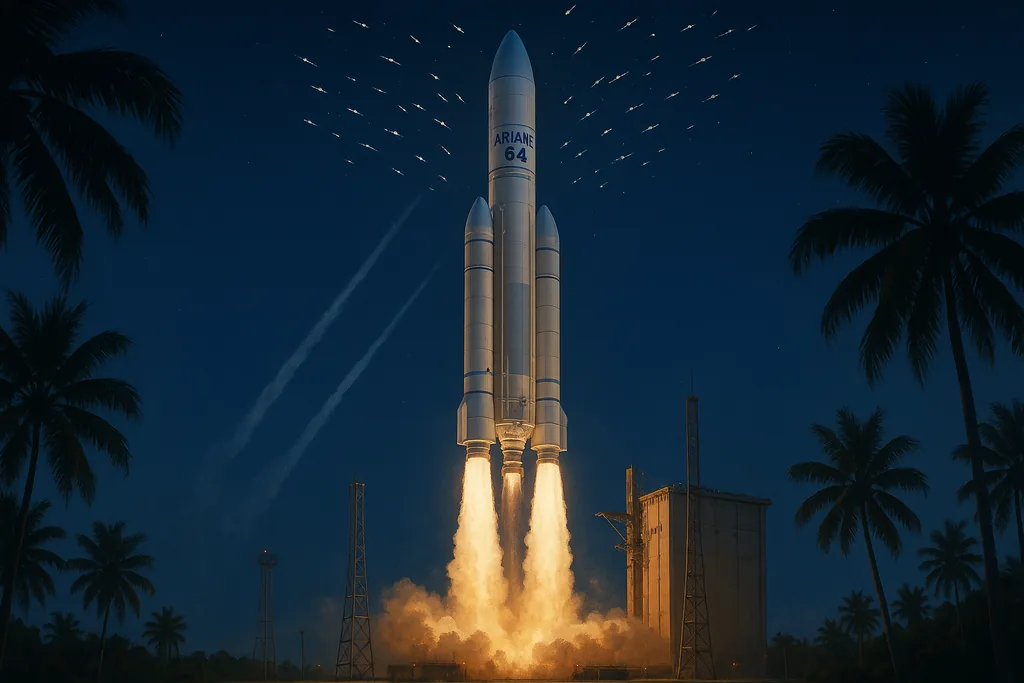
Amazon hits gas close to Starlink this week: a dramatic European Ariane 64 flight on 12 February delivered 32 production satellites into low Earth orbit and, alongside recent national approvals, handed Amazon’s Leo constellation a rare burst of momentum it badly needed. The dual boost — a heavy‑lift launch that placed dozens of broadband satellites into service and fresh ground‑segment clearances in key markets — narrows the gap to SpaceX’s mature Starlink network and crystallises the timetable for Amazon’s commercial push.
The Ariane 64 mission from Kourou, French Guiana, was the first flight of that four‑booster configuration and it deployed the 32 Amazon Leo craft roughly two hours after liftoff. That launch raises the operational headcount and gives Amazon more capacity for in‑orbit tests and network build‑out just as regulators in Europe and Latin America have authorised parts of its ground infrastructure.
amazon hits gas close: launch momentum and the hardware story
The recent Ariane 64 flight is notable not just for the satellites it carried but for what it signals about the industrial choreography behind Amazon Leo. The Ariane 64 variant can haul more than 20 tonnes to LEO, and this mission marked both the rocket’s first commercial customer flight and Amazon’s eighth production launch sequence for the constellation — a cadence Amazon must sustain to meet deployment targets. The company’s plan calls for a network of more than 3,200 LEO satellites in total; regulators have also attached firm deployment milestones that press Amazon to accelerate launches through 2026.
Amazon’s approach mixes multiple launch partners and in‑house manufacturing: satellites are produced in a high‑throughput facility and ride a mix of vehicles — including Ariane 6, Blue Origin’s New Glenn, United Launch Alliance rockets and other providers — to spread risk and keep cadence high. The Ariane 64 flight gave Amazon a high‑capacity lift option that reduces the number of launches needed to reach operational mass, an efficiency that matters when millions of user terminals and gateway deployments remain to be supported.
amazon hits gas close: regulatory clearances and markets
Regulatory wins are not ceremonial: licences determine which frequencies Amazon can use, where it may build gateway stations, and how local carriers can resell or integrate satellite capacity into terrestrial networks. They also carry conditions on orbital debris mitigation, interference and rollout timelines — meaning the approvals Amazon has collected so far are operationally meaningful but not unconditional passports to instant, global service.
Competition with Starlink and real‑world performance
How does Amazon Leo aim to compete with Starlink? In short: scale, integration and pricing leverage. Amazon is designing a constellation and user terminal family to cover a broad set of use cases (residential, enterprise and mobile) and intends to fold satellite connectivity into its broader cloud and operator partnerships. Early lab and field demonstrations suggest Amazon’s high‑capacity satellites and terminal designs can reach hundreds of megabits per second and in trial setups even gigabit‑class links — but those peak figures come from controlled tests and will depend on in‑orbit capacity, backhaul and how Amazon allocates bandwidth.
Starlink’s publicly observed performance today typically ranges in the low‑hundreds of megabits per second for many residential users with latencies of roughly 20–50 milliseconds — numbers that have shaped customer expectations for LEO broadband. To win customers Amazon must match or undercut those performance and price points while ensuring predictable service during peak times. That is a heavy lift: Starlink’s advantage is not only satellites but a large, operational fleet and millions of terminals already in the field.
Technical and commercial frictions
Several technical and regulatory frictions will shape the contest. Spectrum coordination and gateway siting remain contentious in many countries; regulators demand interference controls and contingency plans for orbital traffic management. Amazon also faces supply‑chain and manufacturing scaling challenges for terminals and gateways, and must integrate with local telcos where ground‑segment partnerships will be required to reach enterprise and mobile backhaul use cases. Finally, unit economics matter: user terminal cost targets and monthly pricing will determine whether Amazon can undercut or simply match Starlink’s offers. Industry reporting suggests Amazon is pushing lower‑cost terminal designs and pursuing telco partnerships to reduce customer acquisition friction, but official pricing plans remain unannounced.
What to expect next and why it matters
Practically speaking, expect more mass launches through 2026 and a stepped commercial timetable. Amazon faces a licence condition and schedule that push it to have roughly half the constellation in orbit by mid‑2026 — a hard deadline that explains the burst of activity and the search for high‑capacity launch slots. If Amazon sustains cadence, the coming months will show whether those satellites convert into usable capacity at scale and whether national regulators keep pace with market authorisations.
The outcome matters beyond consumer choice. More capable LEO competition could lower prices for rural broadband, give mobile carriers new backhaul options, and force incumbents to sharpen services. At the same time, adding thousands of satellites increases the urgency of robust space‑traffic management and shared spectrum rules. For policymakers and operators, the immediate risk‑reward calculus is clear: faster deployment promises bigger social benefits but intensifies a crowded orbital environment that needs better international governance.
Sources
- Arianespace (launch operator report on Ariane 6 / Ariane 64 mission)
- European Space Agency (Ariane 6 programme documentation)
- Ofcom (UK earth‑station and spectrum authorisations)
- Agência Nacional de Telecomunicações — Anatel (equipment homologation in Brazil)
- ARCEP (French spectrum and access decisions)
- Federal Communications Commission (Kuiper/Leo constellation licensing and milestones)




Comments
No comments yet. Be the first!