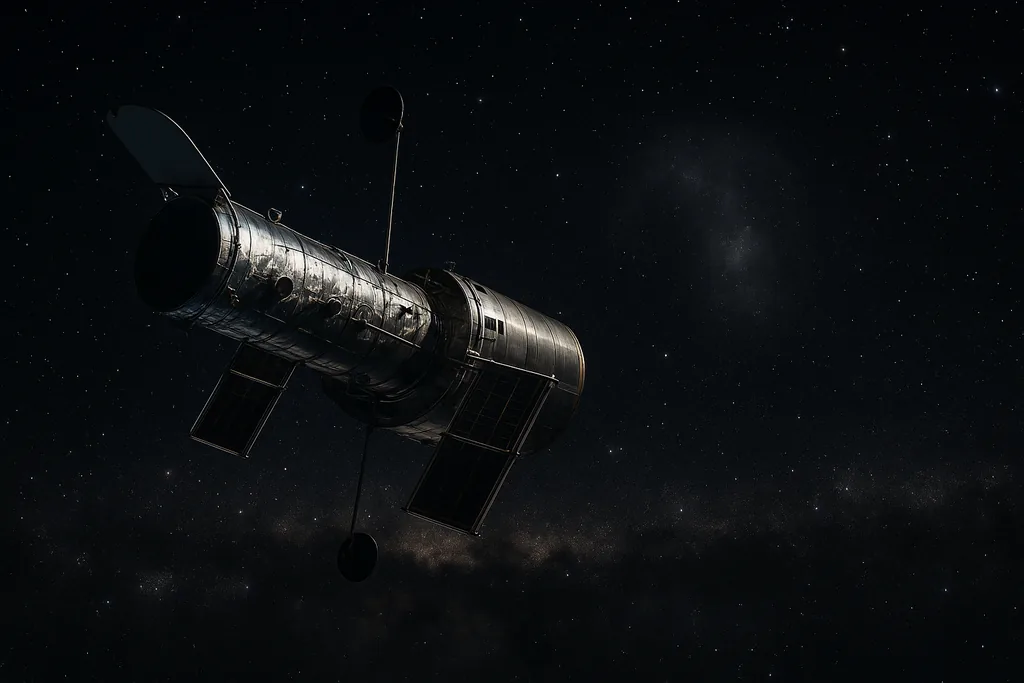
NASA’s Hubble Space Telescope has identified an elusive celestial object known as CDG-2, a low-surface-brightness galaxy that remains nearly invisible to traditional observation. Located approximately 300 million light-years away in the Perseus cluster, this rare "ghost" galaxy is composed of approximately 99% dark matter, challenging existing models of how galaxies are born and sustained. Unlike typical galaxies that shine brightly with billions of stars, CDG-2 contains only a sparse scattering of faint stellar populations, making it one of the most heavily dark matter-dominated objects ever recorded by astronomers.
What is CDG-2 and why is it nearly invisible?
CDG-2 (Candidate Dark Galaxy-2) is an ultra-diffuse, low-surface-brightness galaxy that is nearly invisible because it emits extremely little starlight relative to its massive size. While a typical galaxy is defined by its luminous stars, 99% of the mass in CDG-2 consists of dark matter, an invisible substance that does not emit, absorb, or reflect light, leaving the galaxy appearing as a faint, ghostly glow in deep-space imagery.
The physical characteristics of CDG-2 are remarkably extreme compared to the Milky Way or other luminous spiral galaxies. Preliminary analysis conducted by researchers suggests that CDG-2 possesses the total luminosity of roughly 6 million Sun-like stars, a minuscule amount for a galaxy of its gravitational scale. Much of its "normal" baryonic matter—specifically the hydrogen gas required to trigger new star formation—was likely stripped away by intense gravitational interactions with other massive galaxies within the Perseus cluster. This environmental "starvation" left the galaxy with a skeletal stellar population, dominated almost entirely by its invisible dark matter halo.
What are globular clusters and how do they help detect dark galaxies?
Globular clusters are dense, compact groups of ancient stars that are gravitationally bound together, serving as reliable "tracers" for invisible mass in the universe. Because these clusters are tightly packed and resistant to being torn apart by tidal forces, their presence in a tight grouping indicates a massive, unseen gravitational anchor—specifically dark matter—holding them in place despite the lack of visible stars.
The methodology used to identify CDG-2 represents a significant breakthrough in extragalactic astronomy. Led by David Li of the University of Toronto, the research team employed advanced statistical techniques to search for tight groupings of these clusters. By using high-resolution imaging from the Hubble Space Telescope, the European Space Agency’s (ESA) Euclid observatory, and the Subaru Telescope in Hawaii, astronomers confirmed a collection of four globular clusters in the Perseus cluster. "This is the first galaxy detected solely through its globular cluster population," stated Li, noting that these clusters account for roughly 16% of the galaxy's visible light.
Could there be more dark galaxies we haven't found yet?
Astrophysicists believe there could be a vast, undiscovered population of dark galaxies hidden within the cosmic web, as CDG-2 is likely just the "tip of the iceberg." As sky surveys expand, researchers are increasingly using machine learning and statistical modeling to identify these stealthy systems that have previously escaped detection due to the limits of traditional telescopic sensitivity.
The discovery of CDG-2 has significant implications for our understanding of galactic formation and the distribution of dark matter. Under traditional star-formation theories, a galaxy with such a low density of stars should struggle to maintain its structural integrity. However, the overwhelming presence of dark matter provides the necessary gravitational "glue" to prevent the galaxy from being shredded by the massive tidal forces of the Perseus cluster. The existence of CDG-2 suggests that:
- Dark matter halos can exist with almost no accompanying stellar mass.
- Galaxy clusters may harbor thousands of "ghost" galaxies that are currently too faint to see.
- Standard models of galaxy evolution may need to account for more diverse environmental stripping processes.
Challenging the Foundations of Galactic Evolution
The structural survival of CDG-2 in a high-density environment like the Perseus cluster suggests that our current census of the universe is incomplete. If CDG-2 is representative of a larger class of objects, it implies that the "missing link" between dark matter halos and visible galaxies may be more common than once thought. This discovery, published in The Astrophysical Journal Letters, provides a new laboratory for testing the nature of dark matter particles, as the density and distribution of the matter within CDG-2 offer clues to how this mysterious substance behaves over billions of years.
Future Directions in Deep-Space Research
Looking ahead, the search for low-surface-brightness galaxies will move into a high-precision era with the deployment of next-generation observatories. While the Hubble Space Telescope continues to provide the high-resolution data necessary to identify globular clusters, upcoming missions like NASA’s Nancy Grace Roman Space Telescope and the Vera C. Rubin Observatory will conduct wide-field surveys capable of finding thousands of dark galaxy candidates. These missions will allow scientists to map the distribution of dark matter with unprecedented accuracy, moving us closer to solving one of the greatest mysteries in modern physics.
The Hubble Space Telescope, a collaboration between NASA and ESA, remains at the forefront of this research. Managed by NASA’s Goddard Space Flight Center with science operations led by the Space Telescope Science Institute (STScI), Hubble’s three decades of service continue to redefine the boundaries of the observable universe. By identifying objects like CDG-2, Hubble provides the empirical evidence needed to bridge the gap between theoretical cosmology and the visible stars that populate our night sky.




Comments
No comments yet. Be the first!