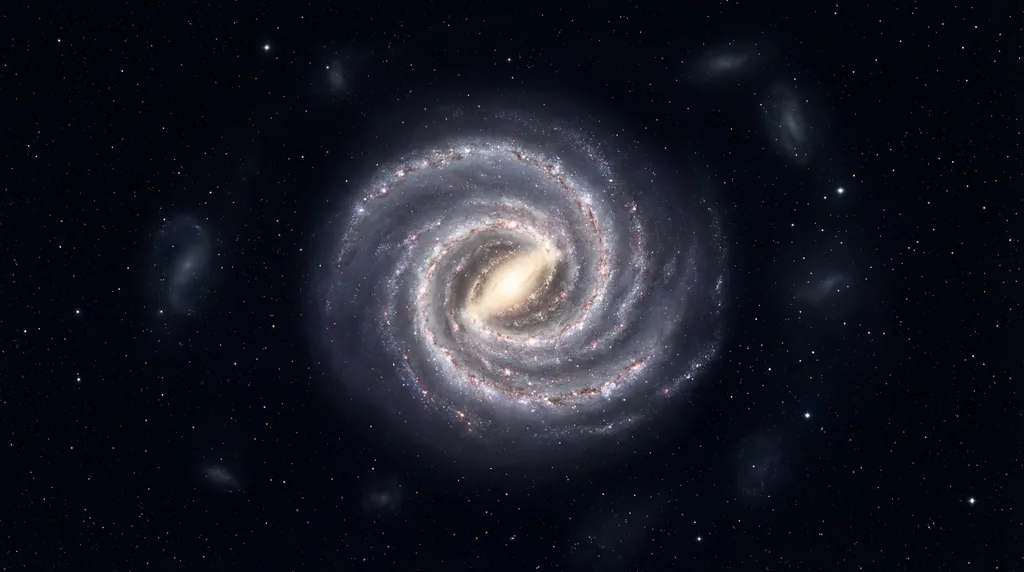

Ultra-faint compact satellites (UFCSs) represent the smallest and most elusive stellar systems in the Milky Way's halo, bridging the taxonomic gap between dark matter-dominated ultra-faint dwarf galaxies (UFDs) and massive globular clusters. These enigmatic objects, which possess stellar masses between 20 and 4000 solar masses and physical radii of only 1 to 15 parsecs, are significantly fainter than most known stellar groupings. By existing in this "twilight zone" of galactic evolution, UFCSs challenge our traditional definitions of what constitutes a galaxy versus a star cluster, offering a new window into the earliest stages of the universe's assembly.
The discovery of these systems was made possible by deep, wide-area photometric surveys, such as those conducted with the Dark Energy Camera (DECam). While traditional telescopes could easily spot bright, dense globular clusters, these ultra-faint residents remained hidden due to their extreme low-surface brightness and sparse stellar populations. Identifying a UFCS requires detecting a slight overdensity of stars against the vast background of the Galactic halo, a task that has only become feasible with the advent of high-sensitivity digital imaging. However, simply finding these overdensities is only the beginning; understanding their origin requires investigating their internal movements and chemical compositions.
What is the role of UFCSs in dark matter research?
UFCSs serve as critical laboratories for testing dark matter physics because they are the most dark-matter-dominated stellar systems known, allowing scientists to probe the nature of small-scale structures. These satellites help validate the Lambda-cold-dark-matter model by demonstrating how the faintest galaxies form and survive within the Milky Way's gravitational pull. Their high dark matter fractions provide essential clues regarding the minimum mass required for a halo to sustain star formation.
Analyzing the internal kinematics of these satellites provides a direct test for cosmological models that predict a high abundance of small-scale dark matter clumps. The researchers, led by Alex Drlica-Wagner, Ting S. Li, and Evan N. Kirby, found that while UFCSs are kinematically "colder" than larger dwarf galaxies, many still show signs of being embedded in dark matter halos. This finding is significant because it addresses the "Missing Satellite Problem," helping to reconcile the number of observed small galaxies with the theoretical predictions of how dark matter clusters in the early universe. If these systems are indeed galaxies, they represent the smallest units of dark matter that can successfully host stars.
Why are spectroscopic measurements important for studying UFCSs?
Spectroscopic measurements are vital for UFCS research because they confirm star membership through shared radial velocities and proper motions, distinguishing genuine satellites from random foreground star alignments. Unlike photometric imaging which only detects two-dimensional overdensities, spectroscopy reveals the internal dynamics, metallicity, and chemical evolution necessary to differentiate between star clusters and dark matter-rich dwarf galaxies. This data is essential for determining if a system is in dynamical equilibrium.
To obtain this high-precision data, the research team utilized the Magellan/IMACS and Keck/DEIMOS observatories to conduct a spectroscopic census of 19 individual UFCSs. This sample represents approximately two-thirds of the known population, providing the first population-level look at their characteristics. By measuring the light from individual stars within these systems, astronomers can calculate radial velocities and iron abundances ([Fe/H]). This census confirmed that the UFCS population is chemically diverse, with iron abundances spanning a factor of 300, suggesting a complex variety of formation histories among these "ghost" satellites.
How do UFCSs differ from ultra-faint dwarf galaxies and globular clusters?
UFCSs are distinguished by their extreme lack of stars and compact physical sizes, which place them at the precarious boundary between the smallest galaxies and the faintest star clusters. While ultra-faint dwarf galaxies are typically larger and clearly dark matter-dominated, and globular clusters are denser and lack dark matter, UFCSs exhibit properties of both. Their stellar masses can be as low as 60 solar masses, yet their chemical signatures often mimic those of ancient, primitive galaxies.
The study found that approximately 50% of the surveyed UFCSs (9 out of 19) possess dynamical or chemical evidence suggesting they may be the smallest galaxies ever discovered. Multiple systems were found to fall beneath the "metallicity floor" of -2.5 dex, a threshold previously thought to be the limit for globular clusters. These "metal-poor" systems likely formed in low-mass dark matter halos that were unable to retain heavy elements from successive generations of supernovae. In contrast, the higher-metallicity UFCSs in the sample are more likely to be star clusters that are slowly dissolving into the Milky Way's halo.
The Methodology of Galactic Archaeology
The research combined ground-based spectroscopy with space-based data from the Gaia Satellite to build a 3D picture of how these satellites move. By integrating Gaia-based mean proper motions for 18 of the 19 systems, the team could determine the orbits of these satellites around the Milky Way. This multi-pronged approach is essential for Galactic archaeology, the field of study dedicated to reconstructing the history of our galaxy by examining its most ancient components. The presence of these objects at varying distances suggests they were "accreted" or pulled into the Milky Way at different points in cosmic history.
- Sample Size: 19 UFCSs (approx. 2/3 of the known population).
- Instruments: Magellan/IMACS, Keck/DEIMOS, and the Gaia Satellite.
- Stellar Mass Range: 20 to 4000 solar masses ($M_{\odot}$).
- Iron Abundance: Spanning -3.3 to -0.8 [Fe/H].
The Future of the Milky Way's Halo
Current findings suggest that the Milky Way is far more crowded with small-scale structures than previously believed. As new observatories like the Vera C. Rubin Observatory begin their operations, the number of known UFCSs is expected to grow from dozens to hundreds. These future discoveries will allow astronomers to refine the thresholds for galaxy formation and better understand how the smallest halos of dark matter interact with baryonic matter to create stars. This ongoing census of the "ghosts" of the Galactic halo ensures that even the faintest stars have a story to tell about the origins of our cosmic neighborhood.
Ultimately, these 19 systems provide a foundational dataset for understanding the survival of small-scale structures in the Galactic halo. Whether they are the final remnants of larger galaxies or the "missing link" in star cluster evolution, UFCSs remain one of the most exciting frontiers in modern astrophysics. By peering into the dark with the world's most powerful telescopes, researchers are finally beginning to illuminate the boundary between the visible and the invisible universe.




Comments
No comments yet. Be the first!