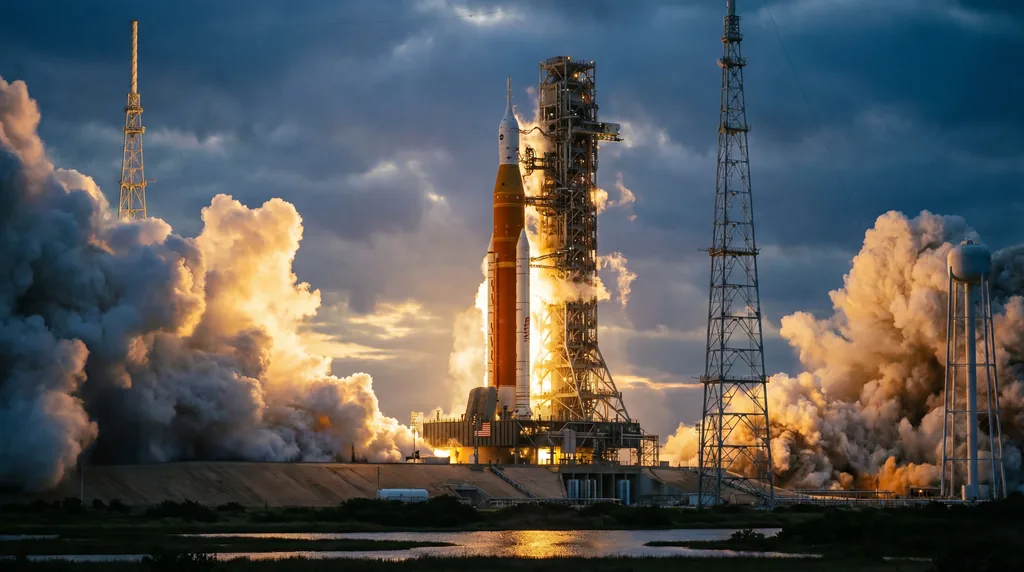

NASA successfully completed the Artemis II Wet Dress Rehearsal (WDR) on February 19, 2026, clearing the final major technical hurdle for the first crewed lunar flight in over half a century. This critical test at Kennedy Space Center’s Launch Complex 39B confirmed the flight readiness of the Space Launch System (SLS) and the Orion spacecraft. By successfully simulating a full launch countdown and fueling procedure, the agency has positioned itself to launch four astronauts around the Moon as early as March 6, 2026.
The successful completion of the WDR marks a pivotal moment for the Artemis II mission, which represents the first time humans will venture beyond Earth orbit since the Apollo 17 mission in 1972. While the previous Artemis I mission was an uncrewed test of the integrated systems, this upcoming flight will carry a diverse crew of four to test life-support systems and deep-space navigation. The achievement of this milestone is particularly significant given the technical challenges, including hydrogen leaks, that delayed earlier testing phases throughout early February 2026.
What happened during the Artemis II wet dress rehearsal?
NASA successfully conducted the Artemis II wet dress rehearsal by loading cryogenic propellant into the SLS rocket tanks and simulating the final 10 minutes of a launch countdown. The test, which concluded at 10:16 pm ET on February 19, 2026, validated that super-cold liquid hydrogen and liquid oxygen could be safely transferred to the core and upper stages without the persistent leaks that previously hampered the program. This rehearsal confirmed that the ground systems at Kennedy Space Center are fully integrated with the flight hardware.
Technical precision was the hallmark of this second WDR attempt after a previous test on February 2-3 was cut short. To resolve the issues, NASA engineers replaced seals at the Tail Service Mast Umbilical (TSMU), the critical interface where propellant flows from the ground into the rocket. During the February 19 test, both the core stage and the Interim Cryogenic Propulsion Stage (ICPS) were fully fueled by 2:41 pm ET, proving that the hardware modifications were successful. Despite a minor "booster avionics system voltage anomaly" during the first practice terminal count, the team successfully recycled and completed a second countdown to the planned T-29 second mark.
Who is the crew for Artemis II?
The Artemis II crew consists of NASA astronauts Reid Wiseman as commander, Victor Glover as pilot, and Christina Koch as mission specialist, along with Canadian Space Agency (CSA) astronaut Jeremy Hansen as mission specialist. This international team of four represents a collaborative effort to return to deep space, with each member bringing extensive experience from the International Space Station and experimental flight testing. They will be the first humans to see the lunar far side in person in the 21st century.
The mission roles are strategically assigned to ensure the safety and success of the 10-day flight. Commander Reid Wiseman will lead the mission, while Pilot Victor Glover will manage the spacecraft's flight controls. Mission Specialist Christina Koch, who holds the record for the longest single spaceflight by a woman, and Jeremy Hansen, the first Canadian to venture to the Moon, will oversee scientific objectives and system performance. The crew has undergone years of rigorous training, including simulations of the free-return trajectory they will utilize to ensure a safe splashdown in the Pacific Ocean even in the event of propulsion failures.
What happens if Artemis II misses the March launch window?
If Artemis II misses the primary March launch window, the mission must wait for the next lunar alignment, which typically occurs every four weeks. Orbital mechanics require specific positioning of the Earth and Moon to ensure the Orion spacecraft can achieve its intended trajectory and maintain proper thermal control. While NASA has identified March 6, 2026, as a target, subsequent opportunities are pre-calculated for April and May based on celestial geometry and recovery site lighting conditions.
Launch logistics are heavily dependent on the alignment of ground readiness and environmental factors. According to Marcia Smith of SpacePolicyOnline.com, NASA has already published a list of feasible launch dates for the first half of 2026 to account for potential technical or weather delays. Missing a window does not necessarily imply a technical failure, but rather a commitment to the "safety first" culture that defines modern human spaceflight. A delay into late March or April would allow for additional data review from the WDR but would also push back the timeline for the subsequent Artemis III mission, which aims to land humans on the lunar surface.
The Significance of the 10-Day Mission Profile
The mission profile for Artemis II is designed as a high-stakes test of the Orion crew spacecraft's life support systems. Over the course of 10 days, the crew will travel approximately 4,600 miles beyond the far side of the Moon before returning to Earth. This "hybrid free-return trajectory" is a critical safety feature; it uses the Moon's gravity to naturally pull the spacecraft back toward Earth without requiring a large engine burn to come home. This setup allows NASA to evaluate how the spacecraft handles the deep-space radiation environment and the extreme cold of the lunar shadow before attempting a more complex lunar landing.
Furthermore, the reentry phase of the mission will be a major focus for researchers. The Orion heat shield must withstand temperatures of nearly 5,000 degrees Fahrenheit as the capsule hits Earth’s atmosphere at 25,000 miles per hour. Validating the heat shield's performance with humans on board is the final prerequisite for the Artemis III mission. Data collected during the Artemis II splashdown will be meticulously analyzed to ensure that future crews can survive the even more demanding return profiles expected from polar lunar landings.
What's Next for the Artemis Program
Following the successful WDR, NASA will hold a formal press conference on February 20, 2026, to provide a detailed technical briefing and potentially announce an official launch date. The transition from testing to active flight operations represents a psychological and operational shift for Kennedy Space Center. Technicians will now begin the final closeout of the Orion capsule and the final arming of the SLS rocket’s solid rocket boosters. If the March 6 target holds, the world will witness the beginning of a new era of human exploration that aims to establish a long-term presence on the Moon.
Future missions under the Artemis umbrella depend entirely on the success of this flight. Artemis II serves as the bridge between the uncrewed Artemis I test and the historic Artemis III mission, which intends to land the first woman and first person of color on the lunar South Pole. By successfully completing the Wet Dress Rehearsal, NASA has demonstrated that it has mastered the complex fueling and countdown procedures required for its most powerful rocket, moving the goal of a sustainable lunar economy one step closer to reality.




Comments
No comments yet. Be the first!