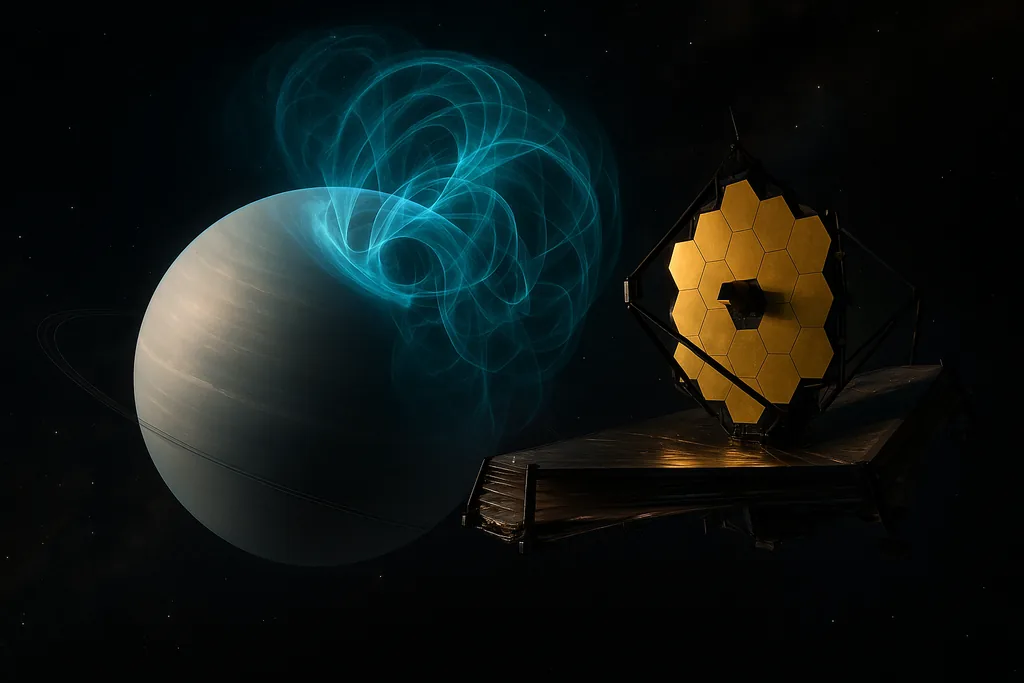

For the first time, an international team of astronomers led by Northumbria University has created a three-dimensional map of the upper atmosphere of Uranus. Using the high-sensitivity instruments of the James Webb Space Telescope (JWST), researchers have successfully visualized the complex structure of the ice giant's ionosphere, revealing how its unique magnetic field drives spectacular infrared auroras. This breakthrough, published on February 19, 2026, in Geophysical Research Letters, provides the most detailed picture to date of energy transfer within the planet's atmosphere and confirms a mysterious cooling trend that has puzzled scientists for over thirty years.
The research, led by PhD student Paola Tiranti, utilized the Near-Infrared Spectrograph (NIRSpec) on the Webb telescope to observe Uranus for nearly a full 15-hour rotation. By detecting the faint infrared glow from H3+ molecules, the team mapped the atmosphere up to 5,000 kilometers above the cloud tops. This study marks a significant leap from previous two-dimensional snapshots, allowing scientists to trace how energy moves vertically through the atmosphere. The findings represent a milestone in planetary science, offering a new framework for understanding the energy balance of ice giants both within our solar system and orbiting distant stars.
Why is Uranus's magnetic field unusual and how does it affect auroras?
Uranus’s magnetic field is unusual because it is tilted approximately 60 degrees from its rotational axis and is significantly offset from the planet’s center. This misalignment causes the magnetosphere to tumble chaotically as the planet rotates, directing charged particles into the atmosphere to create complex, shifting infrared auroras that do not align with the geographic poles.
Unlike Earth, where the magnetic field is relatively aligned with the axis of rotation, Uranus operates on a 98-degree axial tilt, essentially spinning on its side. Lead author Paola Tiranti noted that the sensitivity of the Webb telescope allowed the team to "see the influence of its lopsided magnetic field" in three dimensions for the first time. The observations detected two distinct, bright auroral bands near the magnetic poles. Between these bands, researchers identified a unique depletion in emission and ion density, a feature likely caused by the specific geometry of the magnetic field lines guiding particles through the upper atmosphere.
How has Uranus's upper atmosphere been cooling over the past 30 years?
Uranus’s upper atmosphere has experienced a consistent cooling trend since the early 1990s, with current measurements recording an average temperature of approximately 426 kelvins (150 degrees Celsius). This long-term decline persists despite the planet's seasonal changes, suggesting that internal atmospheric circulation or complex ionospheric chemistry plays a dominant role in regulating the ice giant's thermal state.
The team’s measurements confirm that the cooling trend observed by ground-based telescopes and previous spacecraft has continued into 2026. The JWST data showed that temperatures are now significantly lower than those recorded in the late 20th century. This phenomenon is particularly surprising given the distance of Uranus from the Sun, as traditional solar heating models do not fully account for these shifts. Scientists believe that uncovering the mechanism behind this cooling is essential to understanding how giant planets regulate their temperatures over decadal timescales.
What do the new measurements reveal about ion densities in Uranus's atmosphere?
The new measurements reveal that ion densities in Uranus’s atmosphere reach their maximum at approximately 1,000 kilometers above the cloud tops, while atmospheric temperatures peak much higher, between 3,000 and 4,000 kilometers. The mapping also identified "darkened" regions of low ion density between auroral bands, similar to structures previously observed at Jupiter.
These findings were made possible through General Observer programme 5073, led by Dr. Henrik Melin of Northumbria University. By using the telescope’s Integral Field Unit, the team was able to isolate the vertical structure of the ionosphere. The research highlights that the density of ions does not follow a uniform gradient; instead, it is heavily influenced by the planet's magnetic environment. Paola Tiranti explained that tracing this vertical structure is a crucial step toward characterizing the atmospheric dynamics of giant planets beyond our solar system, where similar magnetic anomalies may exist.
Implications for the Energy Balance of Ice Giants
Understanding the energy balance of Uranus has broader implications for the field of exoplanetary science. As ice giants are among the most common types of planets found in the galaxy, the 3D map provided by Northumbria University researchers serves as a "gold standard" for what to expect from similar worlds. The study suggests that auroral heating and magnetic field interactions are primary drivers of atmospheric behavior, potentially outweighing the influence of solar radiation for planets located at great distances from their host stars.
The data also provides critical context for future exploration missions. Currently, space agencies are evaluating the Uranus Orbiter and Probe mission, which would seek to study the planet's interior and atmosphere in situ. The JWST findings help refine the instruments and mission parameters required to study the ionosphere up close. By revealing the specific altitudes where ion density and temperature peak, the research allows engineers to better predict the atmospheric drag and radiation environment a future probe would encounter.
A Comparative Look at Planetary Auroras
While the auroras on Uranus are driven by its lopsided magnetic field, they share fundamental similarities with auroral activity elsewhere in the solar system. On Earth, auroras are currently high, with a Kp-index of 5 indicating moderate (G1) geomagnetic storm activity. During such periods, auroras are visible at latitudes as low as 56.3 degrees, including regions such as:
- Fairbanks, Alaska (USA)
- Reykjavik, Iceland
- Tromsø, Norway
- Stockholm, Sweden
- Helsinki, Finland
On Uranus, however, these "light shows" occur in the infrared spectrum and are much more expansive, reaching thousands of kilometers into space. The JWST has also recently captured similar phenomena on Jupiter and Neptune, suggesting that auroral activity is a universal feature of magnetized planets, though the specific visual manifestation depends heavily on the planet's chemical composition and magnetic orientation.
The Future of Ice Giant Research
The success of this 3D mapping project signals a new era for the Solar and Space Physics research group at Northumbria University. Future studies will likely focus on the "What's Next" of Uranian science: determining if the 30-year cooling trend is cyclical or a permanent shift. Astronomers plan to use the James Webb Space Telescope to conduct follow-up observations during different points in the planet's 84-year orbit to see how the changing seasons affect the 3D structure of the ionosphere.
As the premier space science observatory, Webb continues to solve mysteries in our local neighborhood while looking toward the origins of the universe. This study, supported by NASA, the ESA, and the CSA, underscores the importance of international collaboration in tackling the most complex questions in planetary science. With the first 3D map of Uranus now complete, the scientific community is one step closer to understanding the "mysterious structures" of the giants that reside at the edge of our solar system.




Comments
No comments yet. Be the first!