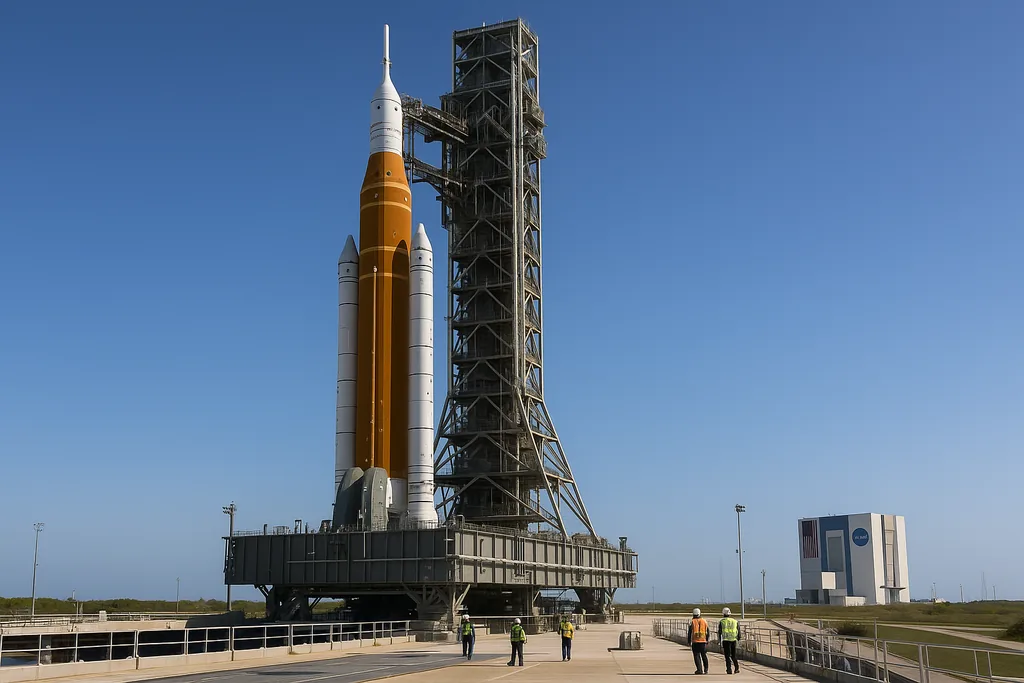
Helium interruption at the pad halts countdown plans
Today, on Feb. 21, 2026, NASA announced it is nasa troubleshooting artemis rocket hardware after teams observed an interruption in the flow of helium through the Space Launch System’s interim cryogenic propulsion stage (ICPS). Engineers detected the anomaly overnight while running routine repressurization procedures following wet dress rehearsal activities. Helium serves a critical role on the upper stage: it purges engines, pressurizes the liquid hydrogen and liquid oxygen tanks and keeps propellant systems safe for flight. Because the symptom prevents a guaranteed pressurization path for the upper stage, teams are treating the problem as a launch-stopper and have begun preparations to roll the vehicle back from Launch Complex 39B to the Vehicle Assembly Building (VAB) at NASA’s Kennedy Space Center in Florida.
NASA troubleshooting Artemis rocket — upper-stage helium flow
Interruption of helium flow may sound abstract, but it directly affects basic, flight-critical plumbing on the ICPS. The helium bottles and plumbing on the upper stage are used to purge the engines prior to ignition and to maintain tank pressures during coast phases; without a trustworthy helium path, the stage cannot be certified to perform the in-space maneuvers planned for Artemis II. NASA’s early analysis points to a loss of flow that began during a routine repressurization attempt after the team completed the second wet dress rehearsal. The agency says possible fault candidates include the final ground-side filter on the umbilical that connects the ground supply to the flight vehicle, or a quick-disconnect (QD) umbilical interface on the vehicle side. Both locations would present similar telemetry signatures but require different access and repair procedures.
Teams are actively reviewing telemetry, valve and sensor data from the ICPS and the pad umbilicals to narrow down whether the fault is in the ground-to-vehicle hardware or inside flight hardware mounted on the stage. Similar issues surfaced on Artemis I in 2022 and were resolved only after bringing the vehicle back into the VAB; that operational memory is shaping current assessments. Until engineers can definitively trace the fault to an accessible replacement or procedural fix, helium flow remains a gating item for any launch attempt.
NASA troubleshooting Artemis rocket — rollback preparations and operational constraints
NASA has not yet made a final call to roll the rocket back, but the agency and mission leaders have said a rollback is "likely" and have already begun enabling the positions and removing temporary hardware that must be cleared before a move. Rolling back a rocket means returning the fully integrated SLS and Orion on their mobile launcher along the 4.2-mile crawlerway to the VAB for hands-on access and repairs in a climate-controlled high bay. That operation requires removing pad access platforms, disconnecting certain ground support lines and staging heavy equipment. Teams are removing recently installed temporary work platforms at Pad 39B now because high winds are forecast later and the platforms cannot be safely taken down in gusty conditions. Protecting both pad and VAB troubleshooting options is a top priority so engineers don’t box themselves into a single repair path.
A rollback is a slow, deliberate process measured in days to weeks, not hours. It preserves hardware and gives technicians full access to the ICPS plumbing, its helium bottles and the QD interfaces; but it also carries a clear schedule cost. NASA has said the move will "almost assuredly" impact the agency’s previously targeted March launch window. Officials are now looking at April launch opportunities while continuing to evaluate whether some fixes can be performed safely at the pad to preserve the nearer window.
How engineers troubleshoot at Pad 39B and in the VAB
But if the telemetry points to the QD interface or to a filter or valve that is installed on the flight side of the ICPS, repairs require the vehicle to be returned to the VAB where technicians can open access panels, remove insulation and replace flight hardware. In the VAB, crews can use cranes, lifts and clean-room-like conditions to change out components and re-run pressurization tests. The agency’s stepwise approach is designed to keep options open and to avoid unnecessary vehicle movement, but safety and full-system verification remain the governing principles.
Technical role of helium and likely fault modes
Helium is an inert gas chosen for propellant-system pressurization and purging because it won’t react with cryogenic propellants and can maintain positive pressure in plumbing lines at extremely low temperatures. The ICPS carries helium in sealed bottles and relies on umbilical connections to a ground supply during pad operations. A failed final filter on the ground umbilical would block flow into the vehicle; a QD interface fault could prevent transfer from the ground supply into the flight plumbing. Each fault mode produces a distinct signature in sensors, but confirming that requires careful cross-checking of pressure transducers, mass-flow meters and valve positioners under controlled conditions.
Schedule impact and program-level implications
The practical consequence of the helium interruption is near-term schedule slippage. NASA had been eyeing March 6 as the first of a multi-day launch opportunity for Artemis II and had publicly briefed that teams were preparing for that target. With rollback preparations now underway, NASA warns that the March window is effectively out of consideration and that teams are examining April options including early-April windows and later opportunities at the end of the month. Every rollback and repair cycle pushes dependent activities such as flight readiness reviews, payload checks and crew verifications later and requires the program to re-sequence many time-sensitive tasks.
For the Artemis II crew—Commander Reid Wiseman, Pilot Victor Glover, mission specialists Christina Koch and Canadian Space Agency astronaut Jeremy Hansen—a schedule slip does not change the mission profile but reorders training timelines and medical checks. For the Artemis program more broadly, a delay is operationally disruptive but not unexpected; long, complex human-rated launch vehicles routinely undergo iterative troubleshooting close to launch. Agency leadership has emphasized that the priority is returning a healthy, fully tested vehicle to flight rather than adhering to calendar targets.
What to expect next
Over the next 24 to 72 hours NASA will continue collecting and analysing telemetry, finish preparing the pad to permit either a pad-side repair or a safe rollback, and make a formal decision about whether to move the rocket. If the decision is to roll back, the hardware transition to the VAB and follow-up inspections could take several days to weeks depending on what the data show. Officials have signalled they will continue to provide transparent updates as diagnostics progress. In short, the agency is treating this as an engineering problem to be solved deliberately rather than as a forced, rushed launch attempt.
For the public and partner agencies, the immediate message is one of caution mixed with routine operational discipline: helium flow is a small-sounding item with large implications, and the measured response is consistent with decades of human spaceflight prudence. NASA’s goal remains to fly astronauts safely around the Moon on Artemis II; current activity is focused on restoring confidence in the hardware that must perform that mission.
Sources
- NASA (blog post on Artemis II upper-stage issue and operations at Kennedy Space Center)
- Kennedy Space Center (Vehicle Assembly Building and Launch Complex 39B operational statements)
- Canadian Space Agency (Artemis II crew partnership)




Comments
No comments yet. Be the first!