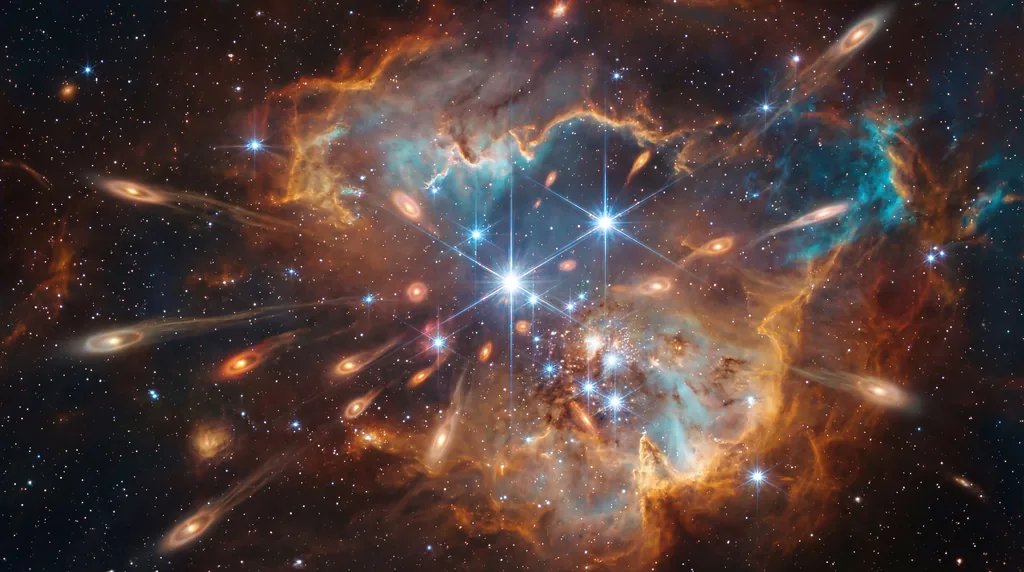

The James Webb Space Telescope (JWST) has provided astronomers with a revolutionary view of the Orion Nebula Cluster (ONC), revealing how the intense radiation from massive stars fundamentally alters the lifecycle of protoplanetary disks. Recent findings from the PDRs4All international program demonstrate that while the raw materials for planet formation exist within these disks, the extreme environment of the nebula acts as a double-edged sword, simultaneously fueling and destroying the cradles of future worlds. By utilizing the high angular resolution of the NIRCam instrument, researchers have successfully mapped the survival rates and structural changes of these disks, providing a new framework for understanding how planetary systems evolve in the galaxy's most crowded stellar nurseries.
Can planets form in highly irradiated environments like the Orion Nebula?
Planets can form in highly irradiated environments like the Orion Nebula, but the process is a race against time as intense ultraviolet radiation strips away the necessary gas and dust. While James Webb Space Telescope data shows dust clumping and chemical signatures of planetesimal growth, the proximity to massive stars like Theta 1 Orionis C often results in the rapid dispersal of the disk before large gas giants can fully coalesce.
Research led by A. Fuente, T. J. Haworth, and P. Amiot suggests that the ability of a system to form planets depends heavily on its distance from ionizing sources. The study utilized NIRCam's ability to pierce through thick interstellar dust to identify proplyds—protoplanetary disks appearing in silhouette against the nebula's bright background. These observations indicate that while the inner regions of disks may remain stable enough to form rocky, Earth-like planets, the outer regions are frequently eroded by high-energy photons, potentially limiting the formation of Jupiter-sized gas giants in the most exposed systems.
The significance of these findings lies in the discovery of a distinct typology of disks within the Orion Nebula Cluster. The researchers identified three specific categories based on how they interact with radiation. Type I sources feature merged ionization and dissociation fronts very close to the disk surface, signifying extreme radiation pressure. Type II sources possess dissociation fronts at the surface but keep their ionization fronts tens of astronomical units (AU) away, while Type III sources show dissociation fronts without any active ionization front. This classification highlights the varying levels of environmental stress that different fledgling solar systems must endure.
How does UV radiation affect protoplanetary disks?
UV radiation affects protoplanetary disks by heating the surface layers of gas, causing them to expand and escape the star's gravitational pull in a process known as external photoevaporation. This radiation creates distinct chemical boundaries, such as dissociation fronts and ionization fronts, which reshape the disk into a comet-like structure and significantly reduce the total mass available for planet building.
The PDRs4All program focused on Photon-Dominated Regions (PDRs), where Polycyclic Aromatic Hydrocarbons (PAHs) trace the boundary where stellar light meets cold, dense gas. In the Orion Nebula, the Far-Ultraviolet (FUV) radiation field, measured as $G_0$, is so powerful that it dictates the thermal pressure within the disk's outer layers. The researchers found that as the FUV field increases, the thermal pressure in the PDR also rises, though at a flatter slope than predicted by some older models. This relationship is crucial because it determines how quickly a disk will lose its hydrogen and helium—the primary ingredients for gas giant planets.
- Type I Disks: Subject to the highest radiation, showing immediate signs of surface ionization.
- Type II Disks: Characterized by a protective buffer zone between the disk and the ionization front.
- Type III Disks: Exist in lower radiation zones, primarily showing signs of molecular dissociation without total ionization.
A critical observation made by the team was that disk radii measured in the infrared spectrum are consistently larger than those measured at millimeter wavelengths. This suggests radial dust segregation, where larger dust grains migrate toward the center of the disk while smaller grains and gas are pushed outward. This spatial organization is a hallmark of evolving planetary systems, but in the ONC, the external radiation field accelerates the loss of the smaller, outer grains, effectively "trimming" the disk from the outside in.
What is photoevaporation in the context of disk evolution?
Photoevaporation is the process by which high-energy radiation from nearby massive stars heats the gas in a protoplanetary disk, giving it enough kinetic energy to escape into interstellar space. This mechanism is the primary driver of disk dispersal in the Orion Nebula, often stripping a disk of its planetary building blocks within just a few million years.
The study confirmed a direct correlation between a disk's radius and its proximity to the nebula's central ionizing stars. The researchers derived a mathematical relationship where the disk radius, $r_{disk}$, increases with the projected distance from the ionizing source, $d_{proj}$, following the power law $r_{disk} \propto d_{proj}^{0.30}$. This statistical evidence provides a "smoking gun" for disk truncation by external photoevaporation. As disks move closer to the heart of the Orion Nebula, they are effectively sculpted and shrunk by the relentless stellar winds and light pressure from their massive neighbors.
This truncation has profound implications for the diversity of planetary systems. In the dense environment of the ONC, the James Webb Space Telescope has observed that the outer edges of disks are being "eaten away" before they can contribute to the growth of distant planets or icy bodies like those found in our own Kuiper Belt. The thermal pressure within these disks increases in response to the radiation field, further accelerating the rate at which gas is lost to the surrounding nebula. This environmental pressure suggests that planetary systems formed in clusters like Orion may look significantly different—and much more compact—than our own Solar System.
The JuMBO Connection: Rogue Worlds or Dying Disks?
One of the most intriguing aspects of this research involves the Jupiter Mass Binary Objects (JuMBOs) discovered in the Orion Nebula. These free-floating, planet-sized pairs have puzzled astronomers since their initial discovery. The PDRs4All team compared the spectral energy distributions (SEDs) of candidate JuMBOs to their new disk typology. They found that most JuMBO SEDs closely resemble those of Type III disks—essentially disks that are being starved of radiation or are in the final stages of evaporation.
However, JuMBO24 stood out as a unique case. Its SED more closely resembles a Type I or Type II source, suggesting it may actually be a young, low-mass binary system hosting an unresolved, highly ionized disk. This findings suggests that some objects previously classified as "rogue planets" might actually be the remnants of small stars or brown dwarfs whose disks were so rapidly truncated by photoevaporation that they never reached full stellar maturity. This "dying disk" hypothesis provides a new pathway for understanding how sub-stellar objects are formed in high-radiation environments.
Implications for the Future of Planet Hunter Science
The data from the James Webb Space Telescope continues to challenge our understanding of how hospitable the universe is to planet formation. By mapping the interaction between stellar radiation and protoplanetary material, A. Fuente and colleagues have demonstrated that the environment of a star's birth is just as important as the star's own composition. The PDRs4All program highlights that while the Orion Nebula is a prolific "planet factory," it is also a highly destructive one, where only the most resilient disks survive long enough to form complex systems.
Looking ahead, the researchers aim to use the James Webb Space Telescope to perform deeper spectroscopic analysis of the ionization fronts. By measuring the velocity of the evaporating gas, they hope to calculate the exact mass-loss rates for these disks. This will allow scientists to predict which disks in Orion are likely to produce planets and which are destined to become "naked" stars, stripped of their planetary potential by the very light that illuminated their birth. As we continue to survey the ONC, the lessons learned here will be applied to other star-forming regions across the Milky Way, refining our models of how common—or rare—Solar Systems like ours truly are.




Comments
No comments yet. Be the first!