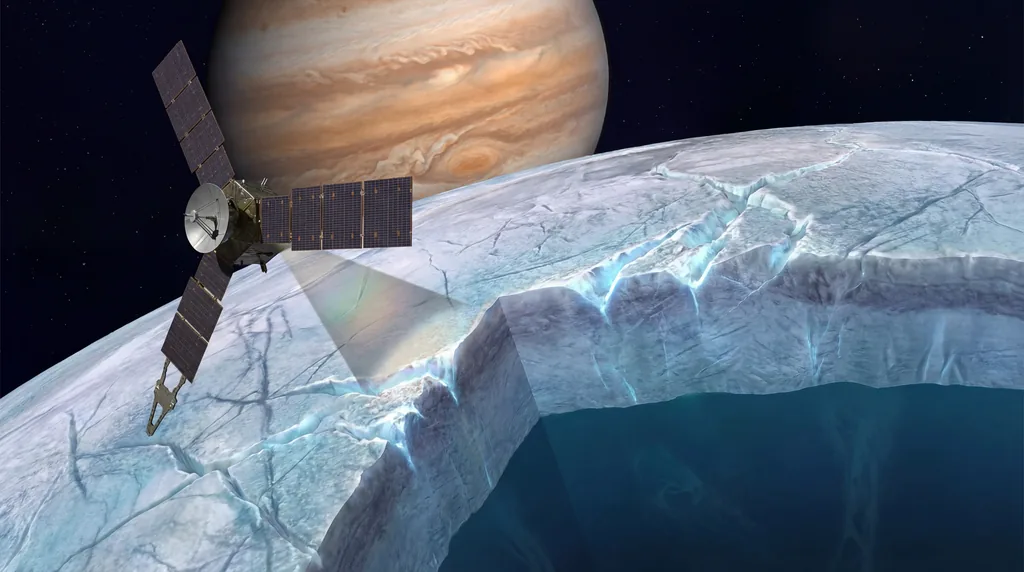

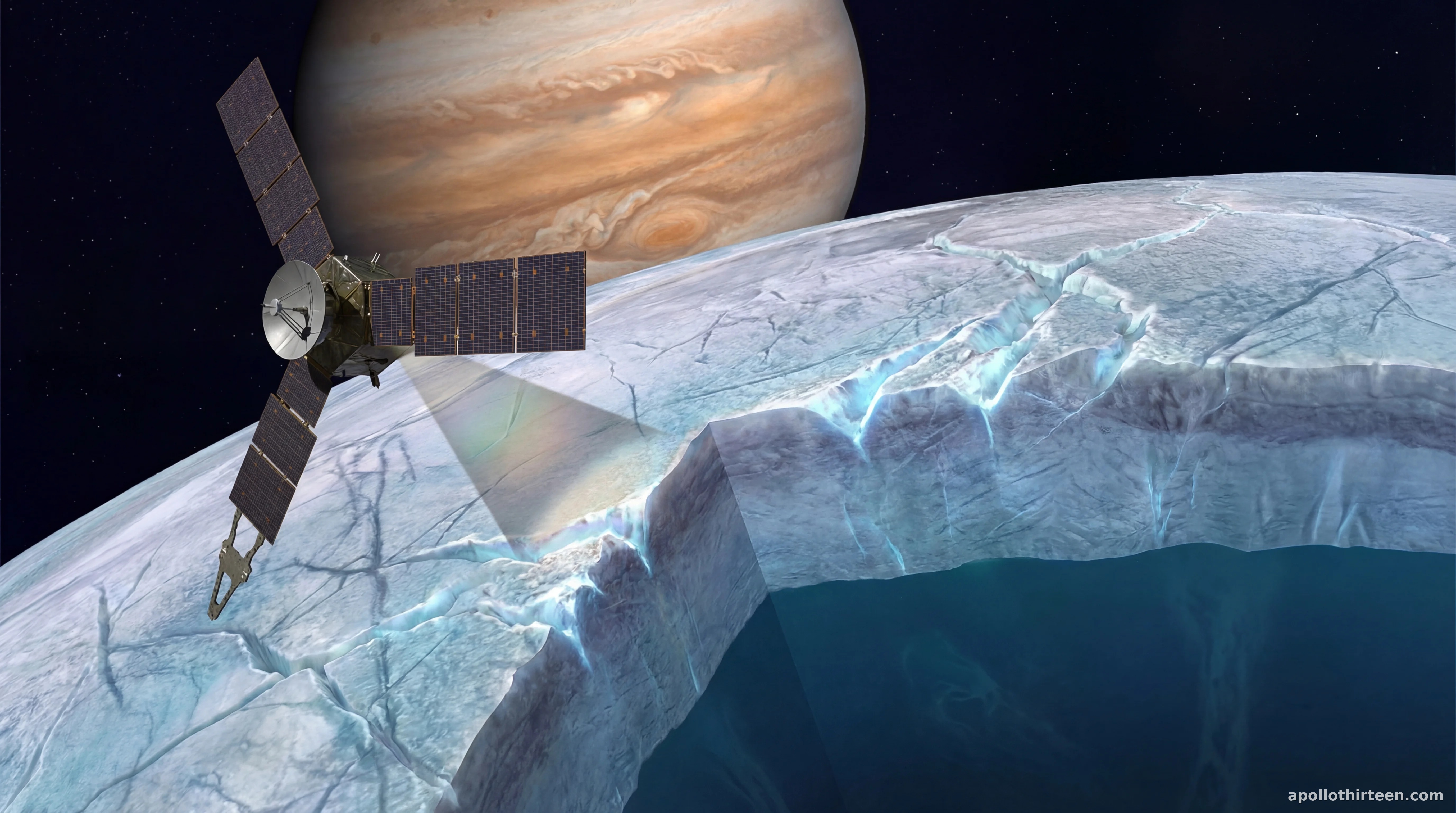
NASA’s Juno spacecraft has provided the first direct measurements of the icy shell covering Jupiter’s moon Europa, estimating the crust to be approximately 18 miles (29 kilometers) thick. This significant finding, recently published in Nature Astronomy, utilizes data from Juno’s 2022 flyby to resolve a long-standing scientific debate regarding the moon's structure. By peering beneath the frozen surface with advanced microwave technology, researchers have determined that Europa possesses a formidable, rigid outer shell that sits atop a vast subsurface liquid ocean, fundamentally altering our understanding of the moon's potential habitability.
Why is the thickness of Europa's ice shell important for habitability?
The thickness of Europa's ice shell is crucial for habitability because it determines the efficiency of nutrient and oxygen transport from the surface to the subsurface ocean. An 18-mile-thick crust acts as a significant thermal and physical barrier, potentially limiting the chemical exchange required to sustain life. While a thinner shell would facilitate easier connectivity, a thicker model suggests that life-sustaining processes may rely on specific geological conduits like cracks or porous voids rather than direct surface contact.
Scientific interest in Europa stems largely from the "thick shell" versus "thin shell" hypothesis. For decades, planetary scientists argued whether the ice was a mere few miles thick or a massive tectonic slab. The Juno data supports the latter, implying that the moon's internal environment is more isolated than previously hoped. This isolation means that any biological activity in the ocean would depend on chemical energy generated through hydrothermal activity at the seafloor or rare vertical transport of oxidants through the thick icy ceiling.
Thermal regulation within the subsurface ocean is also dictated by this icy lid. A 30-kilometer shell provides immense insulation, trapping internal heat generated by the gravitational "kneading" of Jupiter’s massive tidal forces. This tidal heating keeps the water in a liquid state, but the sheer depth of the ice complicates the "conveyor belt" theory where surface ice sinks and brings oxygenated material down to the brine below. Understanding these dynamics is the primary goal for researchers at institutions like NASA's Jet Propulsion Laboratory and the Southwest Research Institute.
What does Juno's Microwave Radiometer reveal about Europa?
Juno's Microwave Radiometer (MWR) data reveals that Europa’s ice shell consists of a cold, rigid outer layer with a thickness of roughly 18 miles, characterized by internal irregularities. The instrument detected microwave scattering consistent with small cracks, pores, or voids a few inches in diameter that extend hundreds of feet into the crust. These findings suggest the ice is not a uniform block but a complex geological structure shaped by intense thermal and mechanical stress.
The Microwave Radiometer (MWR) instrument is uniquely capable of "seeing" through solid ice by measuring thermal emissions across six different frequencies. Unlike traditional cameras that only capture surface reflections, the MWR detects the heat escaping from varying depths within the ice. By analyzing these different wavelengths, the Juno team can create a vertical profile of the ice’s temperature and structure, effectively performing a "CT scan" of a celestial body from thousands of miles away.
Key findings from the MWR analysis include the following structural details:
- Thermal Gradient: The data indicates a sharp temperature difference between the frigid surface and the warmer ice deeper within the shell.
- Scattering Centers: Tiny voids and fractures, likely caused by tidal heating, are prevalent throughout the upper layers.
- Conductivity Variations: Differences in the microwave signals suggest the presence of salts or "brine pockets" trapped within the ice matrix.
- Crustal Rigidity: The measurements confirm the upper layer is extremely stiff and cold, resisting the flow of the warmer ice below.
How does this Juno data impact the upcoming Europa Clipper mission?
Juno's data on the 18-mile-thick ice shell provides critical constraints for the upcoming Europa Clipper mission, allowing scientists to refine their radar sounding strategies and instrument targets. By establishing a baseline for the crustal depth, NASA can better calibrate the Clipper spacecraft’s REASON instrument to penetrate the ice and search for pockets of liquid water. This synergy ensures that the 2030 arrival of Clipper will be optimized for the specific geological reality of Europa.
Preparation for the Europa Clipper mission involves identifying the most promising areas for investigation, such as regions where the ice might be thinner or more active. The Juno findings act as a scouting report, highlighting "chaos terrain"—regions of broken, shifted ice—that may serve as windows into the subsurface ocean. Scientists will now prioritize these areas for high-resolution imaging and spectroscopic analysis to detect organic compounds or signs of venting plumes.
Furthermore, the Juno mission's success with the MWR has demonstrated the value of multi-wavelength sensing in the Jovian system. This has direct implications for the European Space Agency’s (ESA) JUICE mission, which is also en route to study Jupiter’s moons. By cross-referencing Juno’s microwave data with future radar and gravity measurements, the global scientific community can build a high-fidelity 3D model of Europa, bringing us closer to answering whether this icy world could host extraterrestrial life.
Geological Activity and the Evolution of Chaos Terrain
Tidal heating remains the primary engine driving the evolution of Europa's surface and its 18-mile-thick shell. Because Europa orbits Jupiter in an elliptical path, the planet’s immense gravity stretches and compresses the moon, generating friction and heat within the ice. This process is responsible for the formation of "chaos terrain," where the icy surface appears to have melted, broken into rafts, and refrozen into a jumbled landscape. Juno's data suggests these features are likely the result of convection within the thick ice shell rather than thin-ice melting.
The observation of potential plumes or water vapor venting also gains new context with an 18-mile crustal estimate. If water is indeed breaching the surface, it must be traveling through massive fractures or being forced upward by intense pressure. Researchers are now looking for evidence of these high-pressure conduits in the Juno telemetry. If plumes exist, they offer a "free sample" of the hidden ocean, allowing future spacecraft to fly through the vapor and analyze its chemical composition without the need for a complex drilling mission.
What's Next for the Exploration of Europa
As the Juno mission continues its extended lifespan, its focus remains on the Jovian system’s complex environment. The data gathered during the 2022 flyby will be studied for years to come, providing a roadmap for the next generation of explorers. The goal is no longer just to confirm the existence of an ocean, but to characterize the habitability of that environment. Future models will incorporate the 18-mile thickness to simulate ocean currents, salt concentrations, and the potential for life to survive in the dark, pressurized depths of Europa.




Comments
No comments yet. Be the first!