
New LOFAR Survey Uncovers Rare Double-Headed Odd Radio Circles in Deep Space
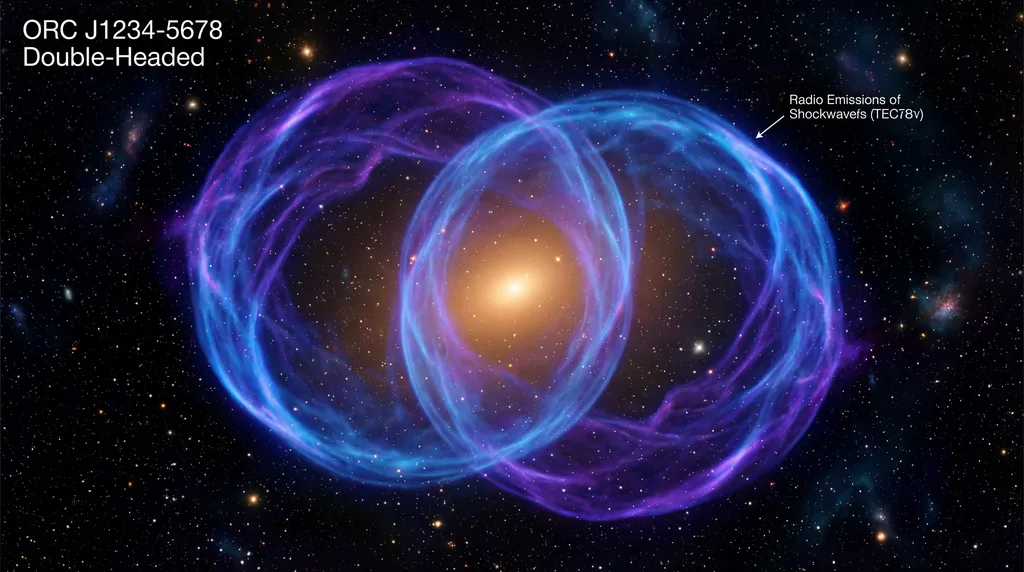
Odd Radio Circles (ORCs) are caused by several possible mechanisms, including shockwaves from merging supermassive black holes, intense star formation creating superwinds, or jets from active galactic nuclei viewed end-on. Recent findings from the LOFAR Two Metre Sky Survey (LoTSS) reveal that double-headed ORCs, characterized by twin intersecting rings, likely result from bipolar radio jets interacting with the surrounding plasma in galaxy clusters. This discovery, led by researchers M. Brüggen, F. de Gasperin, and G. Di Gennaro, significantly expands our understanding of these rare, edge-brightened radio structures.
The growing mystery of Odd Radio Circles (ORCs) began in 2019 when these massive, ring-like structures were first detected, puzzling astronomers with their circular symmetry and lack of obvious optical counterparts at the time. These phenomena typically span approximately 1 arcminute in the sky, a scale that represents hundreds of kiloparsecs at the cosmological distances where they are found. Until the advent of high-sensitivity, low-frequency surveys like LOFAR, these structures remained hidden because of their low surface brightness and the specific frequency ranges required to resolve their faint, diffuse emissions.
What causes single and double headed ORCs in LOFAR surveys?
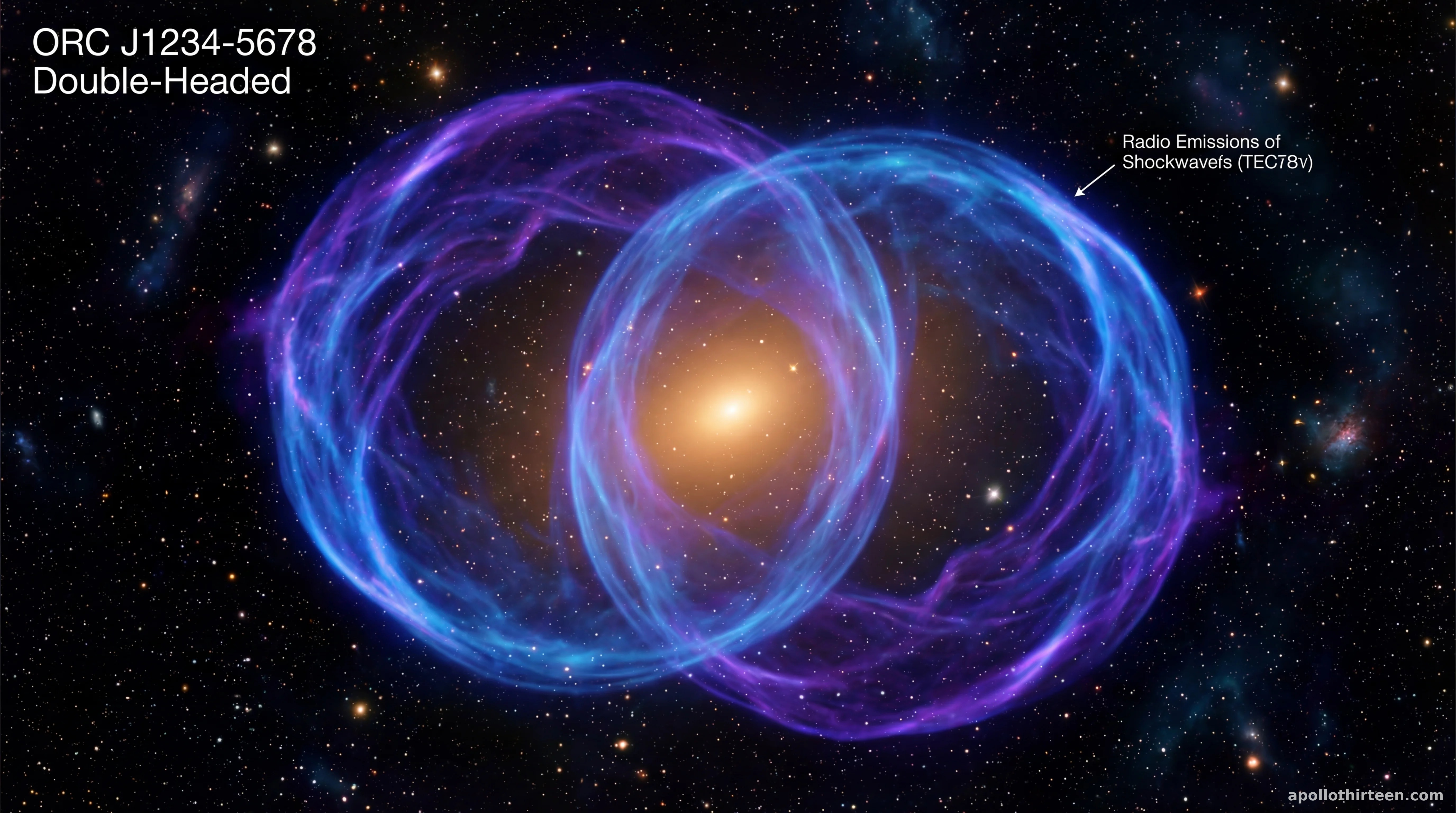
Single-headed ORCs are produced by galactic-scale energetic events such as termination shocks from galactic winds or the remnants of ancient explosions within massive galaxies. In contrast, double-headed ORCs, which feature complex twin-circle morphologies, are thought to be the result of relativistic magnetized plasma jets emanating in opposite directions from a central supermassive black hole. These jets interact with the local environment to form symmetrical, edge-brightened structures that appear as overlapping or adjacent rings in radio wavelengths.
The methodology employed by M. Brüggen and colleagues involved a sophisticated analysis of the LOFAR Two Metre Sky Survey (LoTSS) data release 3 (DR3) at 144 MHz. To navigate the millions of radio sources present in the catalog, the team used a combination of automated parameter filtering and rigorous manual visual inspection. This hybrid approach allowed them to isolate 18 distinct sources with ORC-like structures, including five new single-headed ORCs and two entirely new double-headed discoveries. By cross-referencing these findings with radio data at 54 MHz and 1400 MHz, the researchers were able to derive critical metrics such as spectral indices and physical dimensions.
Are ORCs associated with elliptical galaxies?
Odd Radio Circles (ORCs) are associated with large elliptical galaxies in the vast majority of observed cases, which typically occupy the geometric center of the radio rings. While earlier surveys were inconclusive regarding host morphology, the high-resolution data from the LOFAR survey confirms that these massive ellipticals serve as the "galactic anchors" for the phenomena. The presence of these specific host galaxies suggests that the energetic processes required to create an ORC—such as major black hole activity—are intrinsic to the evolution of the universe's most massive galaxies.
Redshift data derived from these optical counterparts has allowed the research team to estimate the physical size of these structures more accurately than ever before. The study found a notable correlation between the physical size of the Odd Radio Circles (ORCs) and their integrated spectral index; specifically, smaller ORCs appear to avoid steep radio spectra. This heterogeneity suggests that the ORC population may be more diverse than previously suspected, consisting of multiple sub-types formed by different environmental conditions or stages of galactic evolution. The researchers noted that identifying the host galaxy is a critical step in determining whether the ring is a spherical shell or a projected disk.
How do ORCs relate to supermassive black hole jets?
ORCs are directly related to supermassive black hole jets, which act as the primary engine for propelling magnetized plasma into the intergalactic medium. These relativistic jets create enormous pressure as they strike the surrounding thermal plasma of a galaxy cluster, resulting in a termination shock that manifests as a circular, edge-brightened ring. This relationship positions ORCs as a visual record of the intense feedback cycles between a supermassive black hole and its host environment over millions of years.
The implications of this research are profound for the field of extragalactic radio astronomy, as it challenges current theories regarding the "shock wave" versus "jet" origin models. While single-headed ORCs could potentially be explained by a singular spherical shockwave from a merger, the double-headed ORCs identified in the LoTSS DR3 data require a more complex production mechanism. The symmetry observed in these twin rings strongly supports the bipolar jet model, where the energy is channeled along an axis rather than expanding uniformly in all directions. This suggests that some ORCs might essentially be traditional radio galaxies viewed from a specific orientation that emphasizes their circular cross-sections.
Looking ahead, the future of Odd Radio Circles (ORCs) research will depend on even deeper and higher-resolution surveys. The team's work in expanding the known population to include 18 sources provides a much-needed statistical foundation for future modeling. Next-generation facilities, such as the Square Kilometre Array (SKA), are expected to uncover thousands of these structures, allowing astronomers to observe the transition phases of ORC formation. As resolution improves, the scientific community may finally resolve whether these cosmic rings are common features of all massive galaxies or rare relics of the most violent events in the universe.
- Total ORC structures identified: 18
- Double-headed ORCs found: 4 (including 2 new discoveries)
- New single-headed ORCs: 5
- Survey Frequency: 144 MHz (LoTSS DR3)
- Primary host type: Massive elliptical galaxies




Comments
No comments yet. Be the first!