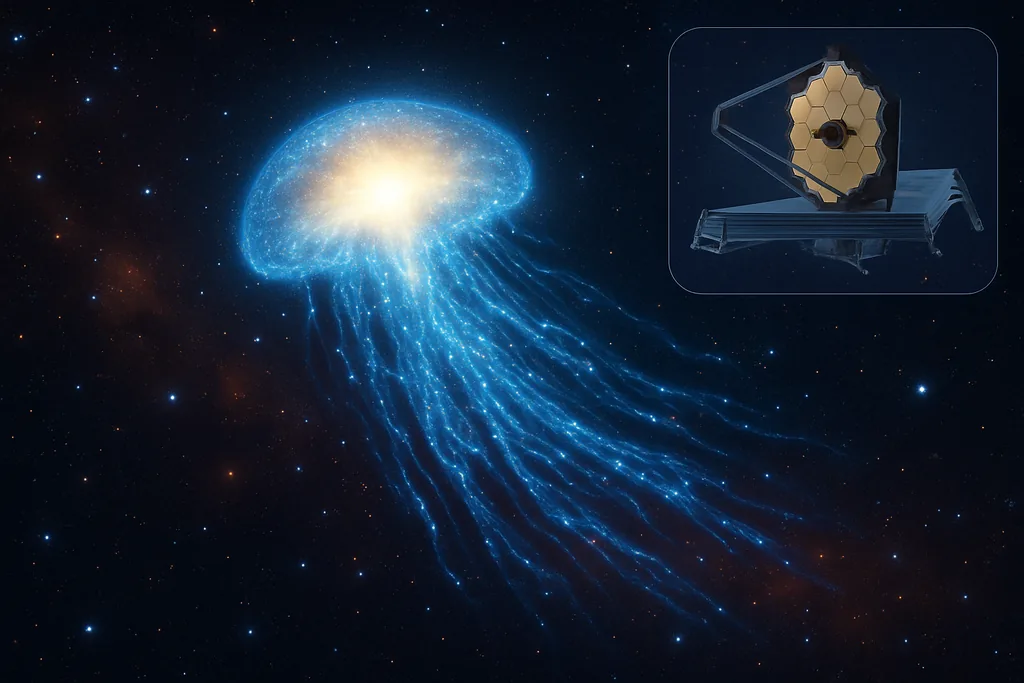
In data from the james webb space telescope, a team led from the University of Waterloo has identified a candidate "jellyfish" galaxy whose light left it roughly 8.5 billion years ago. Catalogued at a redshift of z = 1.156 and unearthed in JWST observations of the COSMOS field, the object shows the long, tentacle-like streams of gas and young stars that define nearby jellyfish systems. The discovery, published as "JWST Reveals a Candidate Jellyfish Galaxy at z=1.156" in The Astrophysical Journal, pushes the phenomenon of environmental stripping far earlier in cosmic history than astronomers had previously confirmed.
James Webb Space Telescope discovery in the COSMOS field
The COSMOS field — a deep, tidy patch of sky selected precisely because it offers a clear view of faint, distant galaxies — has been a workhorse for surveys. Researchers re-examined JWST imaging and spectroscopy from this well-studied region and identified the jellyfish candidate while searching for signs of galaxies being actively transformed by their surroundings. Because the COSMOS field has minimal foreground contamination and very deep multiwavelength coverage, JWST’s infrared sensitivity makes it possible to see features that are stretched and reddened by cosmological distance but still spatially resolved.
Dr. Ian Roberts, a Banting Postdoctoral Fellow at the Waterloo Centre for Astrophysics, described the find as unexpected: while combing through the dataset the team noticed a distant, undocumented galaxy with an unmistakable morphology — a compact core with long trailing filaments. The combination of JWST’s resolution in the near-infrared and COSMOS’s layered data allowed the team to measure the galaxy’s redshift and assemble a physical picture of a system undergoing active stripping in a dense environment early in the universe’s history.
What defines a jellyfish galaxy?
Jellyfish galaxies are a morphological class named for their long, tentacle-like tails of gas and newly formed stars that trail behind a moving galaxy. Those tails are not decorative: they form when a galaxy plunges through hot, dense gas that fills galaxy clusters. The pressure of this intracluster medium acting on a galaxy’s interstellar gas — a process known as ram-pressure stripping — sweeps material out of the galaxy like wind driving spray off a car, leaving behind elongated streams where gas cools and collapses into new stars.
Nearby examples, observed with instruments such as Hubble and ground-based telescopes, reveal spectacular knots of star formation in the tails and abrupt truncation of star formation in the galaxy’s disk. What makes the z = 1.156 candidate notable is that it demonstrates those same physics were operating when the universe was significantly younger, implying that cluster environments could be hostile to galaxies earlier than standard models had predicted.
James Webb Space Telescope evidence for early cluster stripping
Before this discovery, astronomers thought that the clusters massive enough to produce strong ram-pressure stripping were rarer at epochs corresponding to redshifts around one. The new candidate shows clear morphological signs consistent with stripping at z = 1.156, which corresponds to a lookback time of roughly 8.5 billion years. That timing sits well before the present era of well-established, massive clusters and suggests that protoclusters or dense environments capable of stripping were already actively reshaping galaxies.
The implications are twofold. First, environmental processes that quench star formation and convert gas-rich spirals into passive cluster-dwelling galaxies could have been effective earlier and more widely than many simulations predict. Second, the presence of such a galaxy provides a mechanism for building the large population of "dead" galaxies found in clusters today: gas stripping accelerates the end of star formation, leaving behind red, quiescent systems that dominate cluster cores.
How JWST saw the tails: imaging and context
JWST’s instruments, optimised for near- and mid-infrared wavelengths, are critical for resolving structure in distant galaxies whose optical light has been redshifted into the infrared. In practical terms, that means JWST can image the starlight and dust-reprocessed emission that reveal both the compact stellar core and the extended, faint filaments of a jellyfish galaxy at cosmological distances. The COSMOS field’s extensive ancillary data — from X-ray maps that trace hot intracluster gas to ground-based spectroscopy that provides environmental context — helps researchers interpret whether the galaxy sits in a genuine dense environment or is simply projected near one.
While the paper presents the object as a strong candidate rather than an incontrovertible case, the combination of morphological evidence and redshift places it among the earliest convincing examples of a galaxy undergoing stripping. Follow-up JWST observations and deep X-ray or radio data can help confirm the presence of a surrounding hot medium and establish the dynamics of the system more firmly.
Why this finding matters for galaxy evolution
Galaxies evolve through a mix of internal and external processes. Internal processes — gas consumption in star formation, feedback from supernovae and active nuclei — operate regardless of environment. External processes like tidal interactions and ram-pressure stripping depend on surroundings. Finding stripped galaxies at z ≈ 1.156 shifts the balance: it shows environment-driven transformation was already important when the universe was about half its current age.
That shift has concrete consequences for models of galaxy assembly and quenching. Simulations that aim to reproduce the observed demographics of galaxies must now account for stronger or earlier environmental effects in at least some regions. For observational astronomy, this discovery is a demonstration that JWST can resolve the interplay of galaxies and their environments at lookback times that were previously accessible only as blurred or integrated signals.
Next steps: confirming the candidate and mapping its neighborhood
The james webb space telescope continues to deliver surprises as teams reprocess vast survey fields like COSMOS with fresh sensitivity and resolution. Each newly identified object at high redshift is not only a data point but a probe of the physical processes shaping galaxies across cosmic time, and the z = 1.156 jellyfish candidate is a vivid example of how deep infrared vision reshapes our narrative of the young universe.
Sources
- The Astrophysical Journal (research paper: "JWST Reveals a Candidate Jellyfish Galaxy at z=1.156")
- University of Waterloo (Waterloo Centre for Astrophysics)
- James Webb Space Telescope (NASA/ESA/CSA observations)
- COSMOS (Cosmic Evolution Survey)




Comments
No comments yet. Be the first!