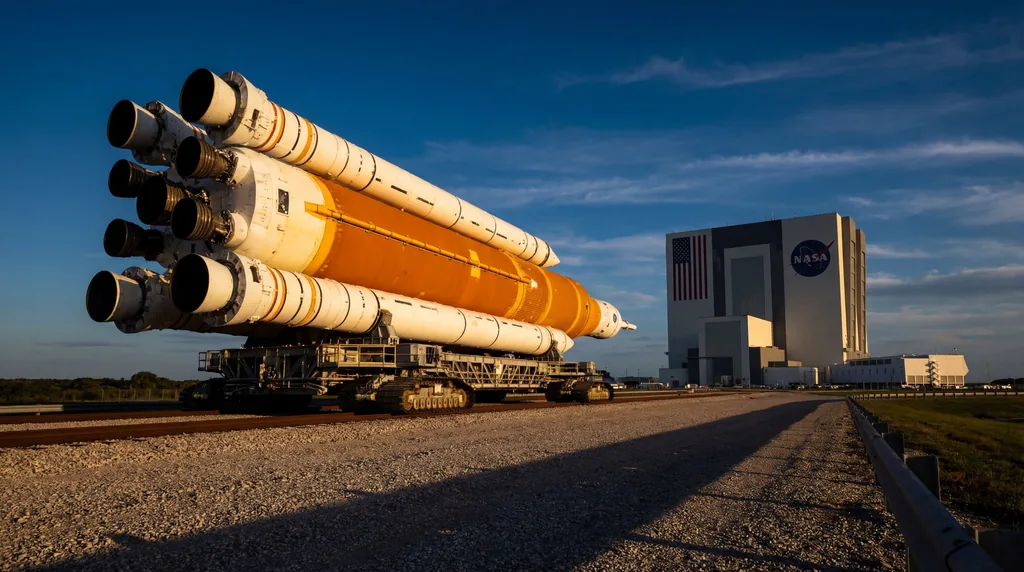

NASA has officially commenced the rollback of its Artemis 2 Space Launch System (SLS) rocket from Launch Complex 39B to the Vehicle Assembly Building (VAB) following the discovery of critical technical anomalies. On February 25, 2026, engineers at the Kennedy Space Center in Florida determined that irregularities in helium flow within the rocket’s upper stage necessitated a return to the hangar for comprehensive repairs. This 322-foot (98-meter) tall Moon rocket, integrated with the Orion spacecraft, must undergo a delicate 12-hour journey covering several miles of crawlerway to reach the controlled environment of the VAB. This strategic retreat marks a significant shift in the mission timeline, pushing the highly anticipated crewed lunar flyby from its original March window to no earlier than April 2026.
What caused the helium flow issue with the Artemis 2 rocket?
The helium flow issue with the Artemis 2 rocket’s upper stage was primarily traced to a compromised seal on the tubing’s quick disconnect and a malfunctioning check valve. These hardware irregularities were detected following the second wet dress rehearsal on February 19, 2026, during standard reconfiguration operations. Despite the rocket performing nominally during the actual test sequences, the subsequent failure to route helium correctly through the Interim Cryogenic Propulsion Stage (ICPS) necessitated an immediate cessation of launch pad activities.
Helium plays a vital role in rocket propulsion by providing the pressure necessary to move cryogenic propellants into the engines and ensuring structural integrity as fuel levels deplete. In the case of the SLS, the helium system is responsible for "pre-chilling" the engines and purging lines to prevent volatile mixtures. NASA engineers are currently investigating whether the interface between the ground support equipment and the rocket’s internal lines contributed to the seal's degradation. Because these components are located in high-access areas that are difficult to reach on the exposed launchpad, the Vehicle Assembly Building provides the only safe environment for the required teardown and replacement of the valves and filters.
How does the solar superflare forecast impact the Artemis 2 timing?
While the current delay is driven by technical hardware failures, the shift to an April launch window increases the mission's exposure to the peak of Solar Cycle 25. Although there is no specific "superflare" currently threatening the mission, the postponement forces NASA to re-evaluate space weather risks for the Artemis 2 crew. Higher solar activity increases the probability of solar particle events (SPEs), which could pose radiation risks to the four astronauts during their ten-day journey around the Moon.
Space weather monitoring has become a critical component of the Artemis flight manifest as the Sun approaches its solar maximum. Recent data indicates a Kp-index of 5, signifying moderate (G1) geomagnetic storming that has already produced visible auroras in northern latitudes such as Fairbanks, Alaska and Reykjavik, Iceland. For a crewed mission like Artemis 2, which lacks the deep-space shielding found on the International Space Station, a solar superflare could disrupt communications and avionics. NASA Administrator Jared Isaacman emphasized that while the hardware repairs are the immediate priority, the mission will only proceed when the launch window aligns with acceptable radiation environment thresholds.
Monitoring Solar Activity for Crew Safety
- Real-time Tracking: NASA utilizes a network of satellites, including the Deep Space Climate Observatory (DSCOVR), to monitor solar wind.
- Radiation Sheltering: The Orion spacecraft is designed with "shelter-in-place" protocols where the crew can use onboard mass to shield against sudden radiation spikes.
- Geomagnetic Impacts: High Kp-index readings (5 or higher) indicate heightened solar energy that can interfere with the SLS navigation systems during the initial ascent.
What does the Artemis 2 delay mean for future Moon landings?
The delay of the Artemis 2 mission creates a significant "domino effect" that will likely postpone the Artemis 3 lunar landing until at least 2027 or 2028. NASA’s current architecture requires the successful completion of the crewed flyby to validate the life-support systems of the Orion spacecraft and the performance of the SLS in a crewed configuration. Any hardware repairs or systemic issues found during the Artemis 2 rollback must be thoroughly analyzed to ensure they do not represent a design flaw that could affect the Artemis 3 vehicle currently under assembly.
Technical integrity remains the primary driver of the mission schedule, as the agency prioritizes crew safety over political or calendar deadlines. The mission will see three Americans and one Canadian astronaut travel approximately 4,600 miles beyond the far side of the Moon. This journey is a foundational step for the goal of establishing a long-term human presence on the lunar surface. However, history has shown that SLS hydrogen leaks and helium anomalies, such as those seen during Artemis 1, often require months of testing and validation. Consequently, the mission's postponement to April is viewed by industry analysts as a conservative estimate that may extend further if the VAB inspections reveal deeper systemic issues.
The Logistics of the SLS Rollback to the VAB
Transporting a 98-meter rocket requires the use of the massive Crawler-Transporter 2, which moves at a top speed of just 1 mile per hour. The transition from Launch Pad 39B to the Vehicle Assembly Building is a high-stakes operation that subjects the rocket to specific structural loads and vibrations. NASA ground teams must carefully monitor the environmental conditions, as the SLS cannot be rolled back during periods of high winds or lightning, which are frequent in the Cape Canaveral climate.
Inside the Vehicle Assembly Building, the SLS will be placed in a vertical position where work platforms can be extended to reach the Interim Cryogenic Propulsion Stage. This allows technicians to perform "hands-on" maintenance that is impossible while the rocket is fueled and vertical on the pad. The repair process involves:
- System De-servicing: Ensuring all residual propellants and high-pressure gases are purged from the rocket stages.
- Component Replacement: Removing the suspect helium check valve and inspecting the quick disconnect seals for signs of material fatigue or contamination.
- Integrated Testing: Running pressurized leak tests to ensure the new seals can withstand the extreme temperatures of liquid hydrogen and oxygen.
What's Next for the Artemis Program?
Once the repairs are finalized in the VAB, the SLS will undergo a third wet dress rehearsal or proceed directly to a launch attempt depending on the results of the component testing. NASA leadership has maintained that transparency regarding these technical setbacks is essential for maintaining public and congressional support. The agency is expected to provide a detailed update on the Artemis 2 flight readiness review in late March 2026. This mission remains the centerpiece of the United States' efforts to return humans to deep space, serving as the ultimate proving ground for the technology that will eventually carry astronauts to Mars.
The international partnership involved in this mission, particularly the inclusion of the Canadian Space Agency, underscores the global importance of the Artemis program. As the SLS rocket sits in the VAB, the world waits for the resolution of these helium flow issues. While the delay is a setback, the history of space exploration proves that the most successful missions are those that prioritize "getting it right" over "getting it done on time." The upcoming weeks will be a critical period for NASA as they work to clear the path for humanity's next giant leap.





Comments
No comments yet. Be the first!