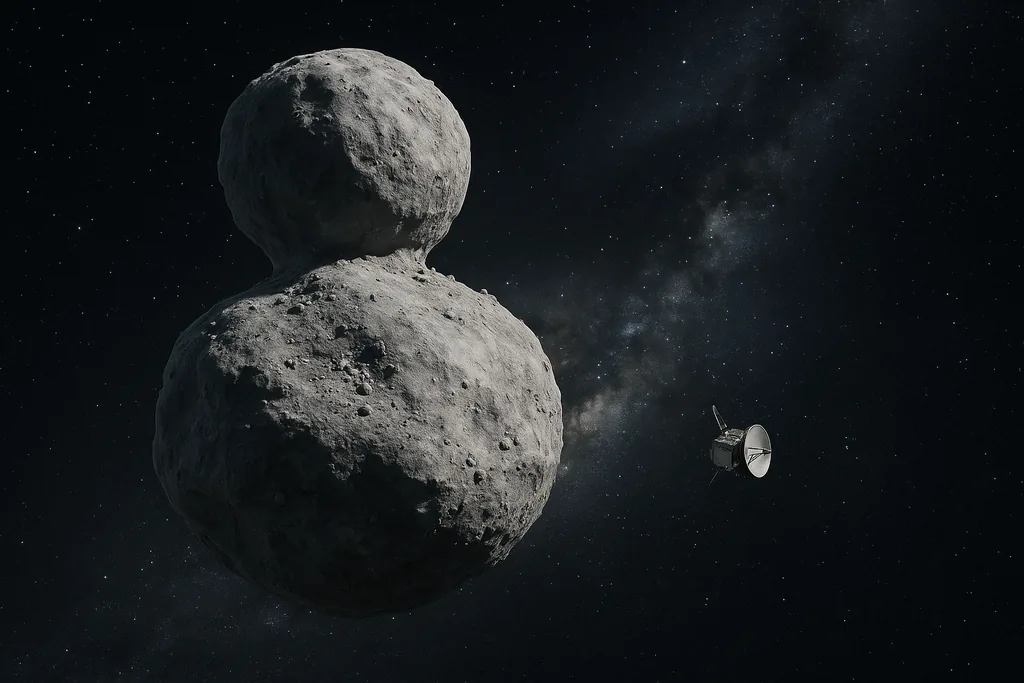
"snowmen flying through deep" space is not a holiday joke — it’s a literal description emerging from recent research that explains why many small worlds out past Neptune resemble two fused snowballs. On 26 February 2026 Michigan State University researchers published a simulation, accepted for the March issue of Monthly Notices of the Royal Astronomical Society, that reproduces the iconic two‑lobed shapes seen in Kuiper Belt Objects like Arrokoth. The model, developed by MSU graduate student Jackson Barnes with collaborators at the Planetary Science Institute and MSU, shows contact binaries can arise naturally when a cloud of icy pebbles collapses under its own gravity and the pieces gently merge rather than shatter.
Snowmen flying through deep: a new simulation
The simulation from Barnes and colleagues offers the first fully self‑consistent demonstration that gravitational collapse of a pebble cloud can produce pristine contact binaries — objects made of two lobes touching like a snowman. The team produced a short video of the run in which multiple small bodies form, migrate and settle into contact without requiring a rare, high‑energy collision or exotic process. That matters because observations from spacecraft flybys and telescopic surveys show a surprisingly large fraction of small Kuiper Belt Objects are contact binaries; any viable formation model has to create them frequently.
Previous computational models often failed to bring two lobes together without artificially tuned collisions or external events. Barnes’ approach starts with a dispersed, gravitationally unstable pebble cloud and lets gravity plus the dynamical interactions do the work. As the cloud shrinks, slower relative speeds and gentle encounters allow aggregates to merge into bilobed configurations that remain intact in the sparse outer solar system.
Snowmen flying through deep and the Kuiper Belt
The new simulation shows how such shapes can be a natural outcome of planetesimal formation in the Kuiper Belt, rather than a rare accident. Once two lobes make contact in the belt’s low‑density environment, further high‑speed collisions are unlikely, meaning these fragile snowman shapes can survive for billions of years and reach us as relatively pristine windows into the early solar system.
The physics of icy sticking
How do tiny frost‑coated grains and pebbles stick together in the near‑vacuum and microgravity of the outer solar system? The answer is a mix of gentle dynamics and surface physics. When velocities between colliding particles are low — centimetres per second rather than kilometres — collisions tend to dissipate energy and let aggregates cohere instead of fragment. This condition is common during the slow collapse of a pebble cloud, where mutual gravity reduces relative speeds among neighbours.
At small scales, short‑range forces are important. Van der Waals attraction — a weak, universal force between molecules — provides cohesion when contact areas are small. Electrostatic charges can also play a role: differential charging from sunlight or plasma can make grains attract or repel, depending on circumstances, and may help form initial clumps. At the same time, at the cryogenic temperatures of the Kuiper Belt, ice behaves differently than at Earthlike temperatures: surfaces can be tackier because sintering and frost recondensation at contact points weld grains together over time.
Laboratory studies and theoretical work across planetary science show that a combination of these effects — low collision speeds, van der Waals cohesion, possible electrostatic attraction and thermally driven sintering — lets even tiny ice grains merge into larger aggregates. Those aggregates can then accrete further in a runaway process that culminates in kilometre‑scale planetesimals and, under the conditions Barnes models, bilobed contact binaries.
From pebbles to contact binaries: gravitational collapse
The central mechanism the MSU team tested is gravitational collapse of a dense cloud of icy pebbles. In this picture, local concentrations of solids — meteorological clumping in a protoplanetary disc or streaming instabilities that concentrate particles — make a subregion dense enough that self‑gravity overwhelms the tendency of the cloud to disperse. As the cloud collapses, individual pebble clumps form and interact.
Crucially, collapse tends to produce low relative velocities among nearby clumps because the process is collective: particles fall toward a common centre rather than slamming into one another on random high‑speed trajectories. Those gentle encounters favour sticking and reconfiguration into contact binaries. The MSU simulation shows multiple outcomes are possible — single spheroids, binaries, and contact binaries — depending on initial density and angular momentum, but bilobed forms appear naturally within realistic parameter ranges, explaining why telescopic and spacecraft observations find them in significant numbers.
Surface processes and spacecraft frost
The same surface physics that helps icy grains cohere in the Kuiper Belt also explains why frost clings to spacecraft surfaces in orbit or why frost can accumulate on landers and instruments in cold parts of the solar system. In microgravity, there is no strong downward pull to shear frost off; instead, molecular forces and slow recondensation keep frost adhered. Electrostatic adhesion can make dust and ice grains stick to solar panels and sensors, presenting a genuine engineering headache for missions operating in dusty or volatile‑rich environments.
Understanding these mechanisms is not just academic: predicting how quickly surfaces sinter or how resilient a contact between two lobes will be under thermal cycling affects how scientists interpret remote observations and plan future missions. For example, a future lander aimed at a bilobed KBO would need to account for fragile contact regions that might be weakly bound compared with the rest of the body.
Implications and future observations
Going forward, telescopic surveys that increase the census of small Kuiper Belt Objects, plus any future flyby or rendezvous missions, can test detailed predictions from collapse models: the distribution of lobe sizes, spin states, surface porosity and the frequency of near‑pristine contact binaries. Laboratory experiments and refined simulations will also probe the microphysics — van der Waals, electrostatics and sintering — that control the earliest sticking of icy grains. Together, those lines of evidence will sharpen our picture of how the building blocks of planets assembled in the coldest reaches of the solar system.




Comments
No comments yet. Be the first!