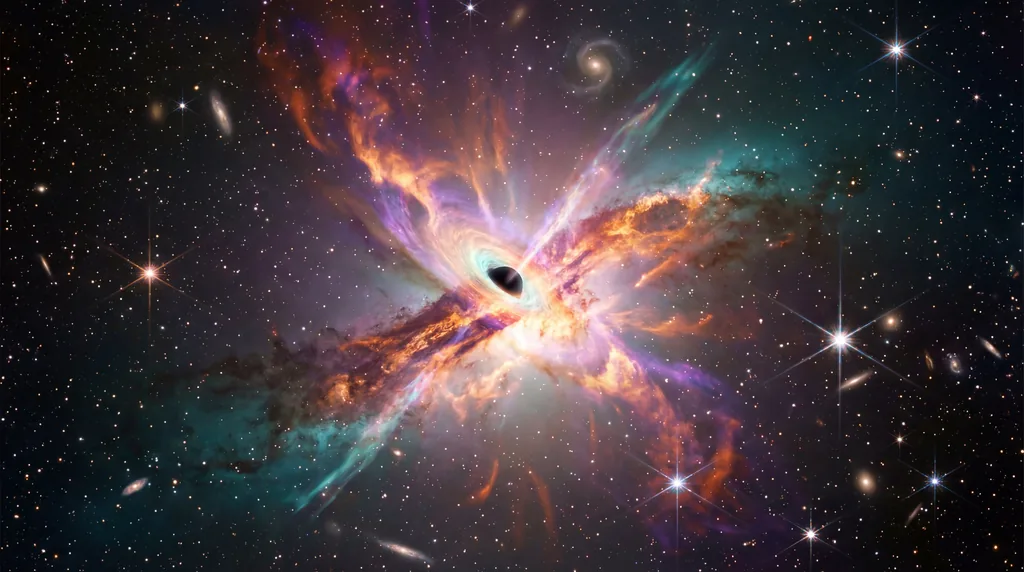

Why is Centaurus A important for studying black holes?
Centaurus A is essential for astrophysical research because it hosts the closest active supermassive black hole to Earth, located approximately 12 million light-years away. This proximity allows scientists to observe the complex interplay between a black hole—possessing a mass of 55 million suns—and its host galaxy in unprecedented detail. By serving as a premier laboratory, Centaurus A provides high-precision data on how active galactic nuclei (AGN) generate powerful jets and influence galactic evolution through gas outflows.
Located in the constellation Centaurus, this elliptical galaxy is the nearest radio galaxy, making it a "Rosetta Stone" for understanding the physics of accretion and feedback. Researchers Yasushi Fukazawa, Kouichi Hagino, and Yoshihiro Ueda utilized this proximity to conduct high-resolution spectroscopy that would be impossible with more distant targets. Their work focuses on the circumnuclear environment, where the gravitational influence of the central engine is most profound, revealing how energy is transferred from the core to the rest of the galaxy.
The importance of studying Centaurus A lies in its ability to bridge the gap between small-scale black hole physics and large-scale galaxy formation. Because it is so close, astronomers can resolve structures within a few fractions of a parsec from the event horizon. This enables the mapping of ionized gas movements, providing a high-fidelity look at the "breath" of a black hole as it consumes matter and expels energy, a process that governs the lifecycle of nearly all massive galaxies in the universe.
Precision Spectroscopy: The Power of XRISM’s Resolve Detector
The X-ray Imaging and Spectroscopy Mission (XRISM) represents a generational leap in capability by utilizing the Resolve detector to achieve unparalleled spectral resolution. Unlike previous instruments that provided broad "colors" of X-ray light, Resolve acts like a high-definition prism, separating X-rays into a fine-grained spectrum. This allows scientists to identify the specific signatures of elements like iron with a precision that was previously unattainable in high-energy astrophysics.
Traditional X-ray telescopes often struggle to distinguish between closely spaced emission lines, but the XRISM mission uses a microcalorimeter to measure the heat of individual X-ray photons. This technological breakthrough allows for the detection of subtle shifts in energy caused by the velocity of gas, known as the Doppler effect. In the study of Centaurus A, this meant the team could finally separate multiple ionized components within the Fe-K band (6.5–6.9 keV) that had previously appeared as a single, blurred feature.
- Spectral Resolution: Resolve provides a resolution of roughly 5-7 eV, compared to the 100+ eV typical of standard CCD detectors.
- Ion Identification: The instrument can clearly distinguish between Fe XXV (helium-like iron) and Fe XXVI (hydrogen-like iron).
- Velocity Precision: Scientists can now measure gas movements with a precision of hundreds of kilometers per second in the X-ray regime.
What is the difference between emission and absorption lines in X-ray spectroscopy?
In X-ray spectroscopy, emission lines are spikes in brightness caused by hot, ionized gas releasing energy, while absorption lines are dark "dips" indicating gas blocking the light. These features act as chemical and physical fingerprints, allowing researchers to determine the temperature, density, and velocity of matter near a black hole. In the case of Centaurus A, both types of lines were detected, revealing a multi-layered structure of gas outflows.
The XRISM data revealed a broad emission component with a width of 3000 km/s, redshifted by +3400 km/s. This component originates incredibly close to the central engine, at a distance of only 0.02 parsecs—approximately 100 Schwarzschild radii. This indicates a high-velocity outflow of gas that is being heavily influenced by the extreme gravity and radiation pressure of the core. The presence of these lines confirms the existence of a photo-ionized plasma environment deep within the galactic center.
Beyond the emission, the team identified two significant blueshifted absorption lines at approximately 7.1 keV and 10.6 keV. These lines correspond to gas moving toward the observer at staggering velocities of 10,000 km/s and 100,000 km/s, respectively. The detection of the 10.6 keV line is particularly notable, carrying a statistical significance of over 98%. These absorption features suggest that a portion of the broad emission gas is being pushed outward at relativistic speeds, creating a complex "wind" that shapes the inner environment of the galaxy.
Mapping the Outflow: From Black Hole to Torus
The discovery of multiple ionized Fe-K components allows astronomers to map the physical architecture of gas moving around the supermassive black hole. By analyzing the widths and shifts of these lines, the research team identified a stratified environment where different gas clouds exist at varying distances from the center. This mapping reveals a dynamic system where matter is not just falling in, but is also being violently ejected or heated by shocks.
In addition to the broad component near the event horizon, XRISM detected two narrow emission components with widths of approximately 500 km/s. These components exhibit both redshifted (+2600 km/s) and blueshifted (-1500 km/s) velocities, suggesting they originate from a more distant region roughly 0.1 parsecs from the core. This area is likely associated with the galactic torus, a doughnut-shaped cloud of dust and gas that surrounds the inner accretion disk of the AGN.
The researchers interpret these narrow lines as shock-heated plasma or photo-ionized gas located near the torus. This finding is significant because it provides a potential physical link to larger-scale outflows. The high-energy X-ray data from XRISM suggests that the "heartbeat" of the black hole sends ripples of energy through the torus, which then manifest as the massive gas structures observed further out in the galaxy. This establishes a continuous chain of energy transfer from the sub-parsec scale to the kiloparsec scale.
Multiwavelength Synergy: Connecting XRISM and JWST Data
Integrating X-ray data from XRISM with infrared observations from the James Webb Space Telescope (JWST) provides a comprehensive view of galactic feedback. While JWST excels at seeing the cooler, molecular gas and dust, XRISM captures the high-energy "plasma" state of matter. Together, these telescopes reveal how the central black hole influences its surroundings across different temperatures and physical states, showing a unified picture of the outflow.
The JWST had previously discovered molecular outflows expanding outside the torus of Centaurus A. The new XRISM data suggests that the narrow, shock-heated components at 0.1 parsecs may be the high-energy progenitors of the gas JWST observed. As the hot plasma moves outward and cools, it may transition from the ionized state detected by XRISM into the molecular state detected by Webb. This synergy allows scientists to track the entire lifecycle of a galactic wind as it travels from the inner core into the star-forming regions of the galaxy.
This multi-layered feedback loop is critical for understanding AGN unification. By observing how these different layers of gas interact, astronomers can better explain why some galaxies become "dead" (cease star formation) while others remain active. The Centaurus A findings suggest that the energy output from the central engine is highly structured, with different "shells" of gas performing different roles in the feedback process that regulates the galaxy's growth.
How does XRISM compare to previous X-ray telescopes?
XRISM provides a transformative improvement over previous telescopes like Chandra or XMM-Newton by offering spectral resolution that is nearly 30 times sharper. While previous missions were excellent at taking pictures of the X-ray sky, they lacked the resolution to distinguish the individual velocities and ionization states of iron atoms. XRISM's Resolve instrument solves this by measuring the energy of photons with such precision that it can detect gas moving at a fraction of the speed of light.
This study on Centaurus A has set a new benchmark for what is possible in high-energy astrophysics. The researchers noted that these results demonstrate the "high potential" of the Resolve detector to characterize features that were previously invisible. By identifying specific ions like Fe XXV and Fe XXVI and measuring their distinct Doppler shifts, XRISM has effectively turned X-ray astronomy into a high-precision laboratory science, similar to how optical spectroscopy revolutionized our understanding of stars a century ago.
Looking ahead, the success of the Centaurus A observations paves the way for the XRISM mission to target other low-luminosity radio galaxies and AGN. The ability to map ionized emission and absorption features in the Fe-K band will allow scientists to test general relativity, study the physics of accretion disks, and refine our models of how supermassive black holes grow over cosmic time. Centaurus A was just the beginning; the "breath" of black holes across the universe is finally being heard in high definition.





Comments
No comments yet. Be the first!