
Decoding the Cosmic Eye: Hubble and Euclid Reveal the Hidden Architecture of the Cat’s Eye Nebula
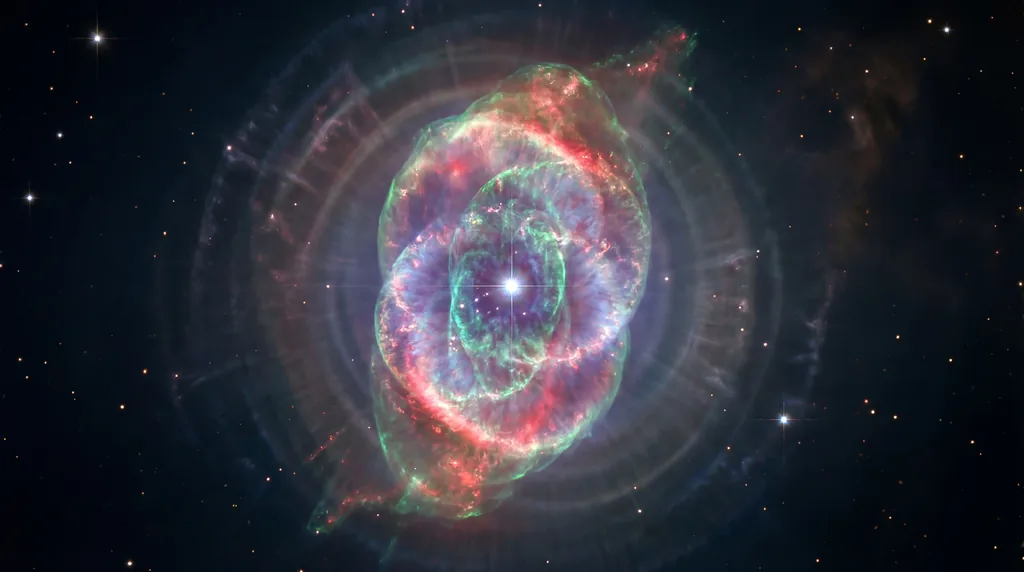
The Cat's Eye Nebula (NGC 6543) represents one of the most complex structural enigmas in the known universe, featuring a sophisticated architecture of concentric shells, high-speed gas jets, and shock-induced knots. Located approximately 4,300 light-years away in the constellation Draco, this planetary nebula has become the subject of a groundbreaking joint observation by NASA and the European Space Agency (ESA). By combining the high-resolution visible-light capabilities of the Hubble Space Telescope with the wide-field near-infrared vision of the Euclid mission, astronomers have produced a comprehensive "fossil record" of a star’s final evolutionary stages.
Planetary nebulae like the Cat's Eye Nebula are formed during the terminal phase of a sun-like star's life, when it sheds its outer layers of gas into the surrounding vacuum. Despite their name, these objects have nothing to do with planets; the term is a 19th-century relic from when their rounded shapes resembled distant gas giants through primitive telescopes. In 1864, the Cat’s Eye became the first planetary nebula to be analyzed via spectroscopy, proving that these structures were composed of glowing gas rather than individual stars, a discovery that fundamentally altered our understanding of stellar death.
What causes the complex structures in the Cat's Eye Nebula?
The complex structures in the Cat's Eye Nebula are primarily caused by the interaction of a fast stellar wind from the central star with previously ejected material, hollowing out an inner bubble. These interactions are further complicated by a suspected binary star system at the core, which may generate precessing polar jets that sculpt the surrounding gas into its signature intricate loops.
Stellar evolution models suggest that the central star of NGC 6543 echelons its mass in distinct, energetic pulses. As the stellar wind—moving at millions of miles per hour—collides with the slower-moving gas from earlier ejections, it creates shock interactions that condense the material into the glowing filaments visible today. This process creates a "bubbling" effect where the inner regions are hollowed out, eventually bursting at the poles to create the elongated, eye-like appearance that gives the nebula its name.
Beyond the simple interaction of winds, the Cat's Eye Nebula displays a level of symmetry that hints at the presence of a companion star. Astronomers believe that a binary partner could be responsible for the "wobble" or precession of the central star's jets. As these jets rotate over time, they carve out surreal patterns in the ejected gas, much like a rotating sprinkler creates patterns on a lawn. These features remain a primary focus for researchers seeking to understand how angular momentum is conserved during the final stages of stellar collapse.
What is the difference between Hubble and Euclid observations?
The difference between Hubble and Euclid observations lies in their spatial scale and spectral focus: Hubble provides ultra-high-resolution visible-light imagery of the nebula’s dense core, while Euclid captures a wide-field near-infrared view of the surrounding halo. This complementary data allows scientists to see both the stellar end-of-life processes and their impact on the broader cosmic environment.
- Hubble Space Telescope: Utilizes visible-light sensors to map the concentric shells and high-speed gas jets with unparalleled clarity, focusing on the intricate "tapestry" of the inner 1,000-year-old nebula.
- Euclid Space Telescope: Employs near-infrared and visible-light wide-field surveys to reveal the colourful fragments of gas in the outer halo, showing how the nebula sits against a backdrop of distant galaxies.
- Data Fusion: By layering these datasets, researchers can trace the movement of gas from the high-resolution core to the farthest reaches of the expanding debris field.
While Euclid was primarily designed to map the "Dark Universe" and distant galaxies, its ability to capture large-scale structures makes it an ideal partner for the aging but precise Hubble. In the new composite view, the Cat's Eye Nebula is not seen in isolation but as a dynamic participant in the interstellar medium. Euclid’s deep imaging reveals that the nebula is surrounded by a massive halo of gas that was ejected long before the central "eye" was formed, providing a much larger context for the star's mass-loss history.
Why are concentric shells visible in the Cat's Eye Nebula?
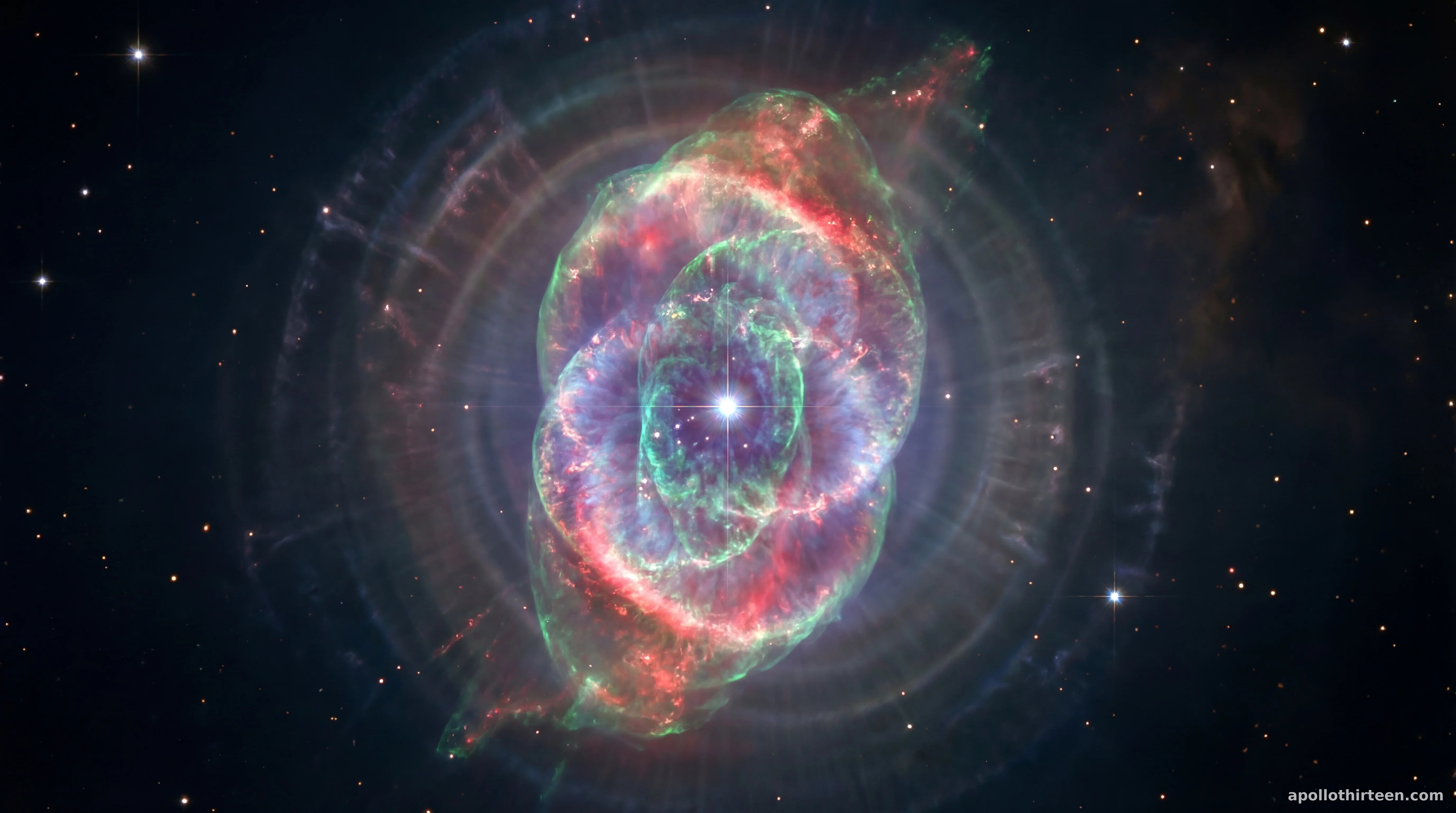
Concentric shells are visible in the Cat's Eye Nebula because the central star underwent episodic mass ejections at regular intervals of approximately 1,500 years. These pulses created a series of nested, onion-skin-like dust shells that were pushed outward by radiation pressure, forming a visible timeline of the star’s final ten thousand years of life.
These concentric rings, of which there are at least eleven, represent a major challenge to traditional stellar evolution theories. Standard models often predict a continuous flow of mass rather than these discrete, timed pulses. The fact that the shells in the Cat's Eye Nebula are spaced so evenly suggests a periodic mechanism—perhaps related to thermal pulses in the star's interior or the gravitational influence of a hidden companion star. Each shell acts as a "fossil," preserving the chemical composition and physical state of the star at the moment of ejection.
The resolution provided by Hubble has allowed researchers to measure the expansion of these shells over several decades. By comparing images taken in the 1990s to those captured in the 2020s, astronomers have confirmed that the nebula is expanding at a rate that places the age of the inner region at roughly 1,000 years. However, the outer shells seen in Euclid's wide view are significantly older, offering a window into the star's behavior long before it reached its final planetary nebula phase.
The Future of Deep-Space Collaboration
The successful synthesis of data from Hubble and Euclid sets a vital precedent for the future of observational astronomy. As the European Space Agency and NASA continue to deploy specialized missions, the ability to merge data across different wavelengths—from ultraviolet to infrared—becomes essential for solving the mysteries of stellar evolution. This collaborative approach allows for a "multi-messenger" style of observation where the strengths of one telescope compensate for the limitations of another.
Studying the Cat's Eye Nebula is more than an exercise in aesthetic appreciation; it is a preview of our own solar system's fate. In approximately five billion years, the Sun is expected to undergo a similar transformation, shedding its outer layers and leaving behind a white dwarf surrounded by a glowing nebula. By decoding the architecture of NGC 6543, scientists are gaining the data necessary to predict how the Sun's death will eventually seed the local interstellar medium with the heavy elements required for the next generation of stars and planets.




Comments
No comments yet. Be the first!