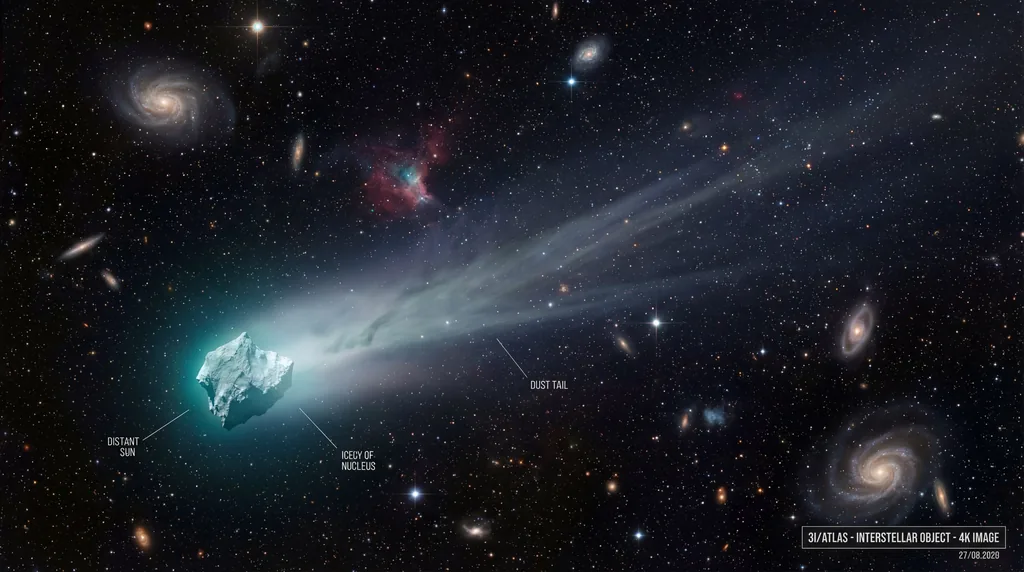

The Third Visitor: Astronomers Reveal the First Detailed Profile of Interstellar Comet 3I/ATLAS
3I/ATLAS differs from regular comets because it originates from outside our solar system, confirmed by its hyperbolic trajectory with an eccentricity of approximately 6.1 and a high velocity at infinity of about 57 km/s. Unlike the icy bodies of the Kuiper Belt or Oort Cloud, this interstellar object is unbound by the Sun's gravity and was meticulously tracked using the Black Hole Target and Observation Manager (BHTOM) to analyze its unique chemical and physical evolution.
The discovery of 3I/ATLAS marks a pivotal moment in time-domain astronomy, offering a rare opportunity to study a traveler from a distant star system before it reached its closest approach to the Sun. Researchers Krzysztof Ulaczyk, M. Hundertmark, and V. Bozza coordinated a massive international effort to characterize this object’s pre-perihelion behavior. By capturing the comet’s activity early, the team aimed to understand the fundamental differences between our local cometary population and those formed in exotic environments across the galaxy.
When did 3I/ATLAS pass closest to Earth and how did the Black Hole network track it?
3I/ATLAS was discovered on July 1, 2025, at a distance of 4.5 AU from the Sun, and while its rapid velocity of 57-61 km/s carried it through the inner solar system in late 2025, it was most intensively monitored between July and September. Using the Black Hole Target and Observation Manager (BHTOM), astronomers secured a 70-day window of high-cadence data to map its trajectory and activity evolution as it moved from 3.18 AU to 2.19 AU from the Sun.
The BHTOM platform served as the central nervous system for this observation campaign, synchronizing 16 different telescopes across the globe. This network allowed for non-sidereal tracking, a complex technique required to maintain focus on fast-moving targets that do not follow the standard motion of stars. By processing 1,554 individual images through an automated pipeline, the researchers were able to maintain a nearly continuous watch on the comet’s brightness and dust production, ensuring that no transient outbursts or structural changes went unnoticed.
How many interstellar objects have been discovered using Black Hole management tools?
Three interstellar objects have been officially discovered to date: 1I/ʻOumuamua in 2017, 2I/Borisov in 2019, and 3I/ATLAS in 2025. The study of 3I/ATLAS leveraged the Black Hole Target and Observation Manager to achieve a level of photometric detail previously unavailable for such short-lived discovery windows, providing a comprehensive profile of its rotation and dust mass-loss rates.
The time-domain photometry conducted by the team revealed that 3I/ATLAS followed a remarkably steady evolutionary path during the 70-day monitoring period. The comet exhibited a steady increase of approximately 3 magnitudes in brightness as it approached the Sun, with no evidence of the anomalous outbursts that often plague solar system comets. This predictability allowed the researchers to calculate a precise rotation period of 15.98 +/- 0.08 hours, a critical metric for understanding the physical integrity and shape of the interstellar nucleus.
Quantifying Dust Activity and Mass Loss
Dust activity in 3I/ATLAS was quantified through Afp measurements, which serve as a proxy for the amount of reflective material in the comet's coma. The researchers observed the relative dust production increasing from A(0)fp ~600 cm to 1100 cm as the object moved closer to the Sun. This steady rise indicates a well-developed and healthy dust coma, typical of a primary comet entering the active phase of its life cycle.
The dust mass-loss rate also saw a significant uptick during the observation window, with the upper limit rising from 217 kg/s to 328 kg/s. To analyze this further, the team calculated an activity index of n = -1.24 +/- 0.02. This specific value suggests that the sublimation of volatile ices was driving a consistent release of dust particles, creating a stable envelope of material around the interstellar nucleus that reflects the chemistry of its parent star system.
Color Evolution and Comparative Astronomy
Color evolution analysis showed that 3I/ATLAS remained statistically stable in its appearance, though it displayed a slight, non-significant tendency to become bluer as it moved from 3.5 to 2.2 AU. This is a departure from 2I/Borisov, which showed more pronounced color shifts. The consistency of 3I/ATLAS suggests a homogeneous surface composition, lacking the patches of varied ices that can cause erratic color changes in other interstellar travelers.
- 1I/ʻOumuamua: Characterized as rocky and elongated, showing no visible coma or dust activity.
- 2I/Borisov: Highly active and distinctly cometary, with a chemical composition rich in carbon monoxide.
- 3I/ATLAS: Exhibits a stable, predictable dust coma and a rotation period indicative of a solid, cohesive body.
Implications for Future Interstellar Research
The success of the BHTOM pipeline in processing massive datasets for 3I/ATLAS sets a new standard for how astronomers will handle future interstellar visitors. By automating the calibration and measurement of 1,554 images, the team demonstrated that ground-based networks can provide space-telescope quality data through coordinated efforts. This infrastructure is essential for the next decade of discovery, where high-cadence monitoring will be the only way to catch these visitors before they exit our solar system forever.
Looking forward, the astronomical community is preparing for the Vera C. Rubin Observatory, which is expected to discover dozens of interstellar objects in the coming years. The detailed profile of 3I/ATLAS provided by Ulaczyk, Hundertmark, and Bozza serves as a vital baseline. By understanding the "standard" behavior of an interstellar comet, scientists will be better equipped to identify truly anomalous objects that could challenge our current understanding of how planetary systems form and evolve beyond our own.





Comments
No comments yet. Be the first!