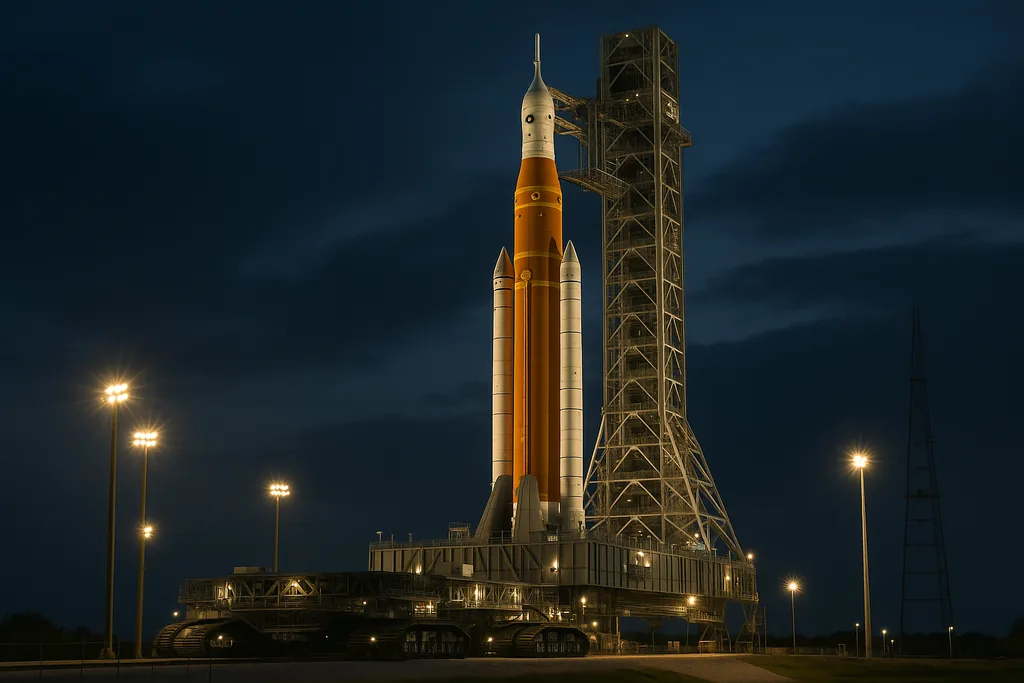
Rollout complete, clock ticking toward a February launch window
On Jan. 17, 2026, NASA's 322‑foot Space Launch System and its Orion spacecraft completed a slow, 12‑hour crawl from the Vehicle Assembly Building to Launch Pad 39B at Kennedy Space Center, arriving just after sunset. The iconic crawler‑transporter moved the fully stacked vehicle — a system weighing roughly 11 million pounds when assembled — at walking speed so teams could begin the final, tightly choreographed sequence of tests and checks that stand between the rocket and a crewed lunar flight. If everything goes to plan during prelaunch testing, NASA is targeting a nighttime launch no earlier than Feb. 6, 2026, with backup windows available in the following days.
Launch‑pad operations and the weeks ahead
Site teams have moved quickly from rollout to integration: technicians are connecting ground support equipment, finishing power and data runs, and testing radio‑frequency links between the vehicle and the Eastern Range. Over the coming days pad crews will service booster systems with hydrazine for thruster functions and complete final outfitting of the Orion crew module — stowing tablets for the crew, medical kits and a suite of science payloads. One payload drawing attention is an experiment nicknamed Avatar that uses organ‑on‑a‑chip technology to study how human bone‑marrow cells respond to the combined stresses of microgravity and deep‑space radiation. Data from that experiment will return with the crew and help shape human health planning for longer missions.
These activities lead up to the mission's single most important rehearsal: a wet dress rehearsal (WDR) currently scheduled for Feb. 2, 2026. During the WDR teams will load more than 700,000 gallons of supercold, cryogenic propellant into the vehicle, run through a near‑complete countdown and then safely drain the propellant. The test stops short of ignition — in principle at about T‑29 seconds — but it exercises the hardware and software that must work flawlessly on launch day.
What a wet dress rehearsal actually does
A wet dress rehearsal is not merely a systems checklist; it replicates the physical stresses and logistical choreography of launch day. Cryogenic propellants change temperature and pressure in predictable but exacting ways; fueling operations require bleed and vent sequencing, leak checks, and coordination with pad environmental control and safety teams. The flight‑control consoles, the launch director's procedures and the communications paths to the Eastern Range are all exercised under real loading conditions. Any anomaly uncovered during the WDR — from a persistently leaking valve to unexpected instrument readings in the cryo system — can force engineers to pause and evaluate whether a rollback to the Vehicle Assembly Building is needed for repair. That rollback would itself take many hours and disrupt the launch calendar.
Crew, vehicle and the mission profile
Artemis II will be the first crewed flight of the SLS and Orion combination. The four‑person crew consists of Commander Reid Wiseman, Pilot Victor Glover, Mission Specialist Christina Koch and Canadian Space Agency astronaut Jeremy Hansen. The aim is not a lunar landing but a high‑value flight test: the mission will send the crew on roughly a 10‑day loop around the Moon and back, probing operational systems under real human‑in‑the‑loop conditions. Flight planners expect Orion to travel several thousand miles beyond the far side of the Moon — roughly 4,700 miles past the lunar surface on the outbound leg in some mission profiles — taking humans farther from Earth than any mission since Apollo and validating deep‑space navigation, life support, and high‑speed Earth reentry systems.
At liftoff the SLS is designed to produce about 8.8 million pounds of thrust, accelerating the stack toward near‑Earth escape velocity and the lunar trajectory. The mission will test not only performance at liftoff but also the separation events, the service module's in‑space operations, guidance through lunar flyby, and the blunt‑body atmospheric return the Orion capsule makes at peak reentry speeds approaching 25,000 mph.
Operational constraints and decision points
Even with the vehicle on the pad there remain several decision moments that will determine whether Artemis II flies in early February or slips to a later window. Weather at the Cape is always a factor for a nighttime launch: high surface winds, lightning or thick cloud layers can trigger automatic scrubs. Equally important are data from the WDR. NASA Administrator Jared Isaacman has been clear that the agency will not confirm a firm launch date until after the WDR and subsequent reviews. If the rehearsal exposes issues that cannot be cleared quickly, teams may opt for a rollback and repair period.
Following a successful WDR, NASA will convene a flight readiness review to evaluate hardware, ground systems and range support before setting a specific launch day. John Honeycutt, chair of the mission management team, and Launch Director Charlie Blackwell‑Thompson are responsible for sorting through the technical inputs and making a go/no‑go recommendation. Because the Moon and Earth move continuously, acceptable launch dates are constrained by complex orbital mechanics; mission planners must select days that allow the stack to enter the correct translunar trajectory given Earth's rotation and the Moon's orbital phase.
Local impact and public viewing
The rollout and pad operations have a visible footprint on the Space Coast. Kennedy Space Center is offering a limited number of tours for visitors who want a closer look, while coastal vantage points across Florida will permit views of any eventual nighttime launch from many miles away. Park managers have already adjusted access: Cape Canaveral National Seashore announced temporary closures and restricted hours for the Playa Linda district, with full closure dates expected around the launch window to protect public safety during liftoff and debris‑hazard periods. Local authorities and national‑park officials will provide final advisories as launch day approaches.
What this flight will prove
Artemis II is a critical systems demonstration. Unlike Artemis I, which flew uncrewed, this mission puts astronauts aboard to exercise life‑support, avionics, navigation and crew procedures in deep space. Mission Specialist Christina Koch framed that work as science and preparation: experiments flown on Orion will produce data that help planners understand radiation exposure, physiological responses and the performance envelope of hardware that must support longer stays on and around the Moon. Successful completion of Artemis II would pave the way for Artemis III, the mission that aims to return humans to the lunar surface, and to the broader goal of building a sustained presence on the Moon as a stepping stone toward Mars.
For now the hardware stands on Pad 39B under bright lights and a close watch. Teams are preparing for propellant servicing and the WDR on Feb. 2 and will only greenlight astronaut ingress and a final launch date after reviewing the rehearsal data and completing the flight readiness review. If all checks line up, the crewed Apollo‑era benchmark finally has a modern successor: a night launch that would carry humans back out into deep space for the first time in more than half a century.
Sources
- NASA (Artemis II mission and rollout imagery)
- Kennedy Space Center (launch operations and Vehicle Assembly Building)
- Canadian Space Agency (crew assignment and international partnership)
- U.S. Space Force Eastern Range (range communications and launch‑window constraints)




Comments
No comments yet. Be the first!