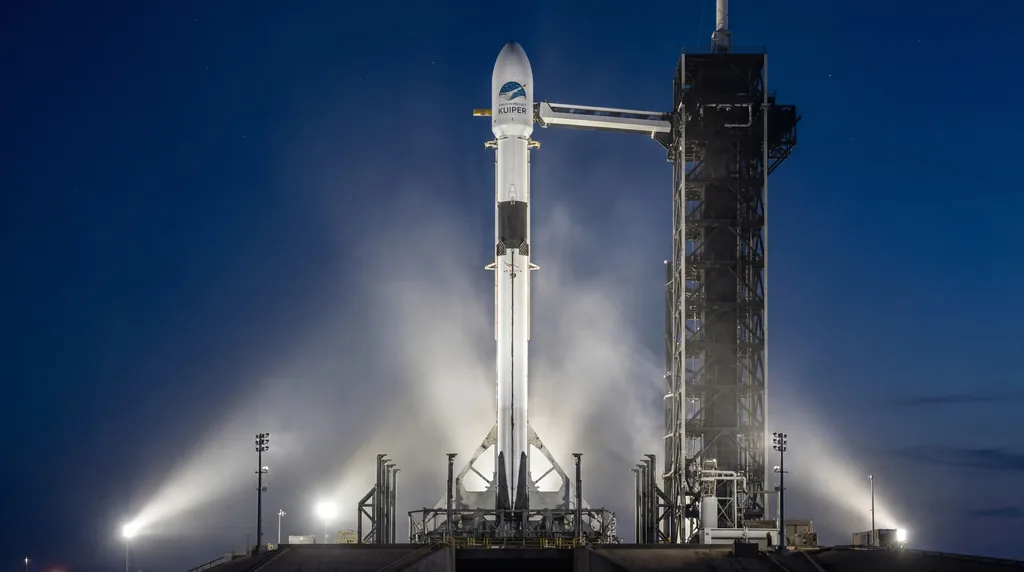

Amazon Project Kuiper has officially purchased 10 additional Falcon 9 launches from SpaceX to bolster its satellite broadband constellation. This procurement, disclosed in a Jan. 30, 2026, filing with the Federal Communications Commission (FCC), highlights Amazon's urgent need to meet regulatory milestones for its 3,232-satellite network. By securing these additional flights, Amazon aims to mitigate a near-term shortage in launch capacity and accelerate its orbital deployment schedule.
The decision to expand its partnership with SpaceX marks a significant strategic pivot for Amazon, which originally bypassed the Elon Musk-led company in 2022. According to SpaceNews reporter Jeff Foust, the new agreement brings Amazon's total commitment to 13 Falcon 9 missions. As of late January 2026, Amazon had only deployed 180 spacecraft, leaving a substantial gap to fill before its mid-2026 regulatory deadline.
How many Falcon 9 launches does Amazon have?
Amazon has secured a total of 13 Falcon 9 launches from SpaceX for its Project Kuiper constellation. This includes an initial contract for three launches announced in 2023—which were completed in late 2025—and the newly disclosed agreement for 10 additional missions. These flights are critical for maintaining a steady launch cadence as Amazon scales its satellite manufacturing to 30 units per week.
The reliance on the Falcon 9 booster reflects the high reliability and availability of the SpaceX launch vehicle in a constrained market. While Amazon founder Jeff Bezos initially focused on a multi-provider strategy involving Blue Origin, United Launch Alliance (ULA), and Arianespace, development delays for those heavy-lift rockets necessitated a secondary deal with SpaceX. Amazon stated in its FCC filing that it has "continued to secure near-term launch capacity wherever available" to ensure the fastest path to full constellation deployment.
Beyond the SpaceX agreement, Amazon has modified its existing contracts to ensure future capacity. The company recently converted options for Blue Origin New Glenn launches into 24 firm orders, double the initial 12-launch commitment. Despite these moves, the company requested an extension or waiver of the FCC’s July 30, 2026, milestone, citing "unexpected slips and scrubs" of scheduled dates that hindered its progress throughout 2025.
Is Project Kuiper faster than Starlink?
Project Kuiper is currently not faster than Starlink in real-world performance, though it has demonstrated peak lab speeds of up to 1.28 Gbps. While Starlink offers proven latencies of 20-40 ms and download speeds between 100-250 Mbps for millions of users, Amazon's network remains in its early deployment phase with a higher operational altitude of 590-630 km compared to Starlink's 550 km.
The architectural differences between the two systems are notable for their impact on speed and reliability. Key technical aspects include:
- Satellite Count: Starlink has over 6,000 active satellites, while Amazon Project Kuiper has launched approximately 180 to date.
- Laser Links: Starlink utilizes inter-satellite laser links for rapid data transfer; Amazon is still scaling its production of similar technology.
- Terminal Performance: Amazon’s standard customer terminals are designed for 400 Mbps, though real-world congestion performance is yet to be tested at scale.
The competition between the two Low Earth Orbit (LEO) giants is intensifying as Amazon Project Kuiper focuses on industrial and residential segments. While SpaceX holds the first-mover advantage, Amazon claims its infrastructure will provide superior integration with Amazon Web Services (AWS), potentially offering an edge in enterprise cloud connectivity once the full constellation is operational by 2029.
When will Amazon's satellite internet be available?
Amazon's Project Kuiper satellite internet is scheduled to begin commercial beta testing in early 2026, with a target launch date no later than March. Initial service availability is expected in the United States, Canada, the United Kingdom, Germany, and France. Full global availability is projected for late 2028 or 2029, depending on the success of upcoming heavy-lift missions.
The timeline for availability is heavily dependent on upcoming launch milestones. A critical mission for Arianespace’s Ariane 64 configuration is scheduled for Feb. 12, 2026, which will carry 32 satellites. Amazon expects to have approximately 700 satellites in orbit by July 2026, a volume the company believes will be sufficient to support consistent early-access commercial services in targeted high-latitude regions.
Looking ahead, Amazon Project Kuiper must navigate a complex launch manifest to meet its 2029 goal of 3,232 satellites. The company told the FCC it expects to have the entire system in orbit well before the final deadline, bolstered by a "noticeable shift in momentum" for its contracted vehicles, including ULA’s Vulcan and Blue Origin’s New Glenn. As manufacturing reaches its peak capacity, the success of these next 10 Falcon 9 launches will be pivotal in determining whether Amazon can truly challenge SpaceX's dominance in the global broadband market.




Comments
No comments yet. Be the first!