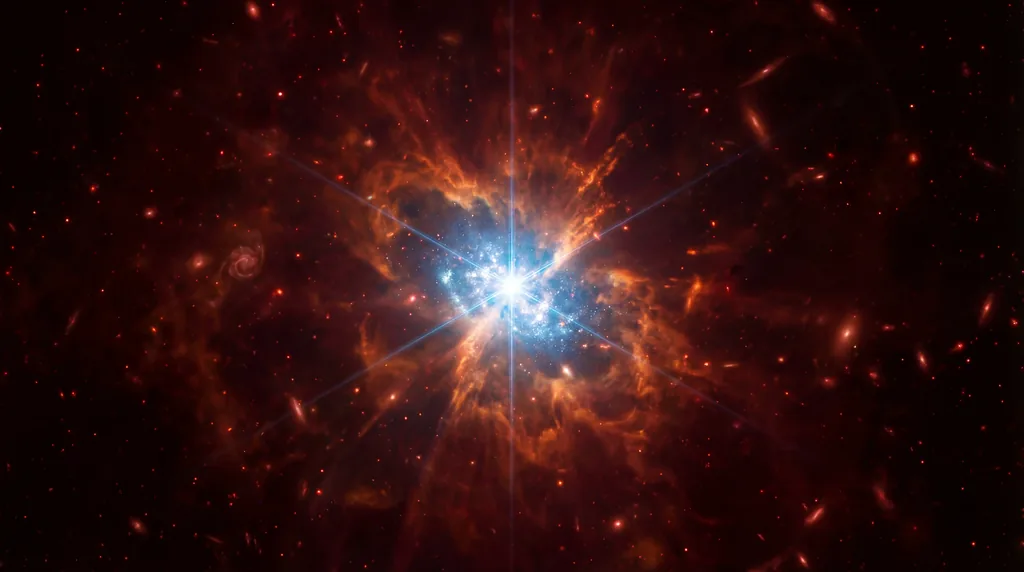

Astronomers using the James Webb Space Telescope have discovered an extraordinary galaxy from just 450 million years after the Big Bang that appears to be structurally "naked." Known as U37126, this rare starburst is leaking nearly 100% of its ionizing radiation directly into the cosmic void. This discovery provides a rare glimpse into the mechanisms that once cleared the primeval fog of the early universe, effectively ending the cosmic dark ages.
What is an ISM-naked galaxy?
An ISM-naked galaxy is a stellar system that has been stripped of its interstellar medium (ISM), the reservoir of gas and dust that typically surrounds stars and traps ionizing radiation. In the case of U37126, researchers found that the galaxy’s intense internal activity likely expelled its gas, allowing nearly all its light to escape into intergalactic space. This state represents a extreme, short-lived phase of galactic evolution where the galaxy is essentially "bare."
The research team, led by Abdurro'uf and colleagues including M. Castellano and P. G. Pérez-González, identified U37126 as a unique case study in the PRISMS survey. By analyzing deep spectroscopic data, the team observed that the galaxy lacks the standard spectral signatures of nebular gas. Typically, young stars are shrouded in hydrogen clouds that re-process ultraviolet light into specific emission lines; however, U37126 shows an exceptionally blue UV continuum slope (beta ~ -2.9), suggesting that there is no gas left to interfere with the light from its massive, young stars.
The physical properties of U37126 are as compact as they are extreme. With a radius of only 61 parsecs, it is remarkably small but highly productive, exhibiting a star-formation rate surface density of approximately 400 solar masses per year per kiloparsec squared. This high density suggests that a massive "starburst" event occurred, generating enough feedback energy to physically blow the remaining interstellar gas out of the galaxy's core. This "ISM-naked" state is what makes U37126 a critical missing link in our understanding of how the first galaxies interacted with their environment.
How does the James Webb Space Telescope see back 13 billion years?
The James Webb Space Telescope sees back 13 billion years by capturing infrared light that has been stretched, or "redshifted," as the universe expands. For the galaxy U37126, which exists at a redshift of z=10.255, its ultraviolet and visible light has been shifted into the near- and mid-infrared spectrum. Webb’s massive primary mirror and cryogenically cooled instruments allow it to detect these faint, ancient photons with unprecedented sensitivity.
To confirm the nature of U37126, the researchers utilized 11 hours of deep spectroscopy from the Mid-Infrared Instrument (MIRI) and the Near-Infrared Spectrograph (NIRSpec). Because U37126 is gravitationally lensed by a foreground cluster, its light is magnified by a factor of approximately 2.2. This natural cosmic magnifying glass, combined with the James Webb Space Telescope’s sensitivity, allowed the team to see the galaxy’s rest-frame optical emission, which is usually invisible to other observatories at such extreme distances.
The methodology involved looking for "Balmer break" features and nebular recombination lines like H-alpha and [OIII]. In a typical galaxy, these lines are bright indicators of star formation occurring within gas clouds. In U37126, however, these lines were remarkably absent. The 3-sigma upper limits for the equivalent widths of H-beta and H-alpha were exceptionally low, confirming that the stellar population is essentially "naked" and devoid of the surrounding gas clouds that would normally capture and re-emit this energy.
What is the Lyman continuum escape fraction?
The Lyman continuum escape fraction (fesc) measures the percentage of high-energy ionizing photons that escape a galaxy rather than being absorbed by internal gas. In U37126, the escape fraction is calculated to be nearly 100%, specifically 94% (+/- 6%). This high percentage means almost all the ionizing radiation produced by its stars is pumped directly into the surrounding intergalactic medium, driving the process of Cosmic Reionization.
Understanding the Lyman continuum (LyC) escape is vital because it explains how the early universe transitioned from a neutral, opaque state to the transparent, ionized state we observe today. During the Epoch of Reionization, high-energy light from the first stars stripped electrons from hydrogen atoms throughout the cosmos. Until now, astronomers struggled to find galaxies with high enough fesc values to account for this massive transformation. U37126 serves as the "smoking gun," demonstrating that a specific class of galaxies can be incredibly efficient at ionizing their surroundings.
The high escape fraction in U37126 is attributed to its ionizing photon production efficiency, measured at a log value of 25.75 Hz erg^-1. Combined with the lack of an interstellar medium to block these photons, U37126 acts as a cosmic lighthouse. The research suggests that if even a small fraction of galaxies (roughly 3% to 6%) in the early universe shared these "ISM-naked" properties, they could have provided 50% to 100% of the total ionizing budget required to complete the reionization of the entire universe.
Stellar Characteristics and Galactic Implications
The stellar population of U37126 is dominated by very young, massive stars that are significantly hotter and more luminous than those found in the modern universe. By fitting the Spectral Energy Distribution (SED), the team estimated a de-lensed stellar mass of approximately 63 million solar masses (10^7.8 Msun). These stars are packed into such a small volume that the stellar mass surface density reaches 3,000 solar masses per square parsec, a concentration rarely seen in later cosmic epochs.
These findings suggest that U37126 is undergoing a rapid evolutionary transition. The specific star-formation rate (sSFR) is calculated at 160 Gyr^-1, indicating that the galaxy is doubling its mass on an incredibly short timescale. This "bursty" mode of star formation is likely what triggers the extreme feedback necessary to clear the ISM. As these massive stars die in supernova explosions, they create powerful winds that push gas out of the galaxy, creating the "naked" appearance observed by the James Webb Space Telescope.
What’s Next for Early Universe Research?
The discovery of U37126 changes the landscape of extragalactic astronomy by proving that "naked" starbursts were active players in the early universe. Future surveys will focus on determining whether U37126 is a one-off anomaly or a representative of a broader population of "leaky" galaxies. If more systems like this are found, it would confirm that reionization was driven by a small number of extremely efficient ionizing sources rather than a large number of faint, "normal" galaxies.
Upcoming observations with the James Webb Space Telescope will target similar UV-bright candidates at redshifts beyond z=10. Astronomers hope to map the distribution of these "naked" galaxies to see if they reside in specific cosmic environments, such as overdense regions where galaxy interactions are more frequent. This research not only illuminates the life cycles of the first stars but also provides the definitive evidence needed to solve the long-standing mystery of how the universe became transparent.
- Key Measurements: Redshift z=10.255; LyC escape fraction >86% (3-sigma); Galaxy radius ~61pc.
- Instrumental Success: 11-hour deep integration using MIRI and NIRSpec confirmed the absence of expected gas signatures.
- Reionization Impact: Galaxies like U37126 could account for the entire ionizing budget of the early universe even if they represent only 5% of the total population.




Comments
No comments yet. Be the first!