
Galactic Outcast: DESI Discovery Traces High-Speed Star Back to the Milky Way’s Central Black Hole
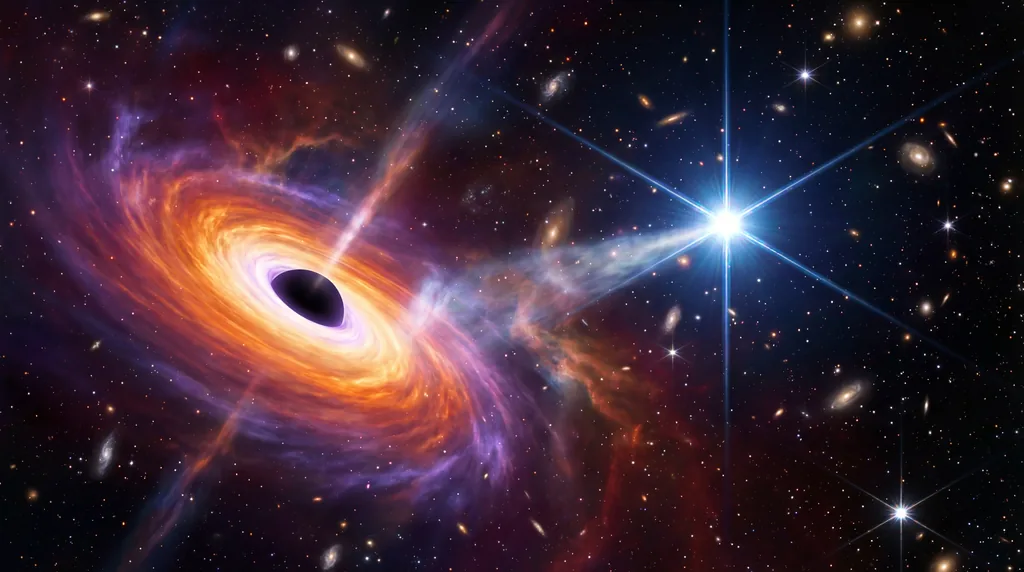
Deep within the heart of the Milky Way, a gravitational dance between a binary star system and the supermassive black hole Sagittarius A* (Sgr A*) ended in a violent expulsion. Millions of years later, astronomers have identified the survivor of this encounter: a stellar refugee named DESI-312. Using the latest data from the Dark Energy Spectroscopic Instrument (DESI), a team of researchers has confirmed that this star is fleeing the Galactic Center at a staggering velocity of nearly 700 kilometers per second. This discovery, detailed in a new study led by Manuel Cavieres and an international team of astrophysicists, provides a rare, unobstructed window into the chemical composition of the most inaccessible region of our galaxy.
The Discovery of DESI-312
The identification of DESI-312 represents a significant milestone in the field of "Galactic archaeology." Hypervelocity stars (HVSs) are exceptionally rare; despite the billions of stars in the Milky Way, only a few dozen candidates have ever been identified, and fewer still have been definitively linked to the Galactic Center. The discovery was made possible by the first data release (DR1) of the DESI survey, which provides high-quality spectroscopy for millions of celestial objects. By combining DESI’s spectroscopic data with the precision astrometry from the Gaia mission, researchers were able to map a full six-dimensional phase-space trajectory for the star, including its 3D position and 3D velocity.
The study, authored by Manuel Cavieres, Sergey E. Koposov, Elena Maria Rossi, and colleagues from Leiden University, the University of Edinburgh, and the University of Cambridge, highlights the precision required for such a find. "Using spectroscopy from DESI and astrometry from Gaia, we conducted a six-dimensional search for HVSs and identified a compelling candidate... whose bound trajectory can be confidently traced back to the Galactic Center," the researchers note. Unlike many other high-speed stars that move randomly through the halo, DESI-312’s path points like an arrow back to the immediate vicinity of Sgr A*, the four-million-solar-mass black hole at our galaxy’s core.
The Hills Mechanism: A Cosmic Slingshot
The mechanism behind such extreme speeds is known as the Hills mechanism, proposed by astronomer Jack Hills in 1988. The process occurs when a binary star system—two stars orbiting one another—wanders too close to a supermassive black hole. The immense tidal forces of the black hole can rip the binary apart. One star is captured into a tight orbit around the black hole, while its companion is slung outward at incredible speeds, often exceeding the escape velocity of the galaxy.
For DESI-312, the researchers calculated an ejection velocity of 698 (+35/−27) km/s. This speed is consistent with the predictions of the Hills mechanism, confirming that the star was likely "kicked" by Sgr A*. While some stars can reach high speeds through supernova explosions in binary systems or dynamical encounters in dense stellar clusters, these "runaway" stars rarely reach the velocities observed in DESI-312. The data suggests that only an encounter with a supermassive black hole could provide the kinetic energy necessary to propel a solar-mass star into the inner halo at such a pace.
Chemical Secrets of the Galactic Core
One of the most striking aspects of DESI-312 is its chemical signature. Spectroscopic analysis revealed that the star possesses "supersolar metallicity," with an iron-to-hydrogen ratio ([Fe/H]) of 0.27 ± 0.09. This means the star is significantly richer in heavy elements than our own Sun. This chemical makeup is a critical piece of evidence regarding its origin. Most stars found in the Galactic halo—the outer fringes where DESI-312 currently resides—are ancient and "metal-poor," having formed early in the universe's history.
A star with high metallicity like DESI-312 is an anomaly in the halo but perfectly at home in the Galactic Center. The core of the Milky Way is a region of intense star formation and chemical enrichment. By carrying this chemical fingerprint with it, DESI-312 acts as a "stellar messenger." Because the Galactic Center is heavily obscured by thick clouds of gas and dust, it is notoriously difficult for astronomers to measure the chemical abundances of stars located there. DESI-312, having escaped that dusty shroud, offers a rare opportunity to study the composition of the inner Galaxy from the much clearer vantage point of the halo.
Mapping the Escape Route
In their analysis, Cavieres and his team meticulously ruled out alternative birthplaces for the star. They considered whether DESI-312 could have been ejected from the Galactic disk or from a globular cluster. However, the star’s orbital energy and its specific chemical profile did not match these scenarios. Disk-ejected stars typically have lower velocities and different element ratios, while globular clusters are generally composed of much older, metal-poor populations.
The trajectory analysis shows that DESI-312 is currently in the "inner halo," meaning it is still gravitationally bound to the Milky Way, albeit on a very elongated orbit. This makes it a "bound" hypervelocity star. While it may not leave the galaxy entirely, its journey from the sub-parsec regions around Sgr A* to its current location thousands of light-years away allows scientists to probe the "Galactic potential"—the distribution of mass, including dark matter, throughout the Milky Way. The path a star takes is dictated by the gravity of everything it passes, making DESI-312 a high-speed probe of the galaxy's invisible architecture.
A New Class of Hypervelocity Star
Historically, most identified HVSs have been massive, hot, blue stars (A- and B-type stars). These stars are short-lived, which provides a "clock" for their travel time but makes detailed atmospheric analysis difficult. DESI-312 is different. It is a roughly one-solar-mass star currently on the main sequence or early subgiant branch. As a Sun-like star, its atmosphere is more stable and its spectral lines are easier to interpret, allowing for a much more detailed breakdown of its chemical elements.
This discovery highlights the growing power of the DESI survey. While the Gaia mission has revolutionized our understanding of stellar positions and movements, Gaia alone often lacks the spectroscopic depth to determine a star's chemistry or precise radial velocity for fainter objects. DESI fills this gap, observing millions of stars and providing the "third dimension" of motion and the "fourth dimension" of chemical history. As the DESI Collaboration continues to release data, astronomers expect to find more of these "Galactic outcasts," each one telling a different story of the violent history of our galaxy's core.
The Future of Galactic Archaeology
The discovery of DESI-312 is just the beginning of what researchers hope will be a golden age for HVS research. With the advent of multi-object spectroscopic surveys like DESI, WEAVE, and 4MOST, the census of high-velocity stars is expected to grow from a handful of anomalies to a statistically significant population. Each new discovery helps constrain the rate at which Sgr A* disrupts binary systems, which in turn informs our understanding of the density of stars and black holes in the Galactic Center.
Furthermore, studying the ejection rates of stars like DESI-312 provides crucial data for predicting other phenomena, such as Tidal Disruption Events (TDEs)—where a star is shredded by a black hole—and the emission of gravitational waves from "extreme mass ratio inspirals" (EMRIs). As Sergey E. Koposov and the team conclude, these stellar fugitives are more than just curiosities; they are essential tools for understanding the most extreme environments in our universe. For now, DESI-312 continues its lonely trek through the halo, a silent witness to a gravitational encounter that happened millions of years ago at the very heart of the Milky Way.
Research Context and Visibility
- Paper Title: Discovery of Galactic center ejected star in DESI DR1
- Lead Authors: Manuel Cavieres (Leiden), Sergey E. Koposov (Edinburgh/Cambridge), Elena Maria Rossi (Leiden)
- Data Sources: Dark Energy Spectroscopic Instrument (DESI) DR1, Gaia DR3
- Observation Date: The paper was finalized in early 2026, coinciding with periods of moderate solar activity (KP-index 5), which saw auroras visible across northern latitudes from Alaska to Scandinavia.




Comments
No comments yet. Be the first!