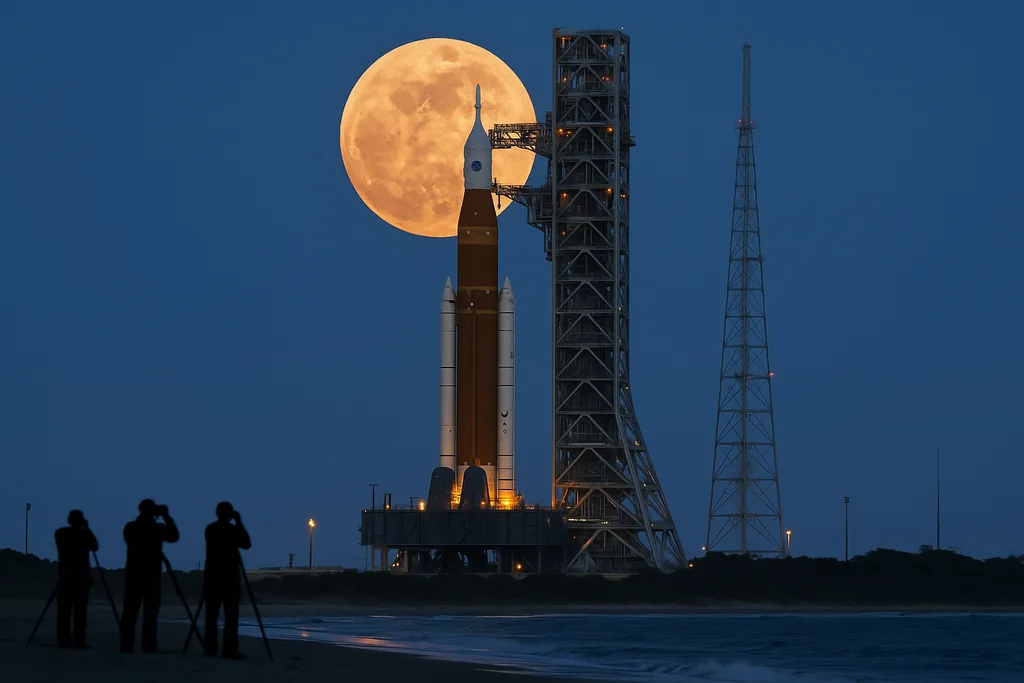
Full moon rises over the rocket: a moment of alignment
On the evening of 1 February 2026, the full Moon rose in a perfect, low-angled arc behind NASA's Artemis II Space Launch System at Launch Complex 39B, Kennedy Space Center. Photographers Chengcheng Xu and Tianyao Yang, stationed on a beach near Orlando roughly 18.55 km from the pad, timed and framed the image so that the Moon appears to sit immediately behind the towering rocket and service tower. The shot — a study in geometry and timing — links the mission's human ambition to the celestial body it will soon visit: the full moon rises over the launch vehicle that will carry four astronauts on a circumlunar flight.
Full moon rises over Artemis II: planning and technique
Capturing the Moon and a launch pad in a single, compositional frame is not simply luck; it is planning. Xu and Yang modelled the scene in advance using a planning app to account for the rocket and tower geometry, elevation of the Moon at the moment of rise, and the exact shooting location that would place the two elements in line. They positioned themselves at the calculated vantage, then used a Canon EOS R5 Mark II with a Canon RF 200–800mm lens. The published exposure details were ISO 500, f/9 and 1/40s — settings chosen to balance the Moon's bright, textured surface with the dimmer foreground silhouette of the rocket and gantry.
Those numbers speak to the particular photographic trade-offs at play. The Moon, though visually striking, is extremely bright compared with the night landscape; stopping down to f/9 reduces glare and helps keep the rocket sharply defined against the Moon's disk, while a relatively high ISO and moderate shutter speed maintain enough exposure for the darker foreground without overexposing lunar detail. A long telephoto lens compresses perspective and brings the Moon and rocket visually closer, making the Moon appear larger relative to the launch complex. The team made only minor adjustments in post-processing — exposure, white balance and contrast — and cropped the frame slightly for composition, preserving the authenticity of the moment.
Launch context: Artemis II's objectives and milestones
Artemis II is planned as the first crewed mission in NASA's Artemis programme that will travel around the Moon and back, a milestone not seen since the Apollo era. The mission's immediate objective is a crewed circumlunar flight to prove Orion and Space Launch System (SLS) performance with astronauts onboard, validate in-flight systems and procedures for deep-space operations, and rehearse communications and mission support required for future landings. NASA is using Artemis II as a stepping stone toward later missions that aim to return humans to the lunar surface and establish sustained operations around and on the Moon.
Behind the photograph, teams on the ground are busy: as of 2 February 2026, preparations were advancing toward a wet dress rehearsal and a formal countdown sequence to test fueling, ground procedures and coordination ahead of launch. Parallel work on mission support has included upgrades to flight-support infrastructure: in 2025 NASA opened a new Orion Mission Evaluation Room at the Johnson Space Center to handle Orion telemetry and mission operations for Artemis-class flights, a concrete step toward the operational tempo expected for crewed lunar missions.
How photographers capture a lunar-backlit rocket
Photographing a bright Moon rising behind a large structure requires synchronising several moving parts: an accurate prediction of lunar azimuth and altitude, a physical vantage point that matches the predicted sightline, and equipment that can render both subjects clearly. Beginners might try the same effect with a simpler landmark, but the principle is identical: use planning software to map the path of the Moon, measure distance to your foreground subject, and test compositions well before the moment you want to capture.
In practice, astrophotographers use a combination of tools: planetarium or photography planning apps to simulate alignment and timing, a sturdy tripod to steady long-telephoto exposures, and a lens selection that compresses the scene while maintaining sharpness. The exposure settings used by Xu and Yang (ISO 500, f/9, 1/40s) are a useful baseline for similar shots in evening light, but every site has its own light pollution, humidity and horizon profile — variables that will change both framing and exposure. Crucially, photographers time the shot for the first moments the Moon clears the horizon: the Moon looks largest then because of visual perspective and because photographers can sometimes use the bright lunar disk to silhouette foreground structures without resorting to extreme post-processing.
Where the photograph was taken and what it shows
The image was captured from a public beach near Orlando, Florida, at approximately 18:04 Eastern Standard Time on 1 February 2026. From that location — about 18.6 km from Launch Complex 39B — the photographers had a clear line of sight that placed the Moon, rocket and gantry in a single vertical plane. The photograph shows the SLS rocket in its final pre-launch posture on the pad, the service structure rising beside it, and the full 'Snow Moon' climbing into view behind the hardware. Because NASA had publicly signalled that Artemis II could launch in early February, the image took on added symbolism: one of the last full-Moon evenings visible before a planned crewed launch attempt.
Symbolism and public resonance
Images like this one do more than record an astronomical or engineering event; they shape public imagination. The composition draws a literal and figurative line between Earth and the Moon, and between the tools of exploration and the destination. For scientists and engineers the photograph is a snapshot of systems and processes being tested — for photographers and the general public it is a rare, beautiful alignment that captures the scale of the endeavour in a single frame.
That resonance is partly why teams working on Artemis have been deliberate about both procedure and public communication. Upgrades to mission control capacity at Johnson Space Center and the sequence of ground rehearsals and tests reflect the program's dual technical and public-facing goals: reduce risk for crewed flight while also maintaining momentum and visibility for a programme intended to re-establish human operations beyond low Earth orbit.
Practical notes for amateur photographers and viewers
- Timing: Identify the exact date and time of moonrise for your observing site and practise the predicted sightline in daylight or twilight.
- Location: Measure the distance to your foreground subject; you may need to move tens of kilometres to get the Moon to line up with a tall structure.
- Equipment: A long telephoto lens (200mm and up) and a sturdy tripod are essential; experiment with apertures between f/5.6 and f/11 and shutter speeds that capture lunar detail without introducing motion blur.
- Apps: Use planning apps that allow you to overlay landmarks and model the horizon, so you can choose exactly where to stand.
The photograph of the Snow Moon behind Artemis II is at once a technical accomplishment and an evocative image of a programme moving from rehearsal toward crewed flight. As Artemis II prepares for its wet dress rehearsal and the final checks that precede launch, that single frame captures a precise instant where sky and steel aligned — and tells a larger story about how careful planning, engineering, and public attention come together in human spaceflight.
Sources
- NASA (Artemis program)
- Johnson Space Center (Orion mission operations)
- Kennedy Space Center, Launch Complex 39B




Comments
No comments yet. Be the first!