
Cosmo-FOLD: New Generative AI Model Upscales the Cosmic Web with Unprecedented Efficiency
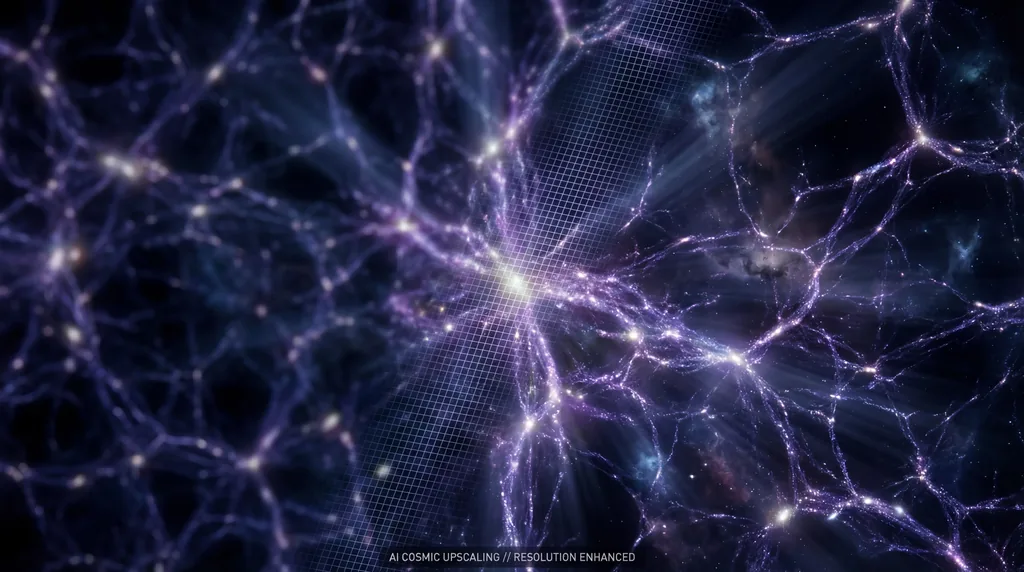
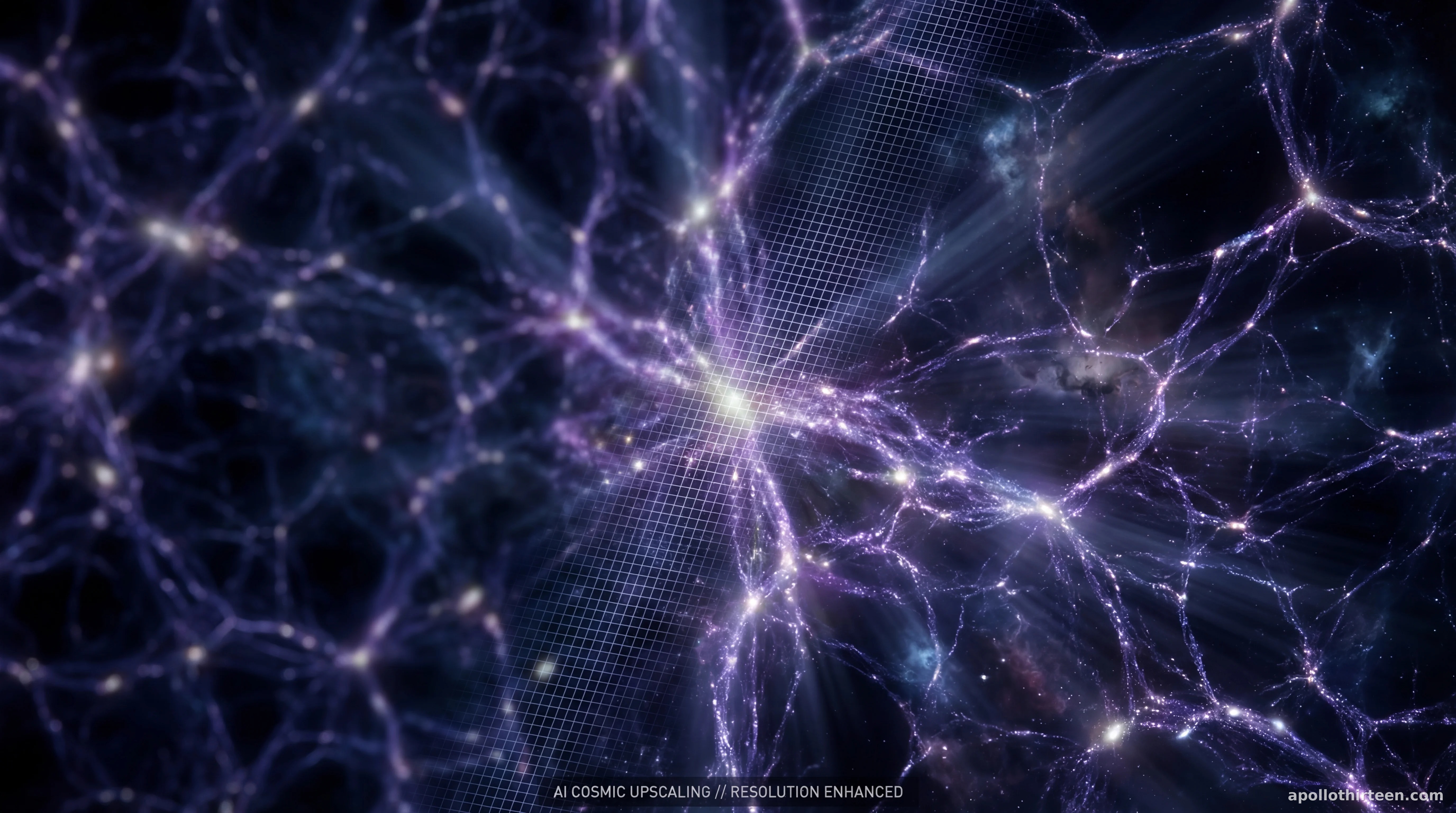
The cosmic web, a vast and intricate network of dark matter filaments and gas that defines the large-scale structure of our universe, has long presented a formidable challenge to computational astrophysics. To understand how visible matter—such as galaxies and hot intergalactic gas—relates to the invisible dark matter scaffold, researchers have historically relied on massive hydrodynamical simulations. However, these simulations require millions of CPU hours on the world’s most powerful supercomputers. A breakthrough study introducing "Cosmo-FOLD" (Cosmological Fields via Overlap Latent Diffusion) promises to disrupt this paradigm. By leveraging advanced generative artificial intelligence, a research team has demonstrated the ability to upscale high-resolution 3D maps of the universe with nearly 100 times the efficiency of traditional methods, bridging the gap between dark matter and observable baryonic probes on a single GPU.
The Computational Challenge of the Cosmos
For decades, cosmologists have faced a significant bottleneck: the "missing link" between dark matter and light. While dark matter dictates the gravitational evolution of the universe, it is the baryonic matter—the gas and stars—that we actually observe with telescopes. Simulating the complex physics of this gas, including cooling, heating, and feedback from supernovae and black holes, is computationally draining. Traditional hydrodynamical simulations like the IllustrisTNG project are gold standards in the field, yet they are limited by the sheer volume they can cover while maintaining high resolution. As the field moves into an era of "big data" with observatories like the Euclid satellite and the Vera C. Rubin Observatory, there is an urgent need for faster, more scalable methods to link dark matter density to gas temperature and density at the field level.
The difficulty lies primarily in the non-linear regime—the small scales where gravity has caused matter to clump together into complex, chaotic structures. Traditional simplified models often fail to capture the nuances of these interactions, while full-scale simulations are too slow to run for the thousands of different cosmological parameters required for modern statistical inference. This is where Cosmo-FOLD enters the fray, offering a probabilistic approach to generating these complex fields without the heavy lifting of traditional fluid dynamics solvers.
How Cosmo-FOLD Leverages Latent Diffusion
The architecture of Cosmo-FOLD, developed by researchers including Roberto Trotta, Satvik Mishra, and Matteo Viel, utilizes a sophisticated generative AI technique known as latent diffusion. Unlike standard diffusion models that operate directly on high-resolution pixel data, latent diffusion models perform the heavy computational work in a compressed "latent" space. This allows the model to capture the underlying statistical patterns of the cosmic web—such as the connectivity of filaments and the distribution of gas—more efficiently than ever before.
A key innovation of the Cosmo-FOLD framework is the "Overlap" component. When generating large-scale 3D volumes, traditional AI models often suffer from "seam" artifacts where individual cubes of the simulation meet. The researchers introduced an overlap latent diffusion technique that ensures continuity and coherence across arbitrarily large cosmological fields. By conditioning the generation on a provided dark matter input field, the model can "paint" the corresponding baryonic properties, such as gas temperature, onto the dark matter framework with remarkable consistency.
Upscaling: Doing More with 1% of the Data
One of the most striking findings of the research is the model’s ability to perform "upscaling." The team trained Cosmo-FOLD on only approximately 1% of the total volume of the TNG300-2 simulation, a high-fidelity hydrodynamical model. Despite this limited exposure, the AI successfully learned to generate expansive 3D fields that matched the complexity of the full simulation. This process allows researchers to take a low-resolution or small-scale map and expand it into a full-scale, high-resolution representation of the cosmic web.
The model’s performance in generating large-scale coherent dark matter filaments was particularly noteworthy. By training on a fraction of the data, Cosmo-FOLD proved it could generalize the physical laws governing matter distribution. The generated gas temperature fields were not merely "vague approximations" but detailed maps that reproduced the intricate thermal history of the intergalactic medium, essential for interpreting observations from modern microwave and X-ray telescopes.
Validation and Statistical Accuracy
To ensure that Cosmo-FOLD was producing scientifically valid data rather than just "pretty pictures," the researchers subjected the output to rigorous statistical testing. They focused on the power spectrum—a standard measure of how matter is distributed across different scales. The AI-generated fields were able to reproduce the power spectra of the original simulations to within 10% accuracy, even for wavenumbers as high as k <= 5 h Mpc^-1. This range is critical because it encompasses the non-linear scales where traditional analytical models typically break down.
Beyond simple one- and two-point statistics, the team evaluated the "bispectrum," a more complex metric that measures the non-Gaussian features of the cosmic web. By including positional encodings within the latent diffusion process, Cosmo-FOLD faithfully reproduced these higher-order statistics. This confirms that the model captures the actual physical morphology of the universe, such as the shape of cosmic voids and the density of galaxy clusters, rather than just the average distribution of matter.
Generalization Across Simulations
A major hurdle for AI in science is "overfitting," where a model works only on the specific dataset it was trained on. However, the researchers demonstrated Cosmo-FOLD’s remarkable generalization capabilities. In a standout experiment, the model was trained on a CAMELS volume—a suite of simulations with a volume of only 25 (Mpc h^-1)^3. It was then tasked with upscaling this to a full TNG300-2 volume of 205 (Mpc h^-1)^3, a massive jump in scale.
Surprisingly, the model performed this task with no additional fine-tuning. This ability to transfer learned physics from one simulation suite to another suggests that Cosmo-FOLD has captured fundamental cosmological principles. This "plug-and-play" capability is essential for researchers who want to apply AI models to different theoretical models of the universe without spending weeks retraining the system on new data.
Efficiency and the Path to the "Digital Twin"
The practical implications of this research are significant for the broader scientific community. While traditional hydrodynamical simulations require thousands of processors running in parallel, Cosmo-FOLD produces its results on a single GPU. This democratization of high-end cosmological modeling allows smaller research groups to conduct complex field-level studies that were previously the exclusive domain of national supercomputing centers. The reduction in computational cost is estimated to be several orders of magnitude, making it feasible to run the thousands of iterations needed for simulation-based inference.
Roberto Trotta and his colleagues envision this as a step toward creating a "Digital Twin" of the universe. In this vision, AI models like Cosmo-FOLD would act as real-time emulators, allowing astronomers to tweak cosmological parameters—such as the amount of dark energy or the mass of neutrinos—and instantly see how those changes would manifest in observable gas and galaxy distributions. This would provide a powerful tool for interpreting the massive datasets expected from the next generation of sky surveys.
Future Directions: Field-Level Inference
As the researchers look to the future, the focus is on integrating Cosmo-FOLD into full field-level simulation-based inference (SBI) pipelines. SBI is a statistical technique that allows scientists to work backward from observed data to find the most likely cosmological model. By having a fast, accurate generative model like Cosmo-FOLD at the heart of the pipeline, cosmologists can compare their telescope observations to millions of theoretical "universes" in the time it used to take to simulate just one.
In conclusion, Cosmo-FOLD represents a significant milestone in the intersection of generative AI and astrophysics. By successfully upscaling the cosmic web with high fidelity and extreme efficiency, the model provides a new lens through which we can view the evolution of the universe. As we stand on the cusp of a data revolution in astronomy, tools like Cosmo-FOLD will be indispensable in turning raw observations of the night sky into a deeper understanding of the dark and visible matter that shapes our reality.




Comments
No comments yet. Be the first!