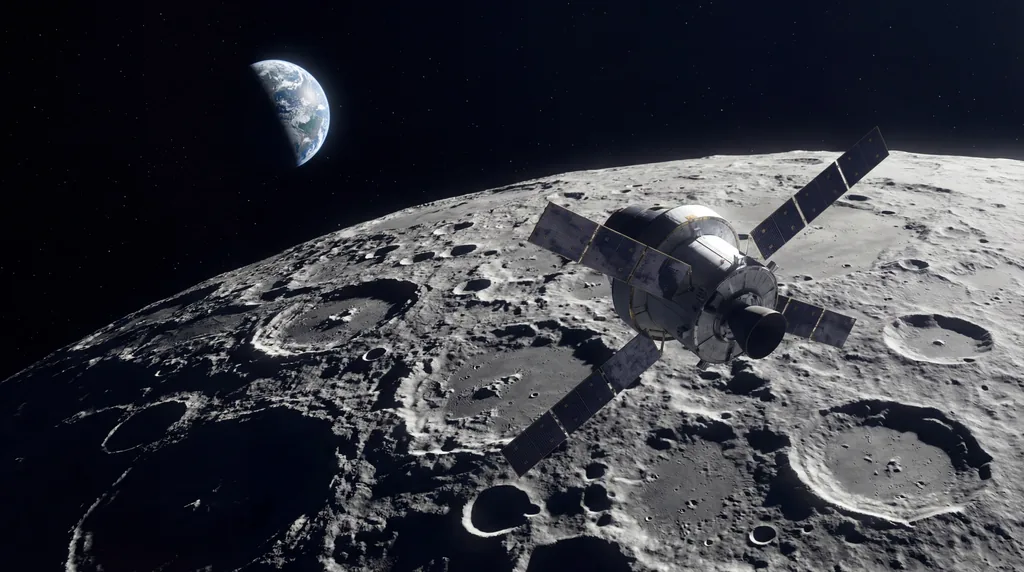

The High-Stakes Orbit: How Artemis II Redefines Lunar Leadership Without a Landing
As the final countdown sequences commence at Cape Canaveral, the world’s attention is fixed on a 322-foot pillar of orange and white: the Space Launch System (SLS). Scheduled for a revised launch window on February 8, 2026, the Artemis II mission represents far more than a high-altitude test flight. While the mission’s profile does not include a lunar landing, its success would signal a decisive shift in the "Second Moon Race." According to science analyst Amcen West, writing for Space Daily, the mission represents a "geopolitical hinge moment" where the victory is measured not in bootprints, but in the narrative of technological and operational dominance. By sending four astronauts—Reid Wiseman, Victor Glover, Christina Koch, and Jeremy Hansen—around the lunar far side, NASA aims to reclaim the deep-space narrative for a new generation.
The primary objective of this mission is to validate the Orion spacecraft’s life support systems and the SLS’s performance in a crewed environment. However, the context of the research and development surrounding this flight suggests a broader strategic goal. Since the last human departure from the lunar vicinity in 1972, the capabilities required for deep-space transit have largely been theoretical or limited to robotic probes. Artemis II serves as the first empirical test of 21st-century human-rated avionics, shielding, and propulsion in the harsh cislunar environment. In an era where China is aggressively pursuing its own 2030 landing goal, the visibility of an American-led crew orbiting the Moon in 2026 creates a perception of leadership that technical nuances cannot easily displace.
The Physics of the Artemis II Free-Return Trajectory
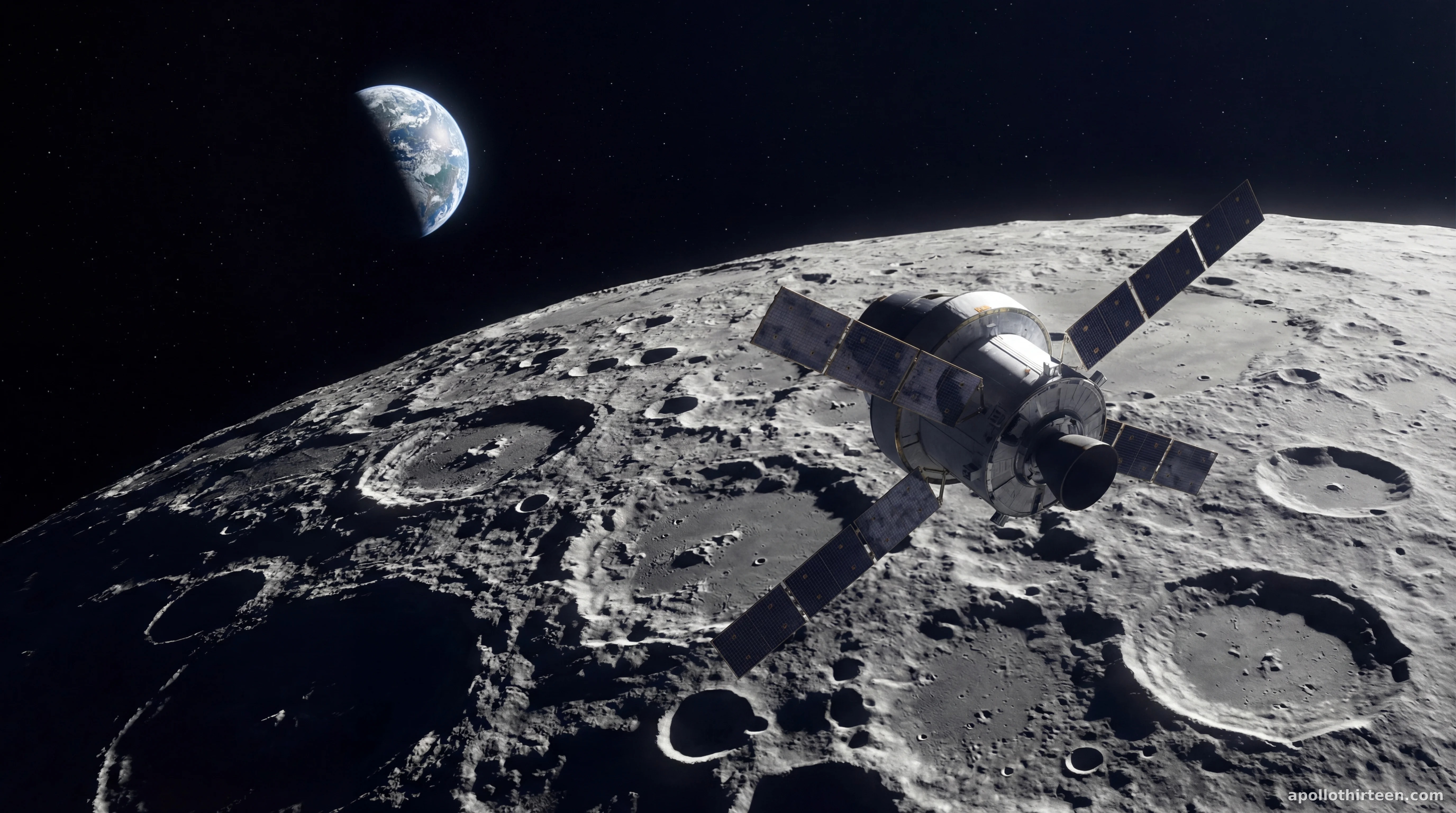
The mechanical elegance of the mission relies on a hybrid free-return trajectory. This specific flight path is a masterclass in orbital mechanics, designed to maximize safety while ensuring the crew reaches the lunar vicinity. After an initial 24-hour checkout period in a high-Earth orbit to ensure all systems are functioning, the Orion spacecraft will execute a trans-lunar injection (TLI) burn. This maneuver propels the craft toward the Moon, where it will utilize Earth's gravity to "whip" around the lunar far side at an altitude of approximately 6,513 kilometers (4,047 miles). The beauty of the free-return trajectory of Artemis II is that it uses the Moon’s own gravity to naturally sling the spacecraft back toward Earth. This ensures that even in the event of a total propulsion failure after the TLI burn, the laws of physics will guide the crew home without further engine intervention.
This approach offers a significant safety margin compared to active lunar insertion, which requires a complex burn to enter the Moon's orbit and another to leave it. For a first crewed mission, the free-return path minimizes the "points of failure" while allowing the crew to test deep-space communication and navigation. The Orion’s Service Module, provided by the European Space Agency, will handle the necessary trajectory correction maneuvers during the 10-day journey. This mission profile serves as a critical methodology for validating the transition from Low Earth Orbit (LEO) to cislunar space, testing how 21st-century life support systems handle the transition from the Earth’s protective magnetic field into the true deep-space environment.
Breaking the Apollo 13 Record in Deep Space
One of the most profound psychological and technical milestones of the mission is its intended distance from Earth. Artemis II is set to take its crew farther from our home planet than any human mission in history. While the Apollo 13 crew currently holds the record at 400,171 kilometers due to their specific emergency abort trajectory, the planned flight path for Orion will push into the lunar far side’s outer reaches. By reaching these "farthest points," NASA is not just breaking a record; it is demonstrating the capability to operate far beyond the immediate reach of Earth-based rescue, a prerequisite for future Mars exploration.
Power and Precision: SLS vs. Saturn V
In terms of raw lift capacity, the debate over whether Apollo was more powerful than Artemis remains a frequent point of discussion among aerospace historians. The Saturn V rocket of the 1960s remains more powerful in terms of raw payload capacity to the Moon, capable of delivering roughly 43.5 tons compared to the current SLS Block 1’s 27 tons. However, the SLS is designed for a different kind of mission: the sustainable, precision-targeted exploration of the lunar South Pole. While the Saturn V was a marvel of mid-century engineering, the SLS utilizes more advanced solid rocket boosters and modern RS-25 engines that offer higher ISP (specific impulse) and more precise trajectory control. This precision is what allows Artemis II to execute its complex free-return path with a smaller margin of error than its predecessors.
The Perception War: Soft Power and Global Prestige
The geopolitical implications of Artemis II are as significant as the engineering feats. As Amcen West notes, space accomplishments are rarely judged purely on technical merit; they are judged by visibility and timing. A successful flyby in early 2026 would re-establish a visible American presence at the Moon years before China is expected to launch its first crewed mission. This "perception wedge" is a vital tool of soft power. For a global audience, the sight of high-definition broadcasts from the lunar far side—delivered by a crew including the first woman, the first person of color, and the first international partner (Canada) to leave Earth orbit—creates a powerful narrative of inclusive, democratic space leadership.
Historical context supports this theory. In 1968, the Apollo 8 mission did not land on the Moon, yet its "Earthrise" photograph and Christmas Eve broadcast are arguably more iconic than many of the later landing missions. Apollo 8 shifted the global perception of the Cold War Space Race, signaling that the United States had seized the initiative. Artemis II occupies a similar strategic position. It serves as a deterrent to rivals by demonstrating that the United States possesses the operational infrastructure—launch, communication, and recovery—to sustain a deep-space presence, even if the "bootprints" are delayed until the subsequent Artemis III mission.
China’s Methodical Approach vs. American Visibility
China’s space leadership continues to frame its goals as part of a methodical, national development plan, targeting a 2030 landing. Their architecture, which utilizes two separate Long March 10 launches to rendezvous in lunar orbit, is sound engineering but lacks the singular "spectacle" of a super-heavy lift launch like the SLS. If Artemis II succeeds, China faces the risk of arriving "second" to a destination they have invested decades in reaching. This creates a vulnerability in their narrative of national rejuvenation. While Beijing officially denies being in a race, the symbolic weight of an American-led crew orbiting the Moon in 2026 will be felt across the international community, potentially influencing which nations align with the Artemis Accords versus China's International Lunar Research Station (ILRS).
Managing the Risks of Deep Space Exploration
Despite the strategic benefits, the mission carries inherent risks that have not been faced by humans in over fifty years. Chief among these is radiation exposure. Artemis II will be the first crewed mission to pass through the Van Allen radiation belts using modern shielding. Beyond the belts, the crew is vulnerable to solar particle events and galactic cosmic rays. The Orion spacecraft is equipped with a specialized "storm shelter" in the lower bay, where the crew can retreat during a solar flare, using the ship’s water supplies and equipment as additional mass to block high-energy particles. Testing these countermeasures is essential for the long-duration missions planned for the lunar Gateway and eventually Mars.
Furthermore, the 10-day duration is a rigorous test for the Orion’s Environmental Control and Life Support System (ECLSS). Unlike the International Space Station, where resupply is possible within hours, a failure in deep space requires the crew to rely entirely on onboard contingencies. The mission will stress-test the carbon dioxide removal systems, oxygen generation, and water management in a high-radiation, microgravity environment. According to NASA’s mission profile, the crew will also conduct proximity operations shortly after reaching orbit, using the discarded Integrated Cryogenic Propulsion Stage (ICPS) as a target to test the spacecraft’s handling and manual piloting capabilities. These "Detailed Test Objectives" are the bedrock upon which the more complex docking maneuvers of Artemis III and IV will be built.
The Implications of a "Muddied" Finish Line
As we look toward the end of the decade, the definition of "winning" the Moon race will likely become increasingly blurred. If NASA completes Artemis II in 2026 and a landing in 2028, and China follows with a landing in 2030, both nations will claim victory. The United States will point to being first in the 21st century; China will point to the first landing of the new era as the true marker of success. However, the mission sets the stage for a long-term competition over infrastructure. The real victory will not belong to the nation that touches the dust first, but to the one that builds a sustainable presence, including the Gateway station and lunar base camps.
In the final analysis, the significance of Artemis II lies in its role as a narrative foundation. It transitions the Moon from a robotic destination back into a human one. The mission proves that the technical and political will to explore deep space has been revived. As the SLS moves toward its February launch window, the stakes extend far beyond the Orion's heat shield or the propulsion equations of the free-return trajectory. The mission is an assertion that the lunar vicinity is no longer a distant memory of the 20th century, but the active frontier of the 21st. For NASA and its international partners, orbiting the Moon is the first step in winning a war of perception that will define the next fifty years of human history.




Comments
No comments yet. Be the first!