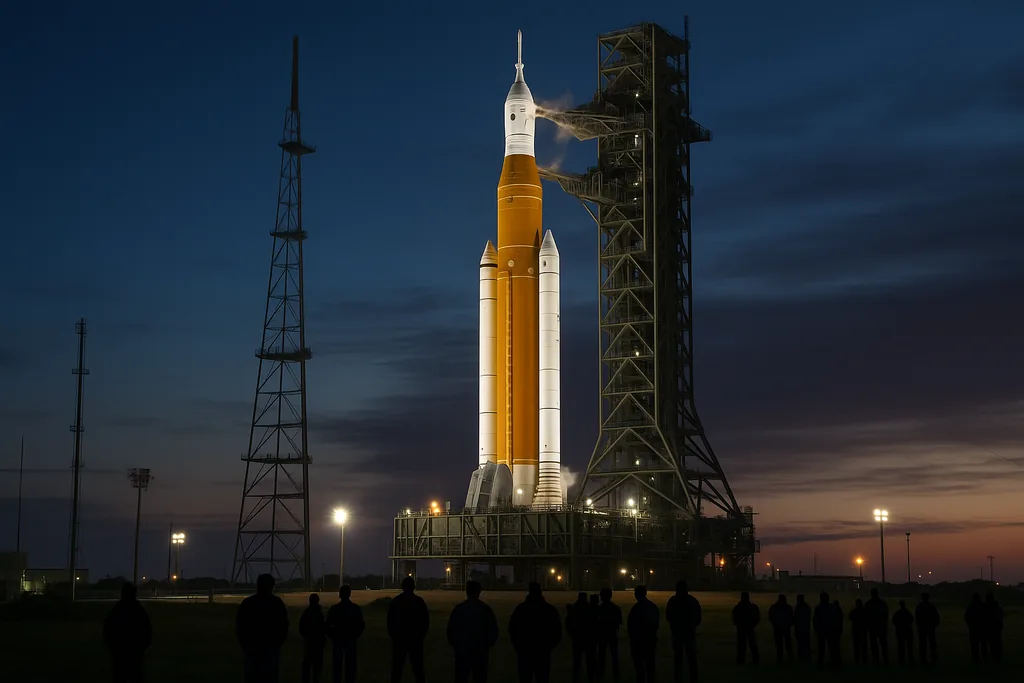
Where the rocket sits and why this launch matters, now
On Jan. 28, 2026, with the big white stack of the Space Launch System and Orion spacecraft installed at Launch Complex 39B at Kennedy Space Center, a new chapter of human lunar exploration is visible from the Florida coast. Artemis II will be the first crewed flight of Orion and SLS and the first time humans travel beyond low Earth orbit in more than 50 years. Four astronauts — Reid Wiseman (commander), Victor Glover (pilot), Christina Koch (mission specialist) and Jeremy Hansen (mission specialist, Canadian Space Agency) — will ride Orion around the Moon on a roughly 10-day flight test that NASA and its partners say is the critical rehearsal for future Artemis missions that will land crews on the lunar surface.
In person: viewing options at Kennedy and nearby beaches
If you want the closest view, the Kennedy Space Center Visitor Complex sells official launch viewing packages and special event experiences that put spectators inside the Cape Canaveral security perimeter for a restricted-line-of-sight view. Those packages frequently include bus tours to vantage points near the Vehicle Assembly Building and access to exhibits and experts before and after liftoff. The visitor complex has been promoting multiple Artemis-related events this week, including indoor “Path to the Moon” exhibits in the Atlantis building timed around the launch window.
Other on-site options are the Kennedy Space Center bus tours — including the Behind-the-Gates and KSC Explore tours — which give controlled, up-close access to historic facilities and photographic viewpoints. For people who prefer a highly curated day (transport, parking, expert narration), the KSC Elite VIP and other tour packages are the way to go.
For a free or lower-cost experience, dozens of public coastal vantage points on Florida’s Space Coast give dramatic views of an SLS liftoff: Cocoa Beach, Cape Canaveral, and Titusville are the best known. Beaches and coastal parks provide a long-distance silhouette of the rocket and the plume, often accompanied by thunderous acoustics for viewers close enough to feel the shock wave. Be aware that launch safety zones and temporary road closures will affect where you can legally stand; arriving early and checking the Visitor Complex’s updates is essential.
Tickets, timing and weather — practical tips
- Buy official viewing tickets early. The Kennedy Space Center and affiliated operators sell the limited-capacity launch viewing packages that get you significantly closer than public beaches. If you want to be near the pad, these are the only guaranteed way.
- Expect changes to the schedule. Launch dates are always tentative. NASA and launch managers set target windows that depend on weather, the rocket’s readiness and range safety. Scrubs and hold times are normal; plan to stay flexible and check official updates before you travel.
- Arrive early and pack for sun and noise. Bring sunscreen, water, a folding chair and hearing protection if you’re within a few miles of the pad. Traffic and parking fill quickly on launch days.
- Consider the viewpoint’s rules. Many public roads and parks will be open, but some vantage points require permits, reservations or have restricted sightlines. The Visitor Complex and county park services post the latest access bulletins before each attempt.
Watch from anywhere: livestreams and pad cameras
If you can’t make Florida, NASA will stream the rollout and launch live: NASA TV and the agency’s streaming channels carry countdown coverage and the liftoff feed. Commercial partners and third-party media also run continuous pad cameras. In the run‑up to launch, 24‑hour pad livestreams let you watch the rocket on the pad as teams complete final preparations and the stack goes through wet dress rehearsals and tanking tests.
Spaceflight broadcasters and social teams will provide multiple feeds — some camera‑heavy and others focused on mission control and the astronauts — so you can pick the angle you prefer. For international viewers, the Canadian Space Agency will carry crew and mission features focused on Jeremy Hansen’s presence on the flight.
What the crew will see on their pass around the Moon
Artemis II is a lunar flyby: Orion will not land, but it will travel beyond the Moon and return to Earth. The crew will pass over the lunar far side at distances much greater than the close Apollo orbits. According to NASA briefings, Orion will reach roughly 6,500–9,500 kilometres (about 4,000–6,000 miles) above the Moon’s surface — far enough that the Moon will look about the size of a basketball at arm’s length. That geometry gives the crew a single, remarkable panorama of the entire far side of the Moon at once: a view no human has ever had from that altitude.
How mission communications will work — and the planned blackout
One of the unseen, mission‑critical elements behind any deep‑space flight is communications. During Artemis II NASA will rely on a mix of terrestrial ground stations and relay assets to stay connected. Early in the flight NASA’s Near Space Network — the heritage network that supports near‑Earth missions and launch operations — will track Orion until the spacecraft’s translunar injection burn. After Orion is on its lunar trajectory, primary support hands off to the Deep Space Network (DSN), the three‑site array of large radio dishes in California, Spain and Australia managed by NASA’s Jet Propulsion Laboratory.
Artemis II will also carry an optical communications demonstrator: a laser terminal that can transmit high‑volume data. NASA has found that optical links can carry more than 100 times the data of traditional radio connections under the right conditions, and the Artemis II optical payload will build operational confidence for such systems on future Moon and Mars missions.
Plan for a brief communications blackout. As Orion flies behind the Moon, Earth‑based networks will be blocked — NASA expects a planned outage on the order of 40–45 minutes while the vehicle is on the lunar far side and cannot “see” Earth. That is normal for lunar trajectories that rely on Earth‑based relays; future lunar relay satellites being developed for Artemis will reduce or eliminate those blackouts.
During the mission NASA will prioritize voice and mission‑health telemetry if bandwidth is constrained; imagery and bulk science data may be compressed or scheduled around higher‑priority traffic. The agency’s Space Communications and Navigation (SCaN) program operates the networks and coordinates handoffs between assets to keep the crew and mission controllers connected.
What happens if you miss liftoff
Artemis II’s journey will be a multi‑day event. Even if weather or a scrub prevents you from seeing T‑0 live, the mission timeline means there are many ways to follow along: launch replay, orbit insertion announcements, translunar injection coverage and the crew’s live commentary are all streamed. NASA posts mission milestones and mission‑control audio shortly after they happen, and mission datasets and imagery are released through the agency’s science and data portals as they arrive on the ground.
Why the view and the networks matter
There is a visceral, cultural value to watching a crewed launch: the thunder, the trail and the intuition that something very old — people leaving Earth — is happening again. There is also an instrumental value. If you want to understand the next decade of lunar exploration, studying how NASA connects vehicles, teams and people across tens of thousands of kilometres of space is as important as watching the rocket clear the tower. Artemis II is both a human flight and a systems test that will validate communications, navigation, crew systems and operational concepts needed for eventual lunar landings and sustained lunar presence.
Quick checklist for the day
- Confirm the launch window and any last‑minute schedule changes from official NASA feeds the morning of a planned attempt.
- Buy or reserve official viewing tickets early if you want to be inside Kennedy Space Center perimeters.
- If you plan to be on the Space Coast, arrive early and expect heavy traffic and temporary closures; bring sun, water and hearing protection if you will be close to the pad.
- If you can’t travel, watch NASA TV or the agency’s livestreams; pad cams and 24‑hour webcast options let you follow final pad operations live.
- Keep your schedule flexible. Scrubbed attempts are part of the process; the mission will fly when engineers, launch managers and weather all agree it is safe.
For anyone watching from the beach, a backyard or Mission Control, Artemis II will be a mixture of spectacle and systems: a very public moment in a carefully choreographed long‑distance flight that depends on radio antennas, laser links and decades of ground‑station engineering as much as it depends on the four astronauts strapped into Orion. Whether you travel to Kennedy or tune in from home, the mission reconnects human spaceflight with a broader plan to build sustainable access and science on and around the Moon.
Sources
- NASA (Space Communications and Navigation Program, Artemis II mission communications)
- Kennedy Space Center Visitor Complex (Artemis II viewing packages and events)
- Jet Propulsion Laboratory (Deep Space Network)




Comments
No comments yet. Be the first!