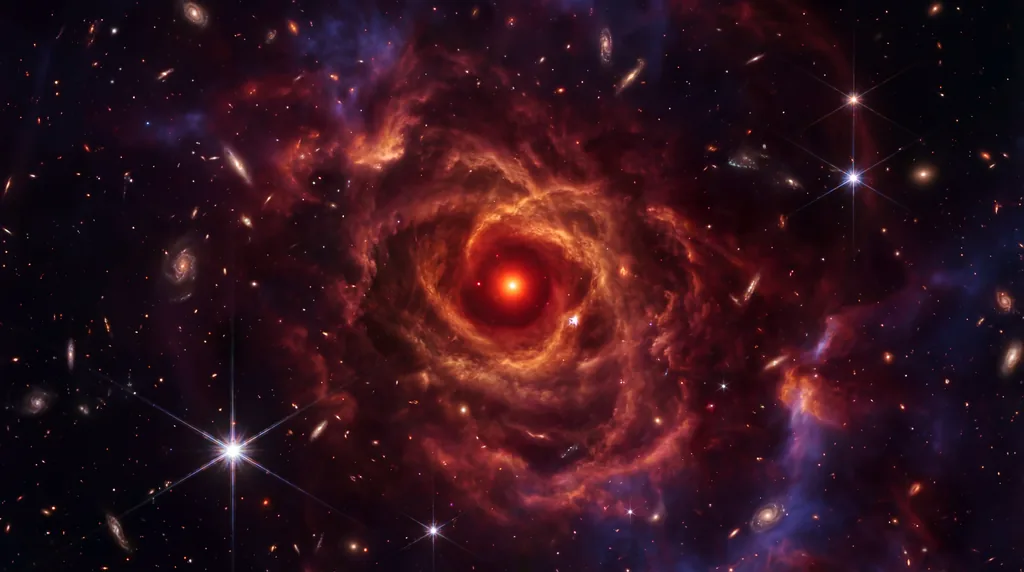

Since its deployment, the James Webb Space Telescope (JWST) has fundamentally altered our understanding of the early universe by capturing images of mysterious, compact, and extremely red objects colloquially known as "Little Red Dots" (LRDs). For years, astronomers debated whether these high-redshift sources (found between $z \sim 2$ and $z \sim 9$) were tiny, ultra-dense galaxies or obscured active galactic nuclei (AGN). A groundbreaking new study led by researchers including Gabriel Brammer, Priyamvada Natarajan, and Sandro Tacchella proposes a third, more exotic possibility: these objects are black hole stars (BH*s), a transient phase where a growing black hole is cocooned within a massive, dense envelope of gas that completely outshines its host galaxy.
What did JWST find in the early universe?
The James Webb Space Telescope (JWST) discovered a population of high-redshift, compact objects known as "Little Red Dots" that appear remarkably red in rest-optical wavelengths. These sources, dating back to just a few hundred million years after the Big Bang, exhibit extreme luminosities and compact structures that challenge existing models of galaxy formation and black hole growth.
The discovery of these objects was unexpected because their spectral signatures did not neatly align with known celestial bodies. Initially, the debate centered on whether the redness was caused by ancient stellar populations in a quiescent galaxy or by heavy dust obscuration around a central black hole. The research team utilized high-quality NIRSpec/PRISM spectra from a sample of 98 LRDs to probe deeper into these "Little Red Dots," seeking to identify the specific mechanism driving their intense energy output.
To isolate the true nature of these objects, the researchers developed a novel scheme to disentangle the central engine from the surrounding host galaxy. They operated on the assumption that the [OIII] 5008Å emission line arises exclusively from the host galaxy's interstellar medium rather than the compact core. By subtracting the host galaxy’s contribution based on this line, the team revealed the underlying spectral energy distribution (SED) of the "heart" of the LRD, which provided the first population-level evidence for black hole stars.
Are Little Red Dots actually Black Hole Stars?
Evidence suggests that many Little Red Dots are indeed powered by black hole stars, which are central singularities enshrouded in thick, opaque gas envelopes. After subtracting host galaxy light, researchers found that the remaining core resembles a blackbody-like SED with a temperature of approximately 4,050 K, far more consistent with a gaseous envelope than a traditional galaxy.
The "black hole star" model, often referred to as a quasistar, describes a unique state of matter where a black hole grows at an accelerated rate within a massive, hydrostatic envelope. The study found that the host-subtracted median stack of these LRDs displays a Balmer break more than twice as strong as those found in massive quiescent galaxies. This specific feature is a "hallmark signature" of dense gas envelopes, rather than the light from old stars, indicating that the black hole is the primary driver of the observed light.
According to the findings of Brammer, Natarajan, and Tacchella, these black hole stars are incredibly luminous, with a bolometric luminosity of $\log(L_{\rm{bol}}) \sim 43.9$ erg s$^{-1}$ and an effective radius of approximately 1,300 au. The study indicates that in a typical LRD, the black hole star accounts for:
- Approximately 20% of the ultraviolet (UV) emission.
- Roughly 50% of the light at the Balmer break.
- Nearly 90% of the light at wavelengths longer than H$\alpha$.
How does a black hole grow inside a gas envelope?
A black hole grows inside a gas envelope by accreting mass at rates that exceed the standard Eddington limit, while the surrounding gas traps the resulting radiation. This creates a dense, pressurized cocoon where the inward pull of gravity is balanced by the outward pressure of the black hole's energy, resulting in a stable but transient "star-like" structure.
The spectroscopic data support this "shrouded" growth model through the observation of a steep Balmer decrement ($H\alpha/H\beta > 10$). Such a high ratio suggests a highly obscured and dense environment, where dust and gas significantly redden the light escaping from the interior. Furthermore, the team detected numerous density-sensitive features, including emission lines from FeII, HeI, and OI, which are rarely seen in standard galaxies but are characteristic of high-density gas clouds surrounding a potent energy source.
The research posits that these black hole stars preferentially reside in low-mass galaxies ($M_{\star} \sim 10^{8} M_{\odot}$) that have recently undergone intense starbursts. The presence of extreme emission line equivalent widths—such as [OIII] 5008Å at 1100Å and CIII] at 12Å—suggests a strong link between rapid star formation and the birth of these massive black hole seeds. This environment provides the necessary reservoir of gas to maintain the envelope during the black hole's initial expansion.
Implications for Early Supermassive Black Hole Growth
The discovery of the black hole star phase has profound implications for how the first supermassive black holes in the universe formed so quickly. Standard accretion models often struggle to explain how black holes reached billions of solar masses within the first billion years of cosmic history. However, the black hole star mechanism allows for rapid, "super-Eddington" growth while the object remains obscured, effectively hidden from view until the envelope eventually dissipates.
The researchers estimate that these objects have a relatively short duty cycle of about 1%, implying a lifetime of roughly 10 million years. Despite this transience, the data suggest that black hole stars are so commonplace in the early universe that almost every massive black hole seen today may have once passed through this "Little Red Dot" phase. This suggests that LRDs are not an evolutionary dead end, but rather a universal "growth spurt" for black holes.
Looking ahead, future observations with the James Webb Space Telescope will likely focus on "blue broad-line AGN," which the researchers believe may be the phase that follows the black hole star once the dense gas envelope begins to clear. By studying the transition from gas-enshrouded "dots" to luminous, unmasked quasars, astronomers hope to map the entire lifecycle of the universe's most massive inhabitants from the cosmic dawn to the present day.




Comments
No comments yet. Be the first!