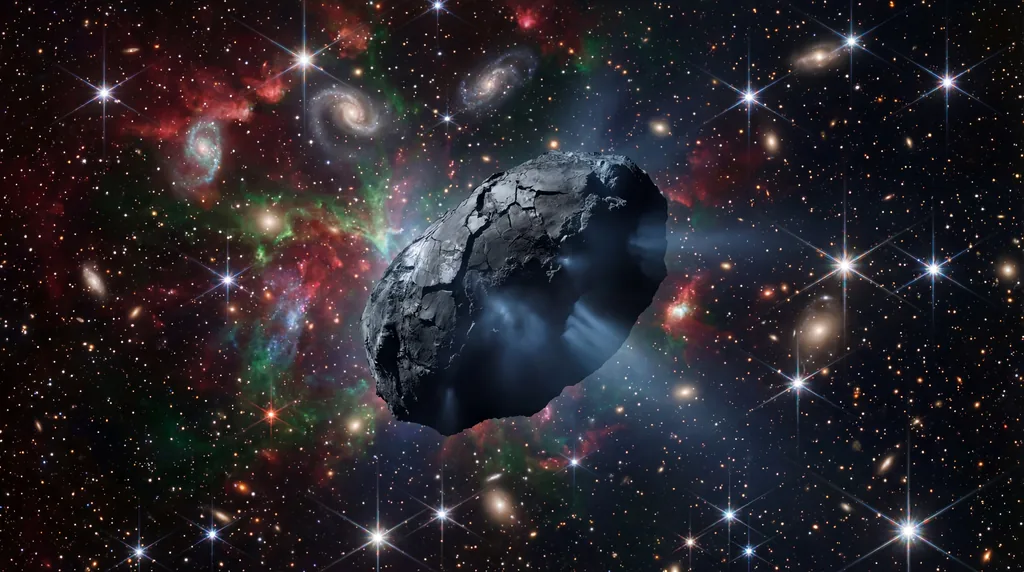

JWST Characterizes Interstellar Object 3I/ATLAS, Detecting Methane and Subsurface Volatiles
The James Webb Space Telescope (JWST) has achieved a significant milestone in the study of extra-solar visitors, performing the first-ever mid-infrared spectroscopic analysis of the interstellar object 3I/ATLAS. This third confirmed visitor from beyond our solar system has provided astronomers with a rare, detailed glimpse into the chemical composition of a body formed in a distant, alien environment. Utilizing the telescope’s Mid-Infrared Instrument (MIRI), a research team including Matthew Belyakov, Ian Wong, and Bryce T. Bolin observed the object post-perihelion, capturing data that suggests a complex history of thermal processing and the preservation of ancient, subsurface volatiles. The findings, obtained during observations in December 2025, represent a paradigm shift in our ability to sample the building blocks of other star systems.
The arrival of 3I/ATLAS follows in the footsteps of the enigmatic 1I/‘Oumuamua and the more traditionally cometary 2I/Borisov. However, 3I/ATLAS has offered a unique opportunity for characterization due to its orbital timing and the unprecedented sensitivity of JWST. Kinematic analysis suggests that this object likely originated from the Milky Way’s thick disk, a region populated by ancient stars, and approached our solar system from the direction of the constellation Sagittarius. By studying such objects, scientists can determine whether the chemical blueprints of our own solar system are typical or if we are outliers in the galactic neighborhood. The observations of 3I/ATLAS were conducted at heliocentric distances of 2.20 and 2.54 au, providing a window into the outgassing behavior of the object as it began its long journey back into the interstellar void.
The Scientific Significance of 3I/ATLAS and its Volatile Signature
To capture the chemical fingerprint of 3I/ATLAS, the researchers employed the Medium-Resolution Spectrometer (MRS) on JWST’s MIRI instrument. This allowed for the detection of specific fluorescence features across the 5–28 micron wavelength range. Among the primary discoveries was the clear detection of the \(\nu_2\) band of water vapor between 5.8 and 7.0 microns, alongside the primary \(\nu_2\) and associated hot bands of carbon dioxide (CO₂) centered around 15 microns. These measurements revealed a striking chemical profile: 3I/ATLAS exhibits an unusually high CO₂ to water ratio of approximately 8:1. This ratio is significantly higher than that observed in typical Solar System comets, suggesting that the object may have formed in a region enriched with carbon dioxide or perhaps under specific radiation conditions that altered its primordial chemistry.
Beyond the standard volatile suspects, the MIRI spectra also revealed a forbidden transition of atomic nickel at 7.507 microns. The presence of such heavy metal vapors in a cometary coma is a phenomenon that has only recently been recognized in Solar System comets, and its detection in an interstellar object underscores the commonality of certain thermal processes across different star systems. The team also observed an extended source of water production within the near-nucleus coma, indicating that the outgassing is not just coming from the nucleus itself but also from icy grains entrained within the coma. This "extended source" phenomenon provides clues about the physical structure of 3I/ATLAS, suggesting a fragile, icy composition that sheds material as it warms.
Breakthrough Detection of Methane and Subsurface Materials
Perhaps the most groundbreaking result of the JWST campaign is the first direct detection of methane (CH₄) in an interstellar object. Methane is a highly volatile species that is often depleted from the surface layers of cometary bodies due to solar heating. In the case of 3I/ATLAS, the researchers noted a delayed onset of methane production relative to water. This suggests that the methane was not present on the immediate surface but was instead locked away in unprocessed subsurface material. As the Sun's heat penetrated deeper into the object during its perihelion passage, these "fresh" volatiles were liberated, providing a look at the pristine material that has remained unchanged since the object’s formation millions or billions of years ago.
This discovery answers a long-standing question regarding the presence of methane on interstellar objects. While previous observations of 2I/Borisov hinted at various carbon-bearing molecules, the direct identification of CH₄ in 3I/ATLAS confirms that these interstellar travelers carry the necessary organic precursors for complex chemistry. The enriched CH₄:H₂O ratio, when compared to the baseline of Oort Cloud comets, further distinguishes 3I/ATLAS as a chemically distinct entity. The emergence of subsurface methane serves as a "thermal clock," telling the story of how the object's outermost layers were processed by interstellar radiation and previous heating events, while its interior remained a cryogenic time capsule from another world.
Comparative Planetology and the Dynamics of 3I/ATLAS Outgassing
The JWST observations were split into two distinct epochs, separated by 12 days in December 2025. This timing allowed the research team to track the evolution of the object’s activity as it moved further from the Sun. Interestingly, the data showed a significant reduction in overall outgassing over this brief period. Most notably, the measured water activity level dropped more steeply than the other gaseous species. This differential outgassing provides critical data on the volatility of the materials involved; as the surface cools, water—which requires more energy to sublimate than CO₂ or CH₄—is the first to see a decline in production. This behavior further cements 3I/ATLAS's status as a highly volatile-rich body compared to the more "temperate" comets found in the inner Solar System.
When comparing 3I/ATLAS to local comets, the starkest difference remains the carbon dioxide enrichment. While most Oort Cloud comets have water as their dominant volatile, 3I/ATLAS appears to be dominated by carbon oxides. This chemical signature may point toward a formation environment in a protoplanetary disk around a star cooler than our Sun, or perhaps in a region of a disk where CO₂ ice could dominate over water ice. The researchers suggest that 3I/ATLAS might have originated in a transition zone between the thin and thick disks of the galaxy, potentially within a primordial planetesimal disk or an exo-Oort cloud that was disrupted by stellar encounters.
Future Directions in Interstellar Research
The successful characterization of 3I/ATLAS marks the beginning of a new era in "alien" astronomy. By establishing a chemical baseline for interstellar visitors, JWST is providing the data necessary to build more accurate models of how planetary systems form and evolve across the galaxy. The presence of methane, carbon dioxide, and atomic nickel in a single interstellar body suggests that the diversity of these objects may be even greater than previously anticipated. Each new visitor provides a "free" sample of a distant solar system, saving us the impossible journey of traveling light-years to reach them.
Looking forward, the scientific community is preparing for a surge in such discoveries. The upcoming Vera C. Rubin Observatory, with its Legacy Survey of Space and Time (LSST), is expected to detect many more interstellar objects as they enter our neighborhood. With JWST providing the high-resolution "follow-up" capability, astronomers will soon move from studying individual curiosities like 3I/ATLAS to performing statistical surveys of interstellar chemical diversity. This evolving understanding of how volatiles are preserved across the vast distances of space will ultimately help us understand the origins of life’s building blocks and the frequency of habitable environments throughout the Milky Way.




Comments
No comments yet. Be the first!