Fueling rehearsal halts as tiny molecules upset a moonshot
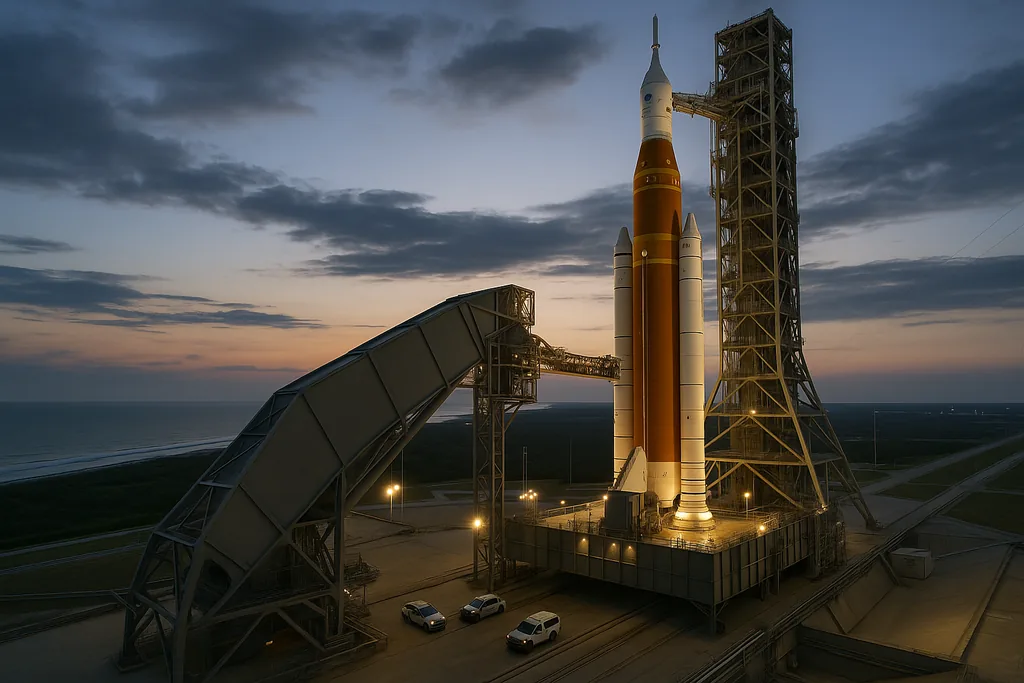
On Monday, at Kennedy Space Center, NASA's mock countdown for Artemis II ran straight into a familiar problem: engineers were unable tame hydrogen leaks that cropped up in the connection between the Space Launch System rocket and its mobile launch platform. The two-day Wet Dress Rehearsal (WDR) proceeded through many milestones, but a spike in liquid‑hydrogen leak rates caused controllers to terminate the countdown at T‑minus 5 minutes and 15 seconds and to begin draining the vehicle. Agency managers said they will now target March — the first available launch window opens on March 6 at 8:29 p.m. EST (01:26 UTC on March 7) — as the earliest practical opportunity for Artemis II while teams review telemetry and plan a second wet dress rehearsal.
Unable to tame hydrogen leaks — what went wrong
The leak appeared in the same spot that challenged NASA during Artemis I: the Tail Service Mast Umbilicals (TSMUs), a pair of roughly 30‑foot arms that bring supercold liquid hydrogen and liquid oxygen from ground tanks into the SLS core stage. At the pad the TSMU connector plates mate with matching interfaces on the vehicle; at liftoff they are supposed to separate cleanly. Because liquid hydrogen must be kept near −253 °C (−423 °F), seals and soft goods can change size and stiffness in ways that open microscopic leak paths. Hydrogen molecules are the smallest and lightest chemical species and can escape through tiny flaws that are effectively invisible at room temperature.
NASA engineers accepted small seepage as normal and monitor hydrogen concentration around the interface. Officials have set a hard safety threshold—around a 4 percent hydrogen concentration in the connector housing—above which operations must stop. During the rehearsal this week that threshold was exceeded multiple times. Teams attempted mitigation steps during the rehearsal: stopping the flow of liquid hydrogen, letting the interface warm so seals could reseat, and adjusting propellant flow rates. Fueling crews did manage to fully load the vehicle with its more than 750,000 gallons of propellants at one point, but a subsequent leak rate spike forced the call to terminate the practice countdown before the rocket assumed internal power and pressurized its tanks.
Unable to tame hydrogen leaks: safety and schedule impacts
Hydrogen leaks matter because they directly affect personnel and public safety and because they cascade into schedule risk. When hydrogen concentration climbs above the safe limit, ground teams must clear the pad and halt sensitive operations — that is exactly what happened during the WDR. The rehearsal was meant to exercise the entire chain of launch events short of liftoff, including final closeout procedures: a ground team closed and secured the hatch on the Orion capsule and prepared to clear the pad so the countdown could reach its terminal phase. A valve on Orion’s hatch pressurization required retorquing during those closeout tasks, and ground communications experienced audio dropouts as teams worked through cold‑weather effects. The leak spike prevented execution of the last preflight checks — including activation of auxiliary power units and a steering check on the core engines — leaving multiple items unchecked.
Because the WDR is a dress rehearsal designed to reveal problems on the ground rather than at launch, the delay should be seen as a measured response: NASA managers will not set a firm launch date until they have reviewed the data, mitigated the faults and completed another full rehearsal. That process could be handled on the pad or could require rolling the rocket back to the Vehicle Assembly Building for repairs and additional testing. Either choice carries time costs: a rollback and repairs typically take weeks; repeated pad attempts must fit within narrow windows tied to orbital geometry for Orion’s planned trajectory.
Mission profile and why the March window matters
Artemis II is the first crewed flight test in NASA's plan to return humans to the Moon. Four crew members — commander, pilot and mission specialists — will ride inside the Orion spacecraft on a lunar flyby that uses a free‑return trajectory around the far side of the Moon to ensure the spacecraft can return safely to Earth if something goes wrong. The mission does not land but is a critical step that validates Orion, the SLS rocket in crewed mode, and integrated ground operations ahead of later missions that aim to land astronauts at the lunar south pole.
Because the Moon’s position relative to Earth constrains trajectories, Artemis II has only a few launch opportunities each month that permit the planned free‑return path and a safe reentry corridor. The earliest practical opportunity after this week’s WDR is March 6 (two‑hour window opening 8:29 p.m. EST), which is why NASA moved the official target to March for “the earliest possible launch opportunity” while teams prepare a second full rehearsal.
Operational lessons and the history of the leak problem
Hydrogen handling has long been a thorny engineering challenge for spaceflight. The Artemis I campaign in 2022 encountered similar leak behaviour; the vehicle eventually launched after teams adjusted hydrogen loading procedures and made operational workarounds. That history informs the current approach: rather than rush a launch, managers are treating the WDR outcome as actionable data, returning to engineering labs and flight‑control consoles to analyse readings from sensors on the TSMU interface, valve behaviour and ambient effects such as the cold air that complicated pad camera and audio systems this week.
Choices now include repeating the WDR with fixes applied, or taking the vehicle back to the Vehicle Assembly Building for hardware changes and deeper inspections. A rollback can take days to complete and weeks to perform corrective work; repeating pad rehearsals also consumes limited calendar time around acceptable lunar geometry. Flight‑safety requirements add further constraints — for example, arming the flight‑termination system establishes a 20‑day operational window tied to launch preparations, which affects the timing of possible follow‑on attempts.
What this means for the crew and the program
The Artemis II crew had been in medical quarantine ahead of the rehearsal; NASA said they will be released to resume training and await the new launch date. Delays like this are disruptive to astronaut schedules, mission readiness and public expectations, but they are also the explicit purpose of a WDR: reveal and fix problems while the vehicle is still on the ground. NASA has emphasised that safety remains the overriding priority for astronauts, workers and the public, and that they will only proceed when confident the hardware and procedures are ready.
Programmatically, the incident highlights the trade‑offs of operating a large, complex launch system: mature launch pads, new heavy lift rockets and supercold propellants each introduce failure modes that must be hunted down in testing. The Artemis architecture — Orion, SLS, ground systems and new operational practices — is being exercised in real time. The data captured during this WDR will determine whether the agency can move toward a March liftoff, needs a short extension for additional pad testing, or must plan a rollback for repairs.
For now, engineers will pore over telemetry from the Tank and umbilical sensors, review how seals and valves behaved at cryogenic temperatures, and test fixes in hardware labs. The goal is not only to resolve this particular leak but to converge on a repeatable, low‑risk procedure for fueling the rocket in crewed operations — a necessary step before the Artemis program can execute its next, higher‑stakes missions to place humans back on the surface of the Moon.
Sources
- NASA (press materials on Artemis II Wet Dress Rehearsal and launch operations)
- Kennedy Space Center (launch pad and Vehicle Assembly Building operations)
- NASA Artemis program technical briefings and SLS/Orion system documentation




Comments
No comments yet. Be the first!