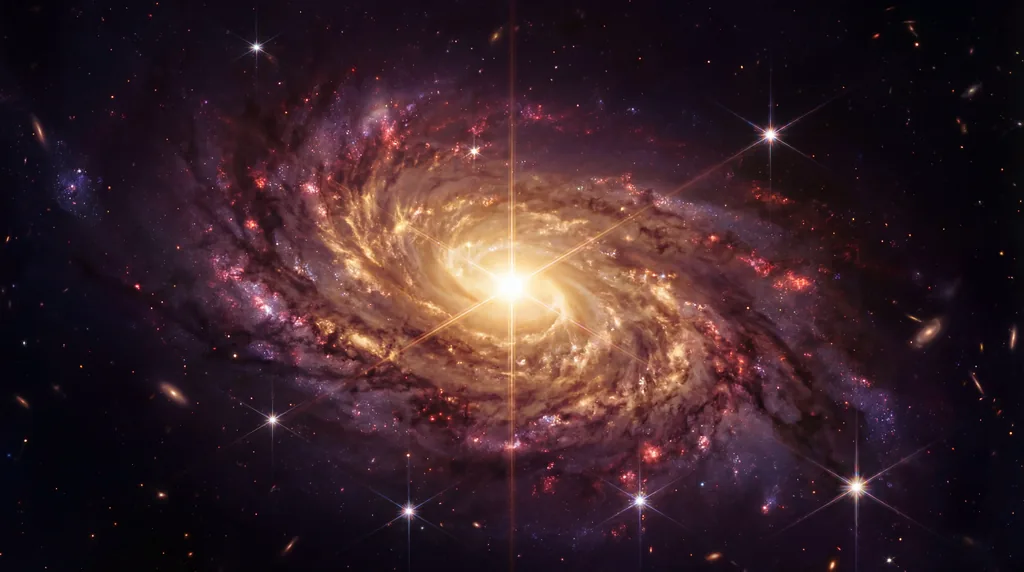

The James Webb Space Telescope (JWST) has officially confirmed the detection of the methyl radical (CH₃) outside the Milky Way for the first time, marking a significant milestone in extragalactic chemistry. In a study published in Nature Astronomy on February 6, 2026, researchers identified this vital molecule alongside an "unprecedented richness" of organic compounds within the deeply obscured nucleus of the nearby luminous infrared galaxy IRAS 07251–0248. Led by the Center for Astrobiology (CAB), CSIC-INTA, and supported by modeling from the University of Oxford, the discovery suggests that extreme galactic environments act as high-efficiency chemical factories.
Ultra-luminous infrared galaxies like IRAS 07251–0248 are among the most energetic and dusty environments in the local universe. Their central regions are often shrouded by dense clouds of gas and dust that block visible light, effectively hiding the chemical processes occurring near the central supermassive black hole. This research was specifically designed to penetrate these barriers, using the advanced infrared capabilities of the James Webb Space Telescope to observe the "buried" chemistry that previous observatories, such as the Spitzer Space Telescope, could not resolve with such precision.
Is the detection of methyl radical outside the Milky Way confirmed by this study?
Yes, this study confirms the first detection of the methyl radical (CH₃) outside our galaxy, specifically within the nucleus of the ultra-luminous infrared galaxy IRAS 07251–0248. Utilizing the high-resolution spectroscopy of the James Webb Space Telescope, researchers identified this highly reactive molecule alongside a suite of complex hydrocarbons, including benzene, acetylene, and triacetylene, proving that these chemical precursors are abundant in extreme extragalactic environments.
The identification of the methyl radical is particularly significant because it serves as a key intermediate in the formation of larger, more complex organic molecules. According to lead author Dr. Ismael García Bernete, formerly of Oxford and now at CAB, the abundances found were far higher than current theoretical models predicted. This discrepancy suggests a continuous source of carbon in these galactic nuclei, likely driven by the fragmentation of larger carbonaceous materials. The presence of CH₃ in such a volatile environment provides a new benchmark for understanding how carbon chemistry evolves under intense radiation and gravitational forces.
How does the James Webb Space Telescope reveal organic molecules in obscured galaxy nuclei?
The James Webb Space Telescope reveals organic molecules by using its Mid-Infrared Instrument (MIRI) and NIRSpec to capture light in the 3–28 micron wavelength range. These infrared wavelengths can penetrate dense dust clouds that scatter visible light, allowing the telescope to detect the unique "fingerprints" or spectral signatures of gas-phase molecules, ices, and solid carbonaceous grains hidden deep within a galaxy’s core.
The methodology employed by the international team involved combining data from NIRSpec (Near-Infrared Spectrograph) and MIRI to characterize the temperature and abundance of chemical species. By analyzing the absorption and emission lines within the 3–28 micron range, the researchers could distinguish between different states of matter, such as water ices and carbonaceous dust grains. This sophisticated modeling, developed in part by the University of Oxford, allowed the team to isolate the effects of cosmic rays. They found that these high-energy particles are likely responsible for shattering polycyclic aromatic hydrocarbons (PAHs), releasing smaller organic molecules into the gas phase where they can be detected.
The study highlights a clear correlation between the intensity of cosmic-ray ionization and the abundance of hydrocarbons. In these dense, buried nuclei, the concentration of cosmic rays is significantly higher than in standard interstellar space. This intense radiation environment essentially acts as a catalyst, breaking down larger dust grains into the "factory" of small organic molecules observed by the James Webb Space Telescope. This process explains why the chemical richness of IRAS 07251–0248 exceeds that of more quiescent galaxies.
Could these organic molecules relate to the origins of life?
While small organic molecules like benzene and methane are not biological, they represent critical precursors in prebiotic chemistry that are necessary for the eventual formation of amino acids and nucleotides. Their discovery in distant galaxies suggests that the fundamental building blocks of life are ubiquitous throughout the universe, even in the most extreme and "hostile" environments far removed from Earth-like conditions.
Professor Dimitra Rigopoulou from the University of Oxford’s Department of Physics emphasizes that while these molecules are not found in living cells themselves, they are vital steps in a chemical chain. The detection of benzene (C₆H₆), methane (CH₄), and diacetylene (C₄H₂) in a galaxy millions of light-years away indicates that the "chemical toolkit" required for complex life is not unique to the Milky Way. Instead, these molecules are processed and distributed in the hearts of luminous galaxies, potentially seeding future generations of stars and planetary systems with organic matter.
The Significance of Molecular Richness in Deep Space
- Benzene (C₆H₆): A stable ring of carbon atoms that serves as a primary building block for more complex aromatic compounds.
- Acetylene (C₂H₂) and Polyacetylenes: These molecules are highly reactive and essential for the growth of larger carbon chains in space.
- Methyl Radical (CH₃): A critical intermediate molecule that facilitates the transition from simple carbon atoms to complex hydrocarbons.
- Carbonaceous Grains and Ices: These solid-state materials act as surfaces where chemical reactions can occur, shielded from the harshest radiation.
The implications of this research extend far beyond the classification of a single galaxy. By demonstrating the James Webb Space Telescope's ability to map the organic inventory of a buried nucleus, the study opens a new era in astrobiology and astrochemistry. Scientists can now begin to investigate whether the chemical "factories" found in IRAS 07251–0248 are a standard feature of the early universe, where luminous, dusty galaxies were much more common than they are today.
Looking forward, the research team plans to expand their observations to a wider sample of infrared-luminous galaxies. This will help determine if the high abundance of organic molecules is a universal trait of obscured nuclei or a unique characteristic of IRAS 07251–0248. As the James Webb Space Telescope continues its mission, each new spectroscopic observation brings us closer to understanding the lifecycle of carbon and the true prevalence of life's building blocks across the cosmos.




Comments
No comments yet. Be the first!