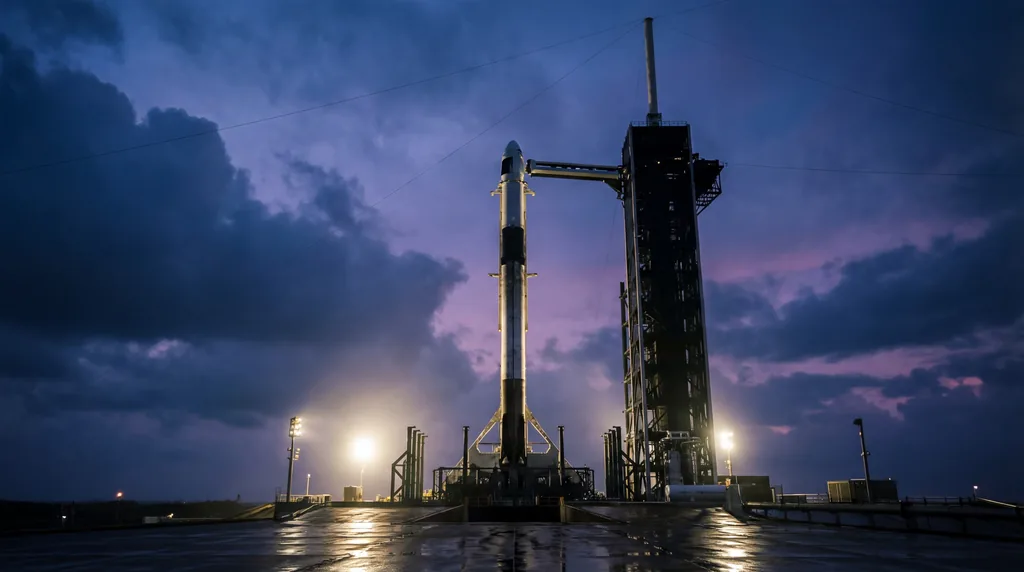

SpaceX has grounded its Falcon 9 rocket fleet following an "off-nominal" condition experienced by the vehicle's second stage during a routine Starlink satellite launch on February 2, 2026. This tactical pause in launch operations has prompted NASA to evaluate potential delays for the upcoming Crew-12 mission to the International Space Station (ISS), which was originally scheduled to lift off from Cape Canaveral on February 11. While the primary mission objectives were met, the anomaly during the deorbit phase has necessitated a comprehensive data review to ensure the continued safety of human spaceflight.
What caused the Falcon 9 second stage issue during the Starlink launch?
SpaceX identified an off-nominal condition in the rocket's second stage during a routine Starlink satellite deployment on February 2, 2026. While the primary mission of orbiting the satellites was successful, the upper stage experienced an unspecified malfunction during its deorbit burn preparation, leading to a fleet-wide grounding for rigorous data review and the determination of a root cause.
Technical assessments are currently focused on the second-stage performance after it had already successfully deployed its payload into the intended orbit. Unlike the first-stage booster, which is designed for vertical landing and reuse, the second stage is a single-use component responsible for the final orbital insertion and subsequent deorbiting to prevent the accumulation of space debris. SpaceX representatives stated that "teams are reviewing data to determine root cause and corrective actions" before the Falcon 9 returns to flight. The lack of specific detail regarding the "off-nominal condition" suggests a hardware or software deviation that was detected by onboard telemetry during the critical preparation phase for atmospheric reentry.
Will the ISS crew be stranded due to SpaceX's grounding?
Current International Space Station operations remain stable, and there is no immediate risk of crews being stranded, although the upcoming Crew-12 rotation may face significant scheduling delays. NASA officials are monitoring the SpaceX investigation closely, as the mission scheduled for February 11 depends entirely on the Falcon 9 returning to flight status with a clean safety record.
The potential delay impacts a diverse international team of astronauts awaiting transport to the orbital laboratory. The Crew-12 manifest includes:
- Jessica Meir (NASA - United States)
- Jack Hathaway (NASA - United States)
- Sophie Adenot (ESA - France)
- Andrey Fedyaev (Roscosmos - Russia)
What is the FAA's role in the Falcon 9 investigation?
The Federal Aviation Administration (FAA) is providing regulatory oversight for the investigation into the SpaceX Falcon 9 anomaly to ensure public safety and vehicle reliability. NASA official Amit Kshatriya confirmed that the agency is collaborating with the FAA to review corrective actions before certifying the rocket for the next crewed mission to the International Space Station.
Regulatory protocols require that any launch anomaly involving a licensed commercial vehicle undergo a formal investigation. The FAA must approve the final report and the implementation of any necessary hardware or software modifications before SpaceX can resume its high-frequency launch cadence. Historically, the Falcon 9 has maintained an industry-leading reliability record, but the stringent requirements of human-rated spaceflight mean that even minor second-stage issues can lead to weeks or months of logistical shifts. This oversight is critical to maintaining the integrity of the NASA Commercial Crew Program, which relies heavily on SpaceX as its primary "workhorse" for low-Earth orbit logistics.
The Strategic Merger of SpaceX and xAI
Elon Musk has announced a major corporate restructuring by merging his artificial intelligence venture, xAI, into SpaceX to create what he calls a "vertically-integrated innovation engine." This move aims to leverage SpaceX's launch capabilities to deploy massive, satellite-based data centers powered by solar energy, bypassing the energy constraints of terrestrial electricity grids. Musk noted that global demand for AI power is exceeding Earth-based solutions, making space-based infrastructure the "only logical solution" for future scaling.
The financial implications of this merger are staggering, with analysts at The Financial Times and Bloomberg estimating the combined entity's valuation between $1.25 trillion and $1.5 trillion. This consolidation of talent and capital is intended to fund Musk’s long-term vision of becoming a "Kardashev II-level civilization," capable of harnessing the full energy output of the sun. The SpaceX IPO, which is rumored for June 2026, is expected to be the largest in history, potentially raising $50 billion to fuel the development of the Starship rocket and the newly proposed space-based AI clusters.
Strategic analysts, including Emma Wall of Hargreaves Lansdown, suggest that this pivot toward automation and AI mirrors Musk's recent shifts at Tesla. By integrating xAI's Grok chatbot and advanced machine learning models with SpaceX's Starlink constellation, the company seeks to dominate the next generation of global information and computing infrastructure. However, the immediate challenge remains the technical reliability of the Falcon 9, which must remain operational to support the very launch schedule required to build this ambitious orbital network.
Looking ahead, SpaceX aims to achieve a launch rate of one flight per hour using the Starship platform, a massive leap from its 2025 performance. While competitors like Jeff Bezos’s Blue Origin and the New Glenn rocket aim to challenge this dominance, the current Falcon 9 grounding serves as a reminder of the inherent risks in aerospace engineering. The coming weeks will be pivotal as NASA and the FAA review the Starlink mission data, determining whether the path to the ISS remains open for the Crew-12 astronauts or if the mission faces a protracted delay.




Comments
No comments yet. Be the first!