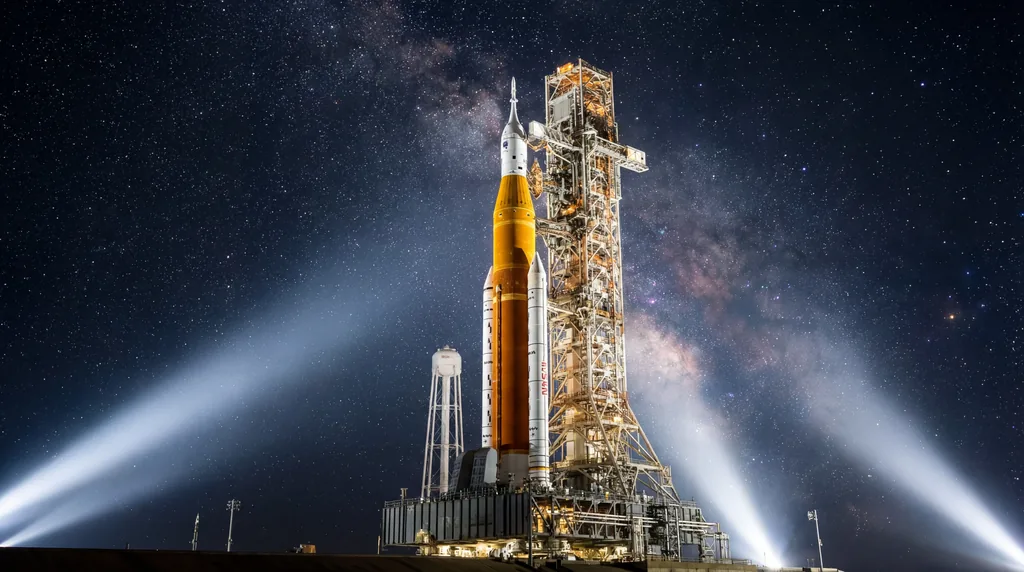

NASA has officially acknowledged that the three-year interval between the first and second flights of the Space Launch System (SLS) creates significant operational hurdles for the Artemis program. In a series of recent statements following a failed wet-dress rehearsal for the Artemis II mission, senior officials admitted that the low flight rate forces each launch to be treated as an experimental procedure rather than an established routine. This rare transparency highlights the logistical and financial strain of maintaining a heavy-lift rocket that lacks the rapid launch cadence found in the commercial sector.
Why is the SLS program 140% over budget?
The NASA Space Launch System (SLS) is over budget primarily due to its reliance on expensive, non-reusable hardware and a flight rate so low that every mission requires "bespoke" engineering and intensive testing. The program has cost U.S. taxpayers over $30 billion to date, with each individual rocket costing in excess of $2 billion, leaving the agency with little room for hardware-rich testing environments.
The financial pressure on the SLS architecture stems from the inherent complexity of its design and the aging infrastructure required to support it. Unlike modern commercial rockets that prioritize reusability to drive down costs, the SLS is "hardware-poor," meaning every component is a precious, single-use asset. According to John Honeycutt, chair of the Artemis II Mission Management Team, the program attempted an aggressive approach to testing valves and seals following the hydrogen leaks that plagued the Artemis I launch in 2022. However, the costs of building dedicated test tanks are so prohibitive that NASA is often forced to conduct "tests like we fly," using the actual flight hardware for high-risk fueling demonstrations.
Moreover, the ground systems at Kennedy Space Center, including a mobile launcher tower that cost over $1 billion, require constant, expensive maintenance between missions. When the gap between launches extends to three years—as seen between the 2022 Artemis I mission and the now-delayed Artemis II—the specialized workforce must essentially re-learn the "breathing" and "venting" characteristics of the vehicle. This "Slow Launch System" reality turns what should be an operational transport system into a series of unique, multi-billion-dollar experiments, driving up the total program cost significantly beyond initial Government Accountability Office (GAO) estimates.
What commercial systems are proposed to replace SLS and Orion?
SpaceX’s Starship and Blue Origin’s New Glenn are the primary commercial systems currently positioned as potential successors or supplements to the SLS and Orion architecture. These private-sector rockets aim for full reusability and significantly higher flight cadences, offering a contrast to the high-cost, low-frequency model of the NASA-designed deep-space booster.
The debate over commercial alternatives has intensified following the recent wet-dress rehearsal failure in early 2026. NASA Associate Administrator Amit Kshatriya noted that the SLS components are "very bespoke," whereas commercial entities like SpaceX are developing systems designed for mass production and rapid turnaround. Jared Isaacman, the recently appointed NASA Administrator, has signaled that the SLS flight rate—the lowest of any NASA-designed vehicle—must become a central topic of discussion. This shift in leadership suggests a growing openness to integrating private heavy-lifters more deeply into the Artemis timeline.
While the SLS remains the only current vehicle capable of sending the Orion capsule and its crew directly to the Moon in a single launch, the rapid advancements of SpaceX Starship are challenging this monopoly. Starship is already integrated into the Artemis program as the Human Landing System (HLS) for Artemis III. If SpaceX can demonstrate reliable orbital refueling and long-duration flight before the SLS completes its mandated fourth and fifth missions, the political and economic pressure to transition away from the SLS "bridge" architecture may become insurmountable for Congress.
How does the 2026 budget prioritize Moon and Mars missions?
The 2026 NASA budget prioritizes the Artemis III human lunar landing while beginning a strategic pivot toward commercial partnerships to reduce the long-term costs of Moon and Mars exploration. While legal mandates currently protect the SLS through its fifth flight, the budget emphasizes the development of the Lunar Gateway and commercial cargo deliveries to the lunar surface.
Recent budgetary shifts reflect a tension between legacy programs and the "Moon-to-Mars" vision. The Trump administration has expressed a desire to limit the SLS to just two more flights, focusing on the milestone of the Artemis III landing. This goal requires NASA to balance the high maintenance costs of the SLS with the need to fund newer, more agile technologies. Amit Kshatriya characterized the current SLS configuration as "experimental" because of the immense energies and "bespoke components" involved, admitting that every launch campaign is currently an adventure rather than a predictable schedule.
To ensure the sustainability of the Artemis program, NASA is increasingly looking at "off-ramps" where commercial providers can take over logistical duties. The 2026 fiscal priorities suggest that while the SLS will remain the primary heavy-lift vehicle for the immediate crewed missions to the Moon, the agency is preparing for a future where private rockets handle the bulk of the mass-to-orbit requirements for Mars transit. This strategy aims to preserve the NASA budget for high-level mission management and scientific discovery rather than the manufacturing and operation of expendable rocket hardware.
The Technical Reality of Hydrogen Leaks
The most persistent technical hurdle for the NASA SLS continues to be the management of liquid hydrogen. During the Artemis II fueling test on February 2, 2026, a leak at the main interface between the ground equipment and the rocket forced an automatic abort at T-5 minutes. John Honeycutt explained that because hydrogen is a tiny, highly energetic molecule, managing its flow at cryogenic temperatures is an immense engineering challenge. The team attempted to "re-seat" seals by varying flow rates, a tactic that worked temporarily but ultimately failed as the countdown reached its final stages.
Future Outlook: Increasing the Cadence
Looking ahead, NASA aims to increase the SLS flight rate to once per year, though this remains an ambitious target given the current hardware scarcity. The move to a more frequent schedule is seen as essential for both safety and cost-efficiency. As Eric Berger of Ars Technica noted, a rocket that flies rarely will inherently have higher operating costs and heightened safety concerns because the ground crews and mission controllers do not get the benefit of repetitive experience. For the SLS to survive the decade, it must transition from a "work of art" into a reliable, high-frequency utility for the Artemis program.
- Mission Status: Artemis II launch delayed to no earlier than March 2026.
- Cost Metric: Total SLS development and launch costs exceed $30 billion.
- Technical Challenge: Recurring liquid hydrogen leaks at the ground-to-flight interface.
- Leadership Change: New NASA Administrator Jared Isaacman is reviewing the SLS flight rate.
The path forward for NASA involves a delicate balancing act. The agency must successfully navigate the "experimental" phase of the SLS to achieve the goals of Artemis II and III while simultaneously preparing for a transition to a more commercially-driven deep-space economy. Whether the SLS remains the backbone of lunar exploration or serves as a temporary bridge to newer systems will likely depend on the success of the upcoming March 2026 launch attempt and the reliability of the "Slow Launch System" in the years to follow.




Comments
No comments yet. Be the first!