'This changes everything,' scientists say: what was found in the sample
Analyses of Bennu fragments have revealed a rich chemistry. Teams report simple and complex organic molecules, 14 of the 20 amino acids used in terrestrial proteins, all five nucleobases that appear in DNA and RNA, ammonium‑bearing compounds, and salts that indicate ancient briny fluids once moved through the rock. The new announcement adds ribose and glucose to that list, and identifies a suite of evaporite minerals — sodium‑rich carbonates, sulfates, chlorides and phosphates — that point to episodes of liquid water and subsequent drying.
In practical terms, scientists describe Bennu as a time capsule. The rock formed more than 4.5 billion years ago and preserves both organics and mineralogy in a way meteorites that fall to Earth cannot, because those meteorites are often contaminated or altered during atmospheric entry and after landing. OSIRIS‑REx's controlled sample return and the careful nitrogen‑based curation have allowed researchers to detect fragile salts and volatile organics that would otherwise have been lost.
Laboratory sleuthing: how scientists test asteroid samples
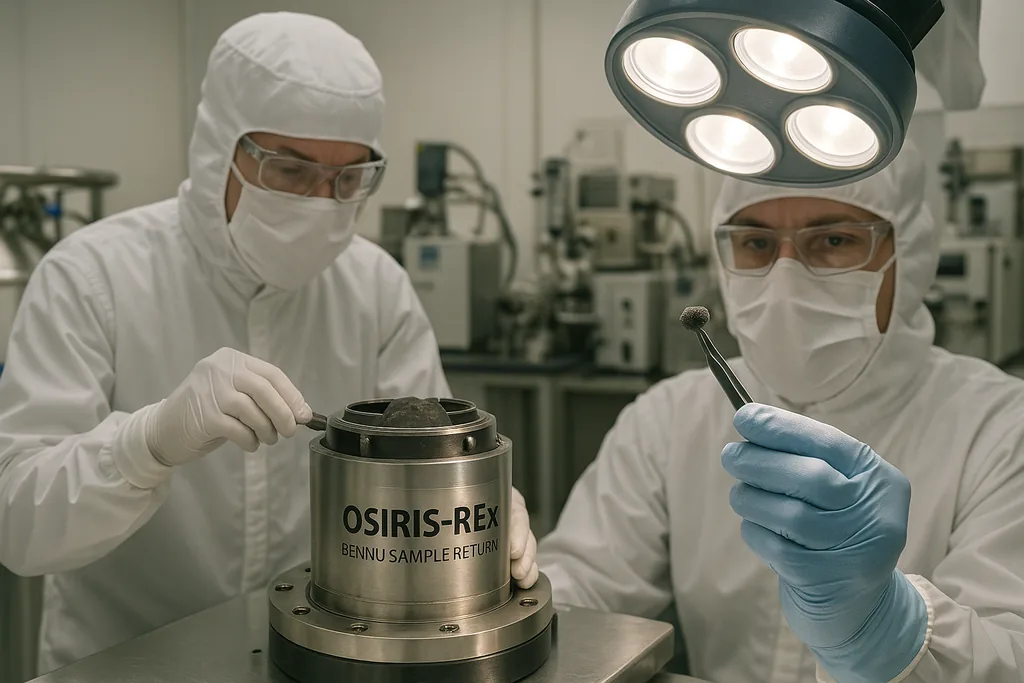
Testing asteroid material combines meticulous curation with an array of complementary instruments. Samples are unsealed inside cleanrooms that exclude Earth contamination and are kept in nitrogen boxes. Scientists examine individual grains using CT scanning to map internal structure, electron microscopy to resolve mineral textures, X‑ray diffraction to identify crystalline phases, and mass spectrometry — including high‑resolution gas and liquid chromatography coupled to mass analysers — to fingerprint organic molecules and sugars.
Isotopic measurements and radiogenic systems, such as lutetium‑hafnium or other isotope clocks used on related samples, tell researchers about the timing of alteration and the sources of elements. Teams also run controlled experiments to test whether detected molecules might be terrestrial contamination; when amino acids, ribose or glucose have been found, their isotopic ratios (ratios of heavy to light isotopes of carbon, hydrogen and nitrogen) are examined to assess an extraterrestrial origin.
Because some minerals are so soluble, earlier studies emphasise that these fragile salts were only visible because samples were never exposed to ambient humidity. That protective chain of custody is why scientists can now see evaporite minerals that point to ancient, localized pockets of brine inside Bennu's parent body.
'This changes everything,' scientists say: what this means for origins of life
Finding ribose, glucose, nucleobases, phosphates and a roster of amino acids in a single asteroid shifts the conversation about how Earth obtained the raw materials for life. It strengthens the case that asteroids and comets acted as delivery vehicles for a prebiotic inventory — a biochemical toolkit that arrived on a young, battered Earth during the heavy bombardment phase and mixed with nascent planetary chemistry.
That said, experts caution against a leap from chemistry to biology. No living organisms have been found in Bennu samples, and the presence of ingredients does not equal a recipe having been executed. Several researchers characterise Bennu as a pantry full of components rather than a kitchen where a cake was baked: the right compounds may be present, but the precise sequence of physical and chemical steps that produce self‑sustaining life remains subject to additional constraints.
The discovery does, however, reframe how scientists think about the availability and diversity of prebiotic molecules in the early Solar System. If briny microenvironments inside primitive asteroids could concentrate salts, phosphates and organics, they would have been promising incubators for complex chemistry long before Earth stabilised into habitable conditions.
How this ties to other sample returns
These Bennu results dovetail with findings from Japan's Hayabusa2 samples from asteroid Ryugu, which revealed evidence that liquid water once flowed through that rock and left isotope signatures that required late fluid movement. Taken together, Bennu and Ryugu show that water‑rock chemistry and organic synthesis were not unique to a single object: multiple primitive bodies preserved wet alteration and complex organics, although each records different thermal histories and exposure ages at their surfaces.
Implications for panspermia, and limits of the claim
Questions about panspermia — the idea that life or its building blocks are transported between worlds — become more topical when a single asteroid carries such a broad set of prebiotic compounds. The Bennu findings make it plausible that Earth received a chemically rich payload from space. They also raise the possibility that other worlds received similar deliveries, nudging probability estimates for life's emergence in other planetary systems.
But even with a pantry of molecules, the jump to self‑replicating chemistry that produces life is non‑trivial. Laboratory experiments show that many reactions that produce biological polymers require specific energy inputs, catalysts and environments. Bennu's chemistry indicates promising locales — salty, ammonia‑rich micro‑pools — where such reactions could proceed, but it does not demonstrate that they did proceed to life on that asteroid.
Why scientists are holding samples back for the future
Only a fraction of Bennu material has been analysed to date. Teams purposefully reserve portions of the collection for future scientists and methods that do not yet exist. That stewardship reflects an awareness that analytical technology improves rapidly; isotopic, molecular and imaging techniques available a decade from now may answer questions that current instrumentation cannot.
What ordinary readers should take away
The headline is significant: an extraterrestrial rock contains many of the molecules life uses on Earth, including the sugar backbone of RNA. That strengthens models where asteroids contributed essential prebiotic chemistry to early Earth and suggests that the ingredients for life are widespread in the Solar System. It does not, however, mean that life originated in space or that we have discovered alien organisms. Rather, Bennu's samples refine the raw materials and environments available during the Solar System's formative years and give laboratory scientists new, uncontaminated material to test how chemistry might step toward biology.
The discovery has immediate consequences for where we look next: missions to comets, more sample returns from varied asteroids, and continued analysis of Ryugu and Bennu material will all sharpen models of planetary chemical evolution. For now, the asteroid has offered a clearer answer to the question "What life‑building ingredients were found in the asteroid sample?" — and that answer is a rich and unexpectedly complete inventory.
Sources
- Nature (research papers on asteroid Bennu analyses)
- NASA (OSIRIS‑REx mission and sample curation)
- Tohoku University (press materials and lead investigator statements)
- Smithsonian Institution (sample analysis and curation commentary)
- Natural History Museum, London (curation and laboratory studies)




Comments
No comments yet. Be the first!