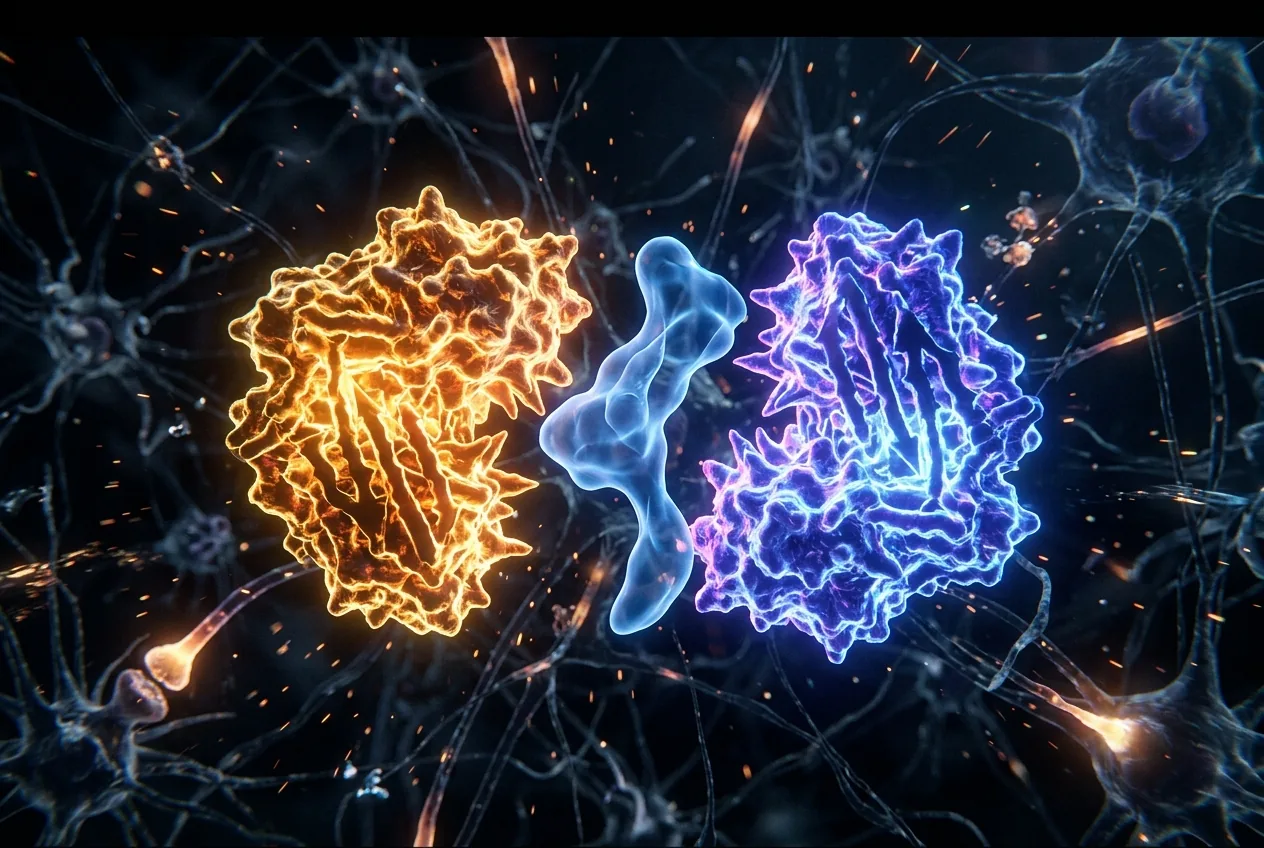
Two proteins meet in the wrong part of a brain cell, shake hands, and effectively sign a death warrant for the neuron. For decades, we have stared at the wreckage of Alzheimer’s disease—the sticky plaques and the tangled proteins—without knowing exactly who pulled the trigger. Now, a team at Heidelberg University in Germany believes they have caught the culprit in the act. It isn’t just a passive buildup of biological trash; it is a specific, physical 'death switch' that can be flipped off.
The discovery centers on an unholy alliance between the NMDA receptor and the TRPM4 ion channel. Under normal circumstances, the NMDA receptor is a hero. It is the molecular engine of learning and memory, allowing neurons to talk to one another and store information. But when it wanders outside its usual neighborhood on the cell membrane and hooks up with TRPM4, it transforms. The resulting 'death complex' stops being a tool for communication and starts a biochemical cascade that systematically dismantles the cell from the inside out.
This isn't just another incremental step in a field littered with failed drug trials. It represents a fundamental shift in how we view the disease. For thirty years, the 'Amyloid Hypothesis' has dominated the landscape, suggesting that if we just cleared out the sticky amyloid-beta plaques, the brain would heal. It hasn't worked. By the time the plaques show up, the house is already on fire. The Heidelberg team has found a way to stop the person holding the match.
To prove this, the researchers developed a molecule called FP802. In the world of high-stakes biochemistry, this is known as a 'TwinF Interface Inhibitor.' Its job is simple but surgical: it slides between the NMDA receptor and the TRPM4 channel, breaking their grip on each other. When they aren't touching, they can't kill. In trials involving mice, the results were almost suspiciously good. The treatment didn't just slow down the memory loss; it effectively protected the brain’s architecture, preserved the connections between neurons, and—crucially—reduced the formation of those infamous amyloid plaques.
The Janitor Problem and the Fire Extinguisher
The current crop of FDA-approved Alzheimer’s drugs, like Leqembi, act like high-priced janitors. They go into the brain and attempt to sweep up the amyloid-beta 'trash' that has accumulated over years. The problem is that the trash might just be a byproduct of the actual crime. If you spend all your time cleaning up the broken glass but never stop the guy throwing bricks through the window, you’re never going to have a functional house. This is why many patients on these drugs see only a modest slowing of their decline, often accompanied by dangerous side effects like brain swelling or bleeding.
There is a specific irony in the fact that the NMDA receptor is involved in both the creation and the destruction of memory. It is a reminder that the brain is a delicate balance of signals. If you block the NMDA receptor entirely, you stop the 'death switch,' but you also stop the person from being able to learn or remember anything at all. This was the failure of earlier drugs. They were sledgehammers. FP802 is a pair of tweezers, removing the toxic connection without disabling the vital function of the receptor itself.
What surprised the Heidelberg team most was the effect on amyloid plaques. Even though FP802 doesn't target plaques directly, the mice treated with it had significantly fewer of them. This suggests a vicious cycle: the death complex promotes amyloid formation, and amyloid, in turn, may push more receptors into the 'death' zone. If you break the cycle at the complex, the whole system begins to stabilize. It’s a hint that the 'trash' we’ve been trying to clean up might actually stop being produced if we stop the cells from dying in the first place.
A Broader Attack on the Cellular Hijackers
Heidelberg isn't the only lab finding evidence that Alzheimer’s is a case of the brain’s own machinery being weaponized against it. At Stanford’s Wu Tsai Neurosciences Institute, researchers have uncovered a similarly grim scenario. They found that amyloid-beta and inflammation converge on a specific receptor that tells neurons to eat their own synapses. This is a process called 'pruning,' and it is perfectly healthy when you are a toddler and your brain is streamlining itself. But in an Alzheimer’s brain, this system is hijacked, and the brain begins pruning itself into oblivion.
The common thread here is the transition from passive 'plaque theory' to active 'signaling theory.' We are moving away from the idea that the brain is simply getting 'clogged' and toward the realization that it is being tricked into committing suicide. This is an important distinction because signaling pathways are much easier to target with modern drugs than the massive, inert clumps of protein that make up plaques.
Meanwhile, at the University of New Mexico, another team has been looking at a protein called OTULIN. When they disabled this protein in lab models, the tau protein—the other big 'villain' in the Alzheimer’s story that creates tangles inside cells—completely vanished. The neurons remained healthy. It’s another example of how scientists are finding specific molecular 'valves' that can be turned to stop the progression of the disease before it becomes irreversible.
This wave of research suggests we are finally moving past the 'Amyloid Era.' For decades, if you weren't studying amyloid, you didn't get funded. That monoculture in research is breaking down, and it’s about time. We have spent billions of dollars on drugs that target the end-stage symptoms while the underlying mechanism remained a mystery. Now, with the discovery of the NMDAR/TRPM4 'death complex,' we have a concrete target that actually explains why the cells are dying.
The Long Road From Mice to Men
The inevitable caveat, of course, is that we have 'cured' Alzheimer’s in mice dozens of times. Human brains are vastly more complex, and our lived experience—decades of diet, stress, and environmental factors—cannot be replicated in a lab mouse. A compound that prevents cognitive decline in a rodent might do nothing for a 75-year-old human whose brain has been under assault for twenty years before the first symptom appeared.
There is also the question of timing. Because Alzheimer’s is often diagnosed only after significant damage has occurred, any treatment based on FP802 would likely need to be administered very early. This creates a massive diagnostic challenge. How do we identify the people whose 'death switches' are starting to flip before they begin losing their keys or forgetting their grandchildren’s names? It would require a revolution in blood tests or retinal scans to catch the disease in its silent, early phase.
Despite these hurdles, the Heidelberg discovery is a massive morale boost for a field that has seen more failure than perhaps any other area of medicine. It provides a clear, mechanical explanation for neurodegeneration. It isn't 'bad luck' or 'mysterious aging'; it is a specific protein interaction that we can now see, measure, and break apart. The 'death complex' has a name and a face, and we finally have a molecule that can punch it in the teeth.
The next few years will be about refining these inhibitors and seeing if they can pass the brutal gauntlet of human clinical trials. But for the first time in a long time, the strategy isn't just about cleaning up the wreckage after the storm has passed. It’s about reinforcing the structure so the storm never takes the house down in the first place. For the 55 million people currently living with dementia, that shift in perspective is everything.




Comments
No comments yet. Be the first!