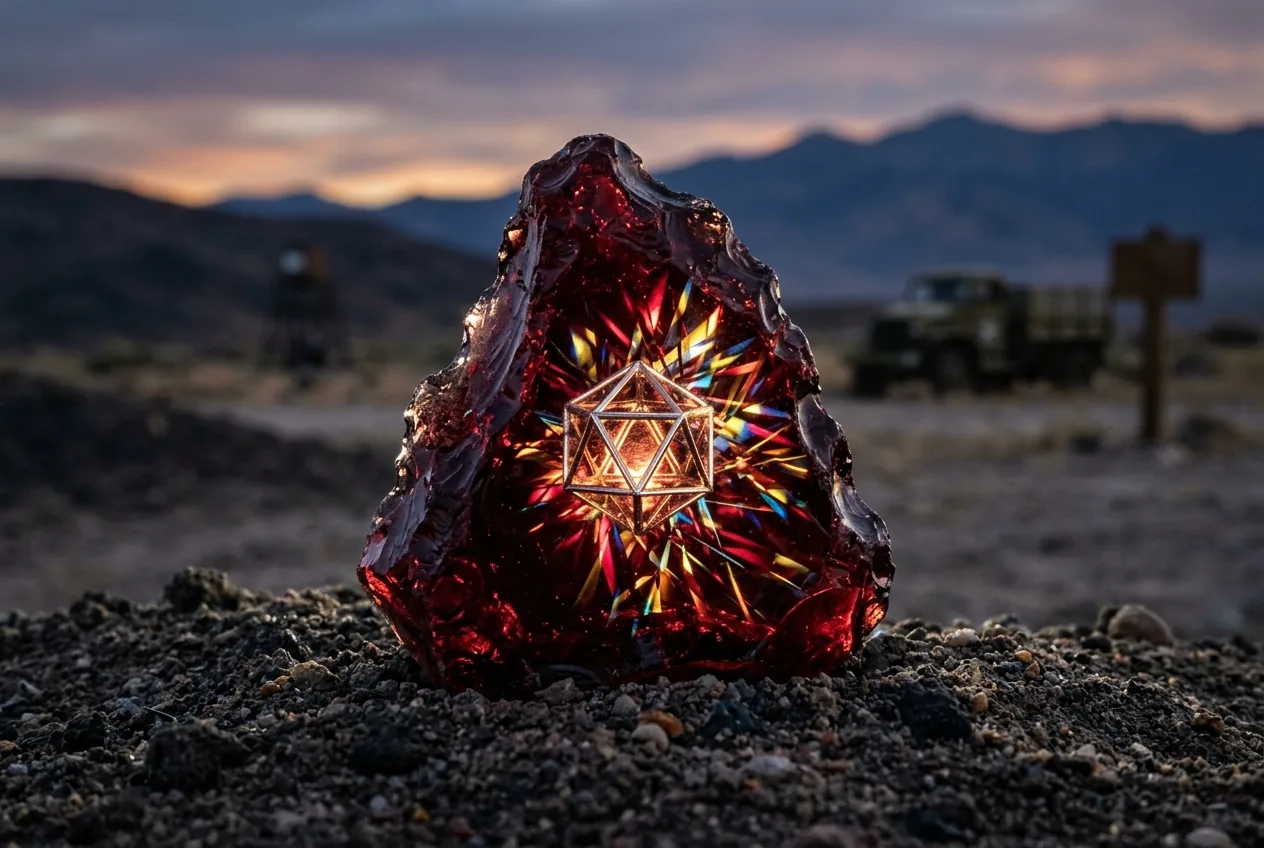
At 5:29 AM on a Monday in 1945, a 100-foot steel tower in the New Mexico desert simply ceased to exist. In its place was a fireball hotter than the surface of the sun, a shockwave that cracked the earth, and a silent, terrifying transformation of the landscape. As the mushroom cloud rose over the Jornada del Muerto desert, the heat—reaching tens of millions of degrees—did something unexpected to the ground below. It sucked up the sand, the copper communication wires, and the remains of the steel scaffolding, fusing them into a radioactive, glass-like substance we now call Trinitite.
The Desert That Liquidated Into Glass
To understand the rarity of this discovery, you have to look at the ingredients of the Trinity test. Most of the Trinitite found at the site is a pale, bottle-green color, formed almost entirely from the silicate sand of the desert floor. The red variety is a different beast altogether. It is the chemical fingerprint of the moment the explosion reached out and grabbed the human-made structures around it. The red hue comes from the vaporized copper of the wires that ran from the tower to the recording instruments, mixed with the iron of the tower itself.
This mixture was subjected to pressures and temperatures that are virtually impossible to replicate in a controlled laboratory setting. We are talking about five to eight gigapascals of pressure and temperatures exceeding 1,500 degrees Celsius. In that brief, violent window, the atoms of the desert sand and the copper wires were forced into a configuration that violates the basic tenets of crystallography. They didn't just melt and reform; they reorganized into a pattern that had never been seen on Earth outside of a few rare meteorites.
The resulting crystal has a 20-sided symmetry—an icosahedron. In standard chemistry, crystals are like bathroom tiles; they follow a repeating, periodic pattern. You can slide the pattern across a floor, and it will always line up. Quasicrystals don't do that. They have an ordered structure, but it never repeats. They are the mathematical equivalent of a mosaic that covers an infinite floor without ever using the same sequence twice.
The Forbidden Geometry of Five-Fold Symmetry
For most of the 20th century, the idea of a quasicrystal was considered a scientific heresy. According to the laws of geometry that governed physics for hundreds of years, you could only have crystals with two-fold, three-fold, four-fold, or six-fold symmetry. Five-fold symmetry—the kind you see in a pentagon or a soccer ball—was thought to be physically impossible in a solid material because the shapes wouldn't fit together without leaving gaps.
The Trinity quasicrystal is a specific composition of silicon, copper, calcium, and iron. It is a combination of elements that does not exist in this configuration anywhere else in the natural world. While we can now grow some quasicrystals in highly specialized labs, we cannot easily synthesize the exact version found in the New Mexico sand. The sheer violence of the nuclear blast provided a shortcut through the laws of thermodynamics, forcing a state of matter that we still struggle to understand.
Why Lab Technicians Can't Replicate a Nuclear Blast
This "far beyond conventional synthesis" label isn't just hyperbole. It represents a gap in our current manufacturing capabilities. We can produce the heat, and we can produce the pressure, but replicating the specific, fleeting interaction between vaporized copper wires and molten sand in a vacuum-like explosion environment is a massive engineering hurdle. The Trinity test was, in a dark sense, a massive, accidental chemistry experiment that we haven't been able to rerun.
This raises a fascinating tension in material science. If we can't make it in a lab, but it exists in the desert, what other materials are we missing simply because we haven't subjected matter to enough trauma? We are currently limited by our tools, while the universe—and our most destructive weapons—operates on a much broader palette of physics.
A New Toolkit for Nuclear Detectives
While the discovery is a win for theoretical physics, it has a much more practical, and perhaps more ominous, application: nuclear forensics. When a nation conducts an undeclared nuclear test, they often try to hide the evidence underground or in remote locations. However, the debris left behind—the melted earth and vaporized infrastructure—contains a permanent record of the blast.
This is particularly relevant as the world enters a new era of nuclear tension. Traditional methods of detecting tests, such as seismic monitoring or sniffing for radioactive gases like xenon, can sometimes be fooled or masked. But you cannot mask the fundamental reorganization of the atoms in the soil. If a quasicrystal like the one at Trinity is found, there is no natural process—short of a massive meteorite impact—that can explain it away.
Echoes of a Dying Star in a New Mexico Grain
The only other place we have found naturally occurring quasicrystals is in the Khatyrka meteorite, a fragment of space rock found in far eastern Russia. That meteorite dates back to the early solar system and likely underwent a massive collision in space, creating the same high-pressure shock conditions seen at the Trinity site. The fact that the same structures appear in both a 4.5-billion-year-old rock and a 79-year-old bomb site is a chilling reminder of the scales of energy we are playing with.
In many ways, the Trinity quasicrystal is a bridge between the cosmic and the man-made. It shows that when we detonated the first atomic bomb, we weren't just creating a new weapon; we were tapping into the same high-energy physics that shaped the planets and the stars. We were, for a fraction of a second, recreating the conditions of a celestial collision on a quiet morning in New Mexico.




Comments
No comments yet. Be the first!