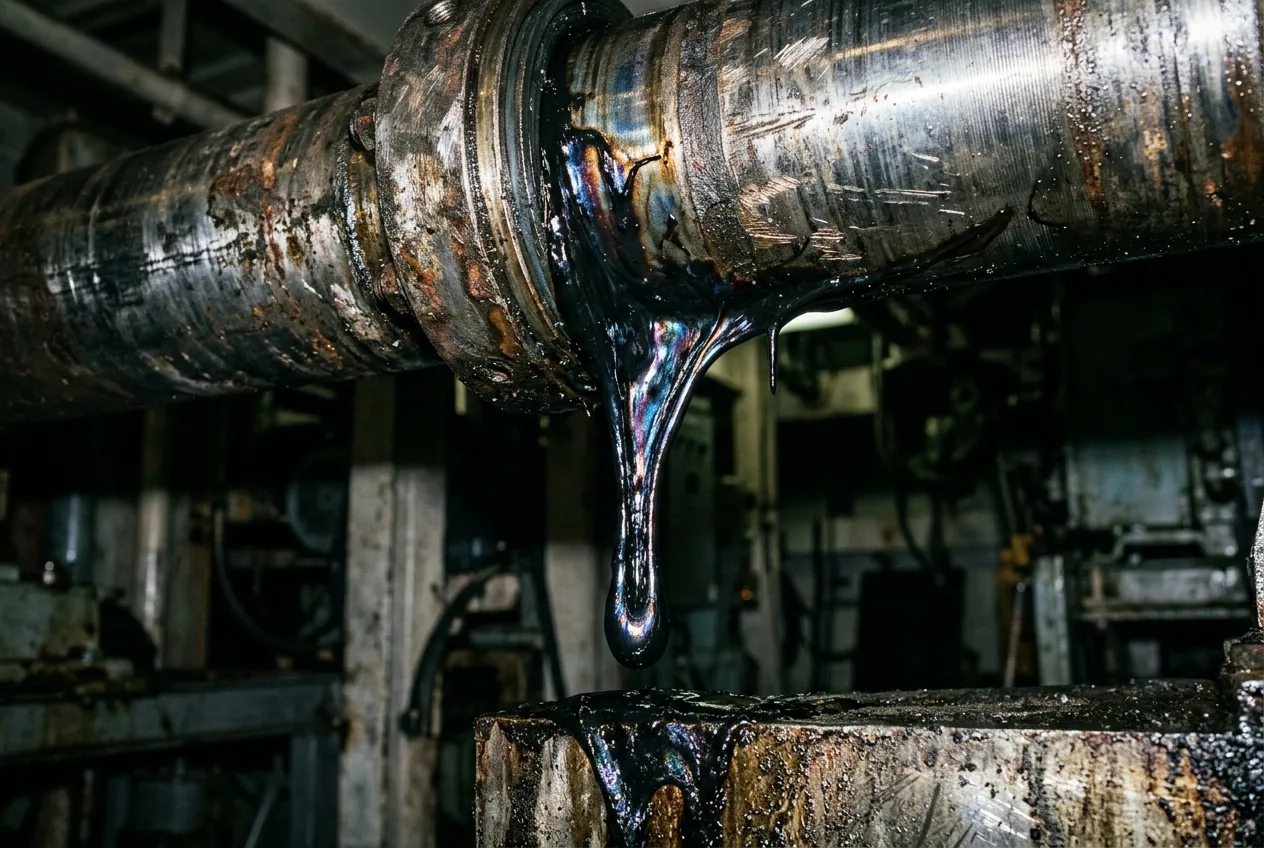
Doug Ricketts, the marine superintendent at the Large Lake Observatory, was performing what should have been a forgettable piece of routine maintenance on the R/V Blue Heron in 2025. When the rudder shaft was pulled for inspection, it wasn’t just the expected layer of industrial lubricant that greeted him. Instead, he found a thick, obsidian-coloured sludge—a substance that felt less like an engineering failure and more like a biological colonisation. It was black, it was viscous, and as researchers at the University of Minnesota Duluth (UMD) soon discovered, it was very much alive.
What Ricketts had stumbled upon was not a chemical breakdown of grease, but a thriving, anaerobic ecosystem. The substance, now informally dubbed "ShipGoo001," contained at least 20 reconstructed genomes, including an entirely new order of archaea and a potential new bacterial phylum. While marine biology typically looks to the deep-sea vents or the abyssal plains for such novelties, this discovery highlights a blind spot in industrial oversight: we are building perfect habitats for extreme life in the very machines meant to navigate the world.
The anaerobic luxury of the rudder housing
The rudder housing of a research vessel is an unlikely cradle for a new branch on the tree of life. It is semi-warm, shielded from sunlight, and entirely devoid of oxygen. To the aerobic organisms that dominate the Great Lakes, it is a tomb; to the archaea found within the goo, it is a five-star resort. Microbiologist Cody Sheik and his team at UMD found that these microbes didn’t just survive in the grease; they were the primary architects of the substance’s consistency. Unlike the "golden orb" discovered two miles deep in the Gulf of Alaska in 2023—which baffled NOAA scientists until DNA sequencing suggested it was a biological specimen rather than a geological anomaly—ShipGoo001 is a product of human infrastructure providing a niche that the natural environment lacks.
The technical mystery is how these organisms arrived. The Blue Heron operates in the highly oxygenated waters of the Great Lakes. For an anaerobic microbe, a trip through Lake Superior should be a death sentence. The prevailing theory among the UMD researchers is that the microbes may have arrived as dormant spores or contaminants within the grease itself. They effectively waited for the rudder to be sealed, creating the low-oxygen pocket they required to begin their metabolic expansion. This represents a form of accidental bio-engineering that has largely escaped the notice of maritime regulators and chemical suppliers alike.
A missed opportunity for the European bio-economy?
The discovery of ShipGoo001 carries implications that go beyond mere taxonomy. Preliminary genomic analysis suggests that some of these organisms are capable of producing hydrogen. In the context of the European Union’s hydrogen strategy and the broader push for sustainable biofuels, finding a microbe that thrives in industrial waste environments while pumping out a high-energy gas is a detail that should be keeping energy policy-makers in Brussels awake at night. If these archaea can be cultivated, the very "black goo" that engineers currently scrub off rudder shafts could become a feedstock for decentralized energy production.
However, the gap between a lab-bench discovery and industrial-scale application remains wide. Under the Horizon Europe funding framework, millions have been poured into synthetic biology to create the kind of robust, hydrogen-producing organisms that Doug Ricketts found sitting in a bucket of grease. The irony is that while we spend billions trying to engineer resilience into microbes, nature is busy doing the work for free in the underside of our ships. The question is whether the EU’s industrial policy can pivot fast enough to leverage these "wild" industrial microbes before they are patented by a US-based venture capital firm.
The biological debt of global shipping
We have spent decades treating bio-fouling as a purely subtractive problem—something to be poisoned with biocidal paints or scraped away with high-pressure hoses. The R/V Blue Heron discovery suggests we should be looking at it as a form of biological debt. Our infrastructure is not a sterile container; it is a selective pressure. As we move toward more complex maritime technologies and deep-sea exploration, we are creating more of these artificial niches. From the newly discovered glowing sea slug, Bathydevius caudactylus, found in the ocean’s "midnight zone," to the flesh-eating Vibrio vulnificus expanding its range into northern waters like Long Island, the boundaries between "human space" and "biological space" are dissolving.
The ShipGoo001 phenomenon reveals that our industrial standards for lubricants and sealants do not account for microbial colonisation. If a rudder housing can host a new order of life, what is living in the cooling systems of our data centres or the fuel tanks of our strategic reserves? There is a profound lack of data regarding the long-term metabolic effects of these organisms on the structural integrity of the alloys they inhabit. While the UMD team noted that the biomass was surprisingly high, they have yet to determine if these microbes are actively corroding the rudder shaft or simply living off the chemical energy of the grease. In the world of maritime insurance and maintenance, that distinction is worth millions of Euros.
Why exploratory science remains a bureaucratic struggle
Cody Sheik’s observation that scientists "don’t often have time to be playful" is a polite way of acknowledging that modern grant structures are allergic to the unexpected. In the current European research landscape, most funding is tied to pre-defined deliverables and milestones. A scientist who stops a project to investigate a weird bucket of sludge found by a maintenance guy often risks their next round of funding. Yet, as this case proves, the most significant data points often hide in the margins of a maintenance log rather than the center of a planned experiment.
We are entering an era where the machines we build to explore the world are becoming the very ecosystems we need to study. The discovery of ShipGoo001 isn’t a one-off anomaly; it is a diagnostic of our current state of ignorance. We have mapped the stars and sequenced the human genome, but we still don't know what is living in our own grease. The engineers in Duluth cleaned the rudder and put the ship back in the water, but the biological reality they uncovered remains. Brussels may eventually fund a study on it, but the microbes have already started their next shift. They don't need a grant; they just need a bit of grease and the absence of light.



Comments
No comments yet. Be the first!