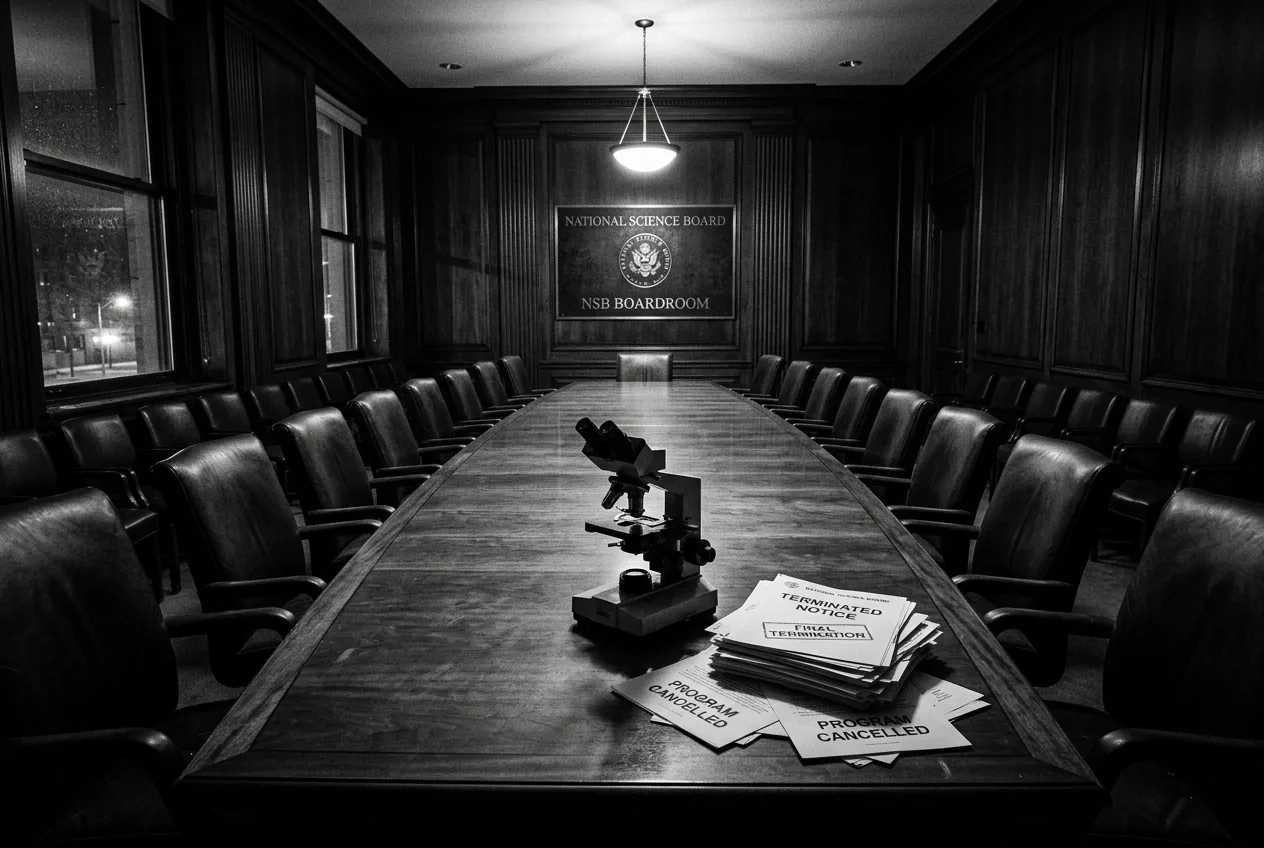
The email arrived on Friday, April 24, and it contained no pleasantries. Sent from the Presidential Personnel Office, the notice informed all 22 members of the National Science Board (NSB) that their services were no longer required. There was no explanation. There was no transition period. There was simply an empty room where the governing body of American basic science used to be.
This wasn't just a routine reshuffle of political appointees. The National Science Board is the brain and the shield of the National Science Foundation (NSF), an agency with a $9 billion budget that funds everything from the search for gravitational waves to the fundamental mathematics that make modern encryption possible. For 76 years, this board has functioned as a non-partisan firewall, ensuring that the scientists decide which experiments are worth the money, rather than the politicians. That firewall has just been demolished.
Willie E. May, the vice president of research at Morgan State University and one of the fired members, did not mince words. He described the move as a "systematic dismantling" of the nation’s scientific infrastructure. To those inside the loop, the Friday massacre was the culmination of a year-long siege on how the United States decides what is true and what is worth discovering.
The $9 billion wallet without a lock
To understand why this matters to anyone who isn't a lab-coat-wearing academic, you have to look at the money. The NSF is the primary engine behind American innovation. It doesn’t do the research itself; it acts as the venture capital firm for the human mind. If you’re a PhD student in a basement in Ohio trying to figure out a new way to sequence DNA or a way to make batteries last ten times longer, the NSF is usually the one keeping the lights on.
Until last Friday, the National Science Board was the group that signed the checks. They approved large-scale funding decisions and set the long-term strategy for American science. Crucially, they were designed to be independent. Members serve six-year terms that are staggered so that no single President can easily pack the board with loyalists. By firing the entire board at once, the administration has bypassed a century of protocol designed to keep science from becoming a campaign tool.
Without the board, the $9 billion budget is essentially a pot of gold without a dragon to guard it. The fear among researchers is that funding will no longer flow to the most promising ideas, but to the ideas most aligned with the current administration’s political or industrial goals. When you remove the experts from the room, the only thing left is the ideology.
A pattern of scientific decapitation
This isn't an isolated incident or a sudden whim. It is part of a broader, clinical strike against advisory bodies across the federal government. Over the last year, the administration has eliminated 152 federal advisory committees. These are the groups of specialists who tell the government if a bridge is likely to collapse, if a new chemical is going to poison a river, or if a new drug is actually safe for your kids.
At the Department of Energy, the administration took a different approach: it didn't fire everyone, it just merged every single advisory committee into one giant, amorphous group. It’s the equivalent of firing your cardiologist, your plumber, and your accountant and replacing them with one guy who claims to be "good with systems." Meanwhile, the Environmental Protection Agency’s research office—the place that actually checks the data on pollution—has been effectively dismantled.
The numbers inside the NSF already tell a story of retreat. Last year, the foundation granted 51% less funding to scientists than the average seen between 2015 and 2024. Hundreds of active grants, some of which had been running for years, were simply terminated. It’s a scorched-earth policy for the lab bench, leaving thousands of researchers without the means to finish their work.
The pivot to profitable intelligence
Why would any government want to hobble its own scientific output? The answer likely lies in a massive strategic pivot. Information leaking from the administration suggests the goal isn't to kill science, but to force it into a very specific, commercially viable box: Artificial Intelligence. There is a growing tension between "basic science"—research done for the sake of knowledge—and "applied science," which is research done to build a product.
The administration has repeatedly proposed cutting $5 billion from the NSF’s budget while simultaneously demanding that the agency prioritize AI and commercial tech that can compete with China. In this worldview, spending money to understand the mating habits of rare insects or the cooling rates of white dwarf stars is a luxury the U.S. can no longer afford. They want weapons, they want algorithms, and they want them now.
The problem is that you don't get the iPhone without basic research into quantum mechanics that happened decades earlier. You don't get the COVID-19 vaccine without decades of "useless" research into mRNA. By firing the board that protects basic science, the administration is effectively eating the seed corn to make a slightly larger loaf of bread today. It’s a strategy that looks great on a quarterly balance sheet but looks like a suicide note for the next generation of American tech.
Who tells the President 'no' now?
Gretchen Goldman, president of the Union of Concerned Scientists, pointed out that the public is now effectively blind to how the NSF is operating. Without the board, there is no one to provide oversight, no one to publish independent reports, and no one to tell the White House that a specific policy is scientifically illiterate. The agency is now a black box.
The legalities of the firing are already being questioned. The National Science Foundation Act of 1950 was written specifically to prevent this kind of mass termination. However, the current administration has shown a consistent willingness to push the boundaries of executive power, betting that the court system will be too slow or too packed with sympathetic judges to stop them before the damage is done.
For the 22 scientists who received that email on Friday, the personal cost is secondary to the institutional one. They represent some of the finest minds in physics, biology, and engineering. They were the last line of defense against the politicization of facts. Their removal sends a chilling message to every scientist currently on the federal payroll: your expertise is a liability, and your independence is a fireable offense.
The end of the 1950 handshake
Since the end of World War II, there has been a quiet handshake between the American government and the scientific community. The government provides the money, and the scientists provide the progress, with the understanding that the politicians won't touch the data. That handshake is over. We have entered an era where science is treated not as a pursuit of truth, but as another branch of the executive’s PR and industrial wing.
In February 2026, during one of the last meetings of the now-defunct board, NSF leadership admitted they were already "limiting" new grant solicitations. The drought had already begun. Now, with the board gone, the drought is likely to become a permanent climate. If you are a young scientist in America today, you are looking at a landscape where the government is no longer your patron, but your boss.
The fallout won't be immediate. You won't wake up tomorrow and find that the internet has stopped working or that gravity has failed. But in ten years, when the next major disease hits, or the next energy crisis arrives, we may look back at April 24, 2026, as the day we decided we didn't need the people who could have solved it. A country that fires its smartest people for being independent is a country that is planning to stop thinking.




Comments
No comments yet. Be the first!