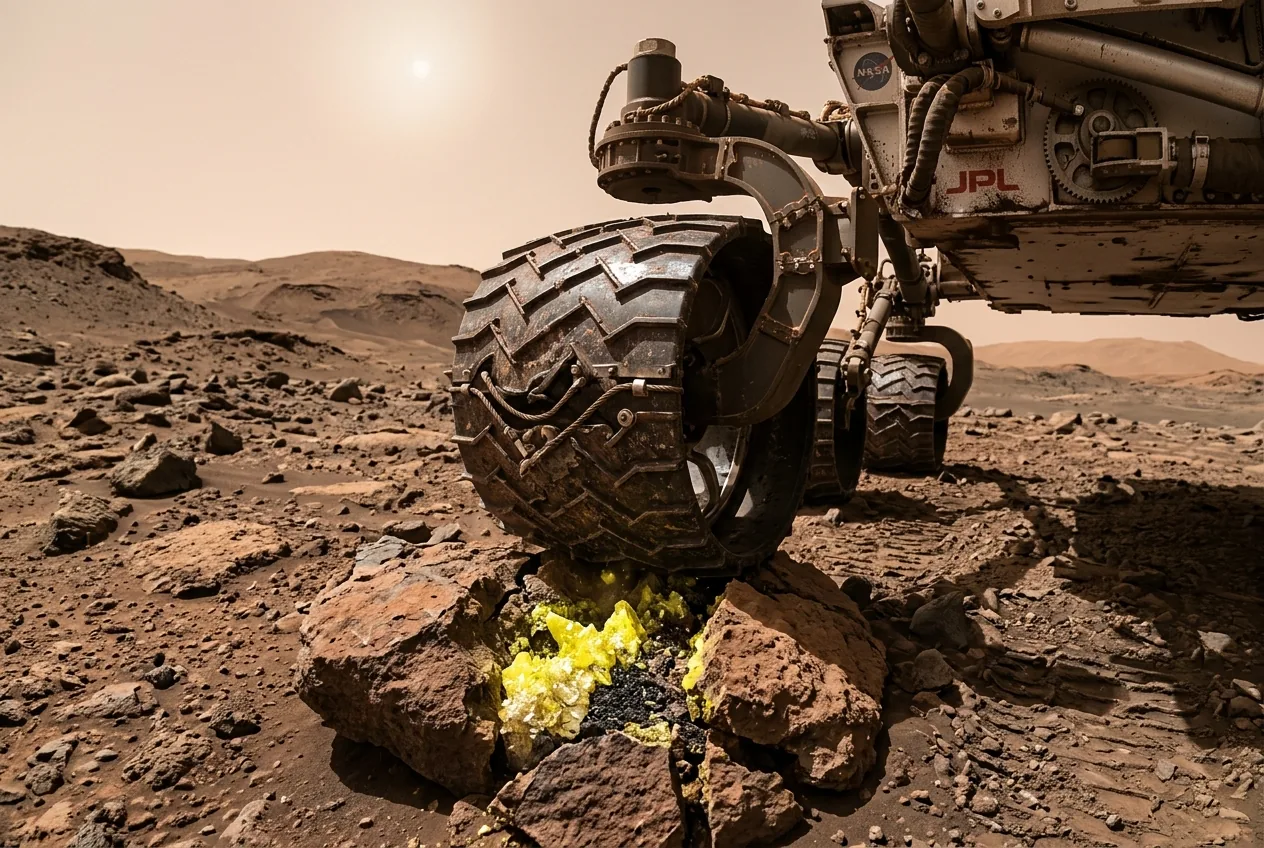
The six-wheeled robot currently roaming the Martian wasteland just had its version of a lucky break. While trundling through the Gediz Vallis channel, a jagged stretch of terrain that looks like a dried-out mountain stream, the Curiosity rover accidentally ran over a rock. The one-ton machine crushed it under its weight, splitting the stone open to reveal something that should not, by any current geological model, be there. Inside the dull, reddish exterior sat a cluster of bright, translucent yellow crystals: pure, elemental sulfur.
NASA’s scientists didn't see this coming. While the team has spent years finding sulfates—salts that contain sulfur mixed with other elements—finding the pure stuff is a different beast entirely. It is the Martian equivalent of walking through a desert and finding a block of pure gold where you expected only sand. Pure sulfur only forms under a very narrow set of conditions, none of which were thought to have existed in this specific corner of Gale Crater. The discovery has effectively tossed a wrench into the tidy narrative of how the Red Planet dried up and died.
The chemistry of a unexpected find
Sulfur is often described as the 'smell of life' on Earth, or at least the smell of its decay. It is essential for every living thing, found in the amino acids that build proteins. On Mars, it has always been a marker for habitability. But the leap from sulfate minerals to pure sulfur is massive. Usually, creating pure sulfur requires a very specific volcanic process or, more tantalisingly, a biological one. On Earth, certain types of bacteria 'breathe' sulfur, processing it into different forms as a way of generating energy. Finding a field of it in a place shaped by water makes you wonder who, or what, was doing the heavy lifting.
The rover didn't just find one rock. After the initial accidental crushing, the team looked around and realised the entire area was littered with these 'yellow-bellied' stones. It wasn't a fluke; it was a deposit. This presents a massive headache for the geologists back in California. There is no obvious volcanic source nearby. There is no obvious hydrothermal vent. It is as if a giant spilled a bag of matchstick heads into a riverbed and left them there for three billion years.
Why pure sulfur changes the map
When we look for life on Mars, we aren't looking for little green men with ray guns. We are looking for chemistry that looks like it was tampered with. Nature likes things to be messy and mixed together. Pure elements are rare because they are reactive; they want to bond with something else. For a field of pure sulfur to survive for eons, the environment had to be incredibly stable or the process that created it had to be incredibly powerful. It suggests that the water that once flowed through Gediz Vallis wasn't just a simple stream, but a complex chemical soup.
The timing of the find is also a bit of a cosmic joke. Just as Curiosity is hitting this chemical jackpot, its younger cousin, the Perseverance rover, is finding 'leopard spots' in another part of the planet. These are small, white circles with black rims on rocks that, on Earth, are often the result of microbial colonies living inside the stone. Both rovers are now staring at evidence that screams 'life lived here,' but both are hampered by the same problem: they are millions of miles away from a lab that can provide a definitive 'yes'.
The limitation of robotic eyes
The frustration for the team at NASA’s Jet Propulsion Laboratory is palpable. They have the data, they have the images, and they have the chemical signatures. But they don't have the context. A rover can zap a rock, but it can't perform a full forensic autopsy. The sulfur find is a classic example of 'the more you know, the more you realise you don't know'. Every time we think we have a handle on the Martian timeline—water, then ice, then dust—the planet throws a curveball like a field of yellow crystals.
A planet of missed connections
There is a certain irony in how we discover things on Mars. We spend billions on high-resolution cameras and sophisticated sensors, but the biggest breakthrough in years came because a wheel happened to hit a rock at the right angle. It’s a reminder that space exploration is still a messy, physical business. You can simulate everything you want in a lab in Pasadena, but the universe will always find a way to surprise you with a bit of yellow rock in a place it has no business being.
The search for life is often framed as a hunt for a 'smoking gun,' a single piece of evidence that settles the debate forever. But science rarely works like that. Instead, it’s a slow accumulation of 'weird' things. A bit of methane in the air here. A strange organic molecule there. A patch of leopard-spotted rocks. And now, a field of pure sulfur. Each one is a puzzle piece. We don't have the full picture yet, but the image that is starting to emerge looks less like a barren rock and more like a crime scene where the suspect has only just left the room.
As we look toward future missions—including the ambitious and controversial plan to bring Martian rocks back to Earth—the sulfur find at Gediz Vallis will be a primary data point. It tells us that Mars was never a simple world. It was a place of chemical extremes, of sudden floods, and of long-lasting habitats. Whether anyone was actually home to enjoy those habitats remains the biggest question in science. For now, we have the yellow crystals. They are a silent, glowing testament to a version of Mars that was far more alive than the one we see today.




Comments
No comments yet. Be the first!