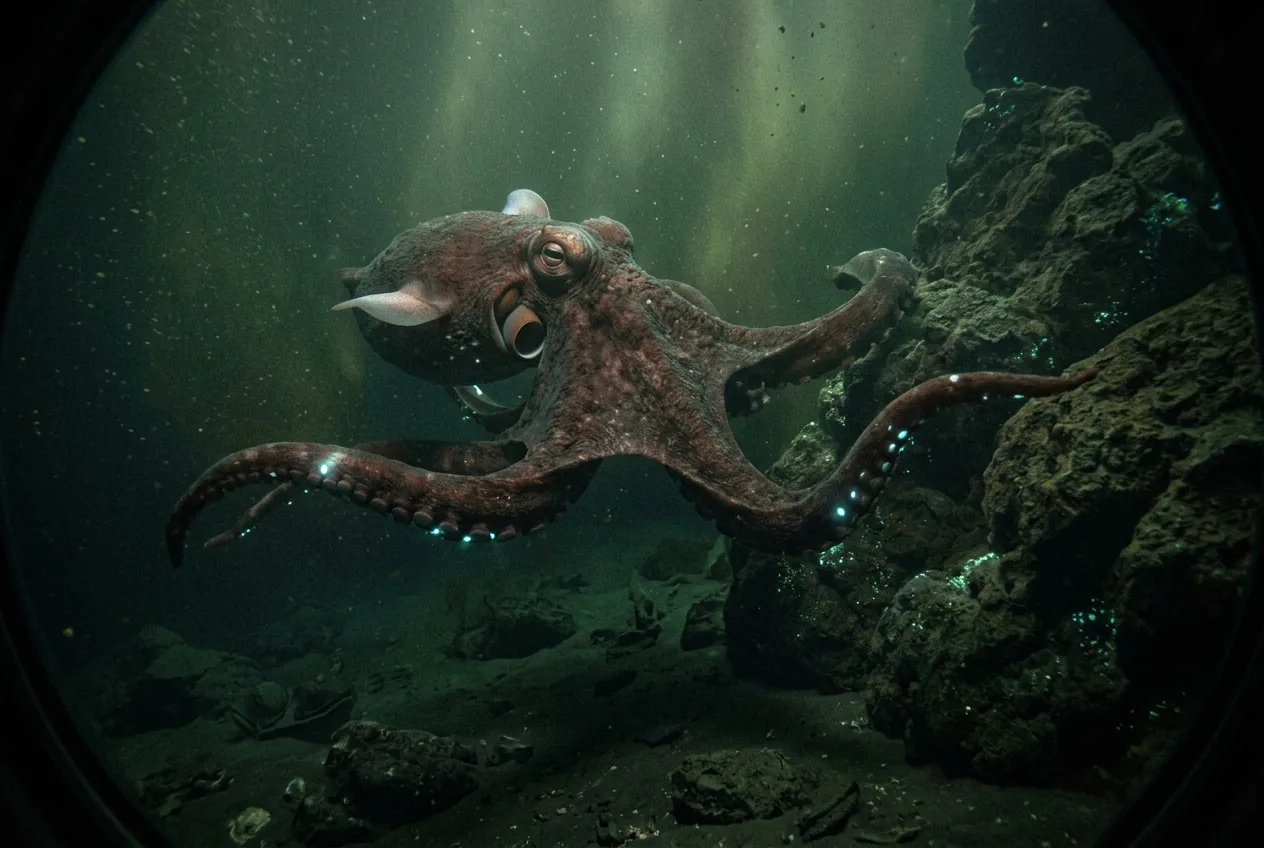
A single, jagged piece of chitin the size of a dinner plate is all it takes to ruin a perfectly good theory about the Mesozoic food chain. For decades, the Cretaceous seas were considered the private playground of the Mosasaur and the long-necked Plesiosaur—reptilian apex predators that looked like evolutionary drafts of a nightmare. But paleontologists have been forced to recalculate the ocean's carrying capacity for monsters after analyzing the fossilized beak of a cephalopod that reached an estimated 62 feet (19 meters) in length.
The discovery identifies a massive, finned octopus that likely patrolled the deep waters of the Late Cretaceous. Unlike their cousins, the squids, which rely on torpedo-like speed and tentacular reaches, these ancient octopuses were cirrates—finned, soft-bodied organisms that moved through the water with the grace of a parachute and the weight of a heavy-duty truck. In a world where the biggest threat was supposedly a lizard with flippers, this 19-meter invertebrate suggests that the most successful hunters in the water didn't even have a skeleton.
The chitinous smoking gun
Cephalopods are notoriously uncooperative when it comes to the fossil record. They are essentially sentient bags of muscle and ink, and muscle does not survive 80 million years of geological pressure. Usually, the only parts that remain are the hard, parrot-like beaks and the occasional internal shell or "gladius." Extrapolating a 19-meter animal from a beak requires a level of biological modeling that borders on the architectural. It is the paleontological equivalent of trying to reconstruct an entire Airbus A380 from a single landing gear bolt.
The engineering reality of a 60-foot soft-bodied organism is a nightmare of fluid dynamics. Without a rigid skeleton, the animal must rely on hydrostatic pressure to maintain its shape. In the deep Cretaceous oceans, this meant a massive metabolic investment. While a Mosasaur can glide through the water with a relatively low energy expenditure between hunts, a 19-meter octopus is a high-maintenance biological machine. Every movement of its fins and every jet of water through its siphon requires a significant caloric intake, suggesting the Cretaceous seas were far more productive and prey-dense than previously estimated.
The metabolic tax of being a giant
In the world of marine biology, size is rarely free. To maintain a 19-meter frame, these octopuses would have needed a consistent supply of high-energy food sources. This suggests a more complex vertical migration system in the ancient oceans than we currently model. If these giants were deep-water residents—as their modern finned descendants are—they were likely tapping into a deep-sea biomass that escaped the notice of the reptilian hunters of the surface.
The discovery also challenges the "Mesozoic Marine Revolution" narrative, which posits that predators became more efficient and heavily armored to deal with a rise in shell-crushing hunters. A soft-bodied giant suggests a different strategy: total avoidance of the armor-piercing arms race in favor of sheer scale and deep-water refuge. It is a reminder that while the Mosasaurs were winning the PR war in the fossil record because they had bones, the squishy giants were likely doing just as well in the shadows.
For European researchers, particularly those at the European Synchrotron Radiation Facility (ESRF) in Grenoble, the challenge is now one of imaging. Because these fossils are often encased in hard nodular rock, traditional preparation techniques can destroy the delicate chitinous structures. Advanced X-ray tomography is becoming the standard for "unwrapping" these fossils, allowing paleontologists to see the internal structure of the beak without ever touching it with a chisel. It is a high-cost, low-yield game that depends heavily on EU research grants that are increasingly pivoted toward more "utilitarian" materials science.
A procurement problem in the deep past
The existence of a 19-meter predator raises uncomfortable questions about Cretaceous ecological stability. In modern ecosystems, apex predators are few and far between. If you add a 60-foot octopus to the mix, the nutrient requirements of the ecosystem spike. This suggests that the Late Cretaceous ocean was an incredibly efficient energy-transfer machine, moving carbon from the surface to the deep with a speed that modern oceans—currently struggling with acidification and warming—simply cannot match.
The German and wider European paleontology communities have long focused on the Solnhofen limestone and the Posidonia Shale, famous for preserving soft tissues. However, these giant cephalopods are often found in less "perfect" environments, requiring a different kind of data-driven investigation. We are no longer looking for the perfect fossil; we are looking for the data points that allow us to simulate the missing mass. It is a shift from classical natural history to something closer to forensic engineering.
There is a certain irony in the fact that we are only now discovering the true "rulers" of the Cretaceous seas. While we have spent a century obsessing over the teeth of T. rex and the jaws of the Megalodon, the octopus was quietly operating at scales we thought were reserved for mythology. It turns out the Kraken wasn't a myth; it was just an early adopter of a very successful body plan that didn't leave a skeleton for us to find.
The oceans have always been better at keeping secrets than the land. A 19-meter octopus can disappear into the geological record with barely a trace, while a medium-sized dinosaur leaves a trail of bones that can be tracked for miles. This discovery isn't just about a big animal; it's about the massive gaps in our understanding of how the planet's largest habitat actually functioned during its most dramatic era.
Europe has the high-res imaging labs and the analytical chemists to solve the riddle of the soft-bodied giants. It just hasn't decided if studying 80-million-year-old ink is worth the electricity bill for a synchrotron. The ocean has always been good at hiding its biggest mistakes—and its biggest successes. We are finally catching up to the scale of the Cretaceous, one beak at a time.




Comments
No comments yet. Be the first!