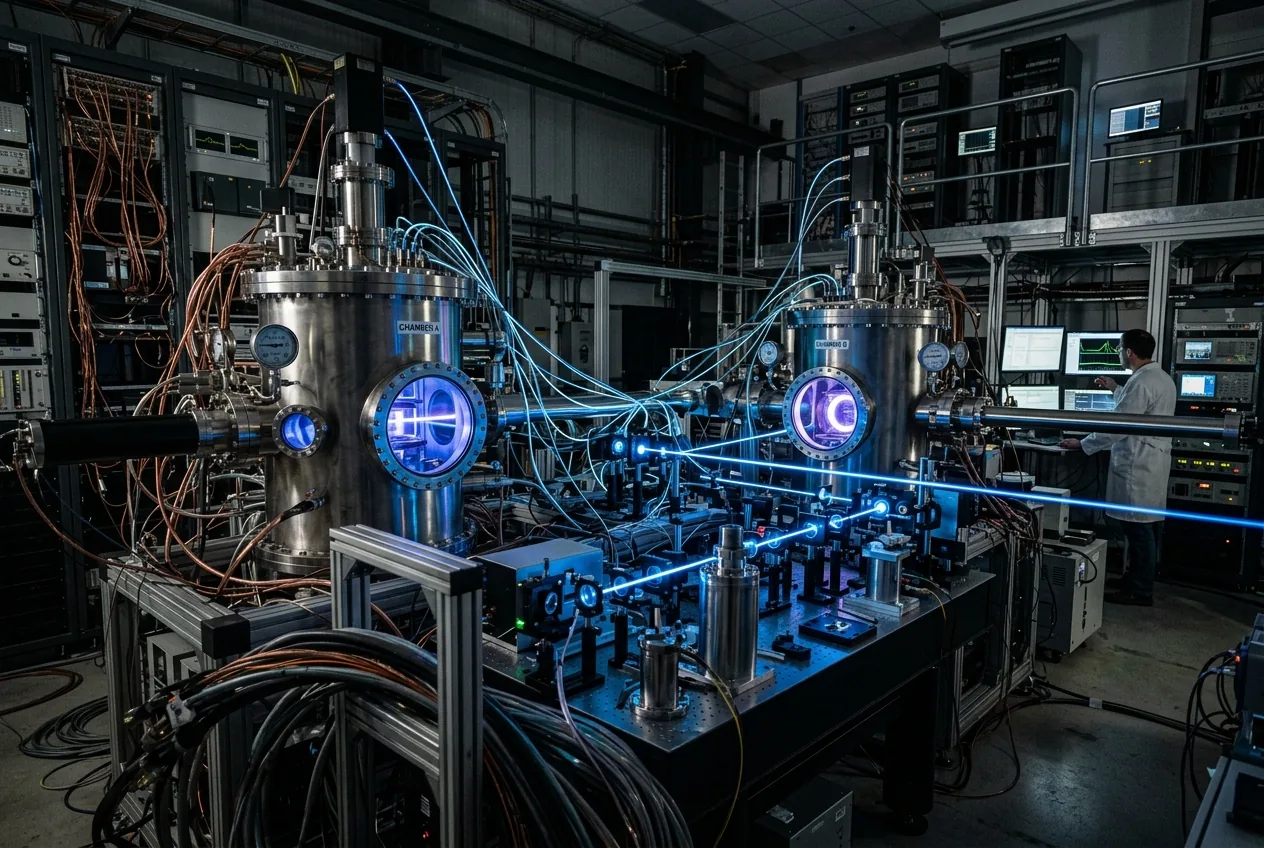
The vacuum chambers in Oxford’s Clarendon Laboratory do not hum with the cinematic resonance of a Starship Enterprise transporter room. Instead, they emit the rhythmic, industrial thrum of vacuum pumps and the precise clicking of optical shutters. In a recent demonstration that has sparked a flurry of breathless headlines, researchers at the University of Oxford successfully performed what physicists call quantum teleportation: the instantaneous transfer of a quantum state from one atom to another across a laboratory floor. While the popular press has jumped to conclusions about human travel, the reality is far more grounded in the brutal, incremental world of semiconductor logic and high-end industrial optics.
To understand what actually happened in Oxford, one must look past the word "teleportation" and toward the concept of the quantum network. The experiment involved two trapped ions—individual atoms held in place by electromagnetic fields. By entangling these ions and performing a specific set of measurements on one, the researchers were able to manifest the exact state of the first ion on the second, effectively moving information without moving matter. It is a feat of engineering that solves a specific, nagging problem in the scaling of quantum computers: how to make two separate chips talk to each other without losing the fragile quantum data that makes them useful in the first place.
The fidelity of the ghost
In the world of quantum hardware, "breakthrough" is a term usually measured in decimal points. The Oxford team didn't just achieve teleportation; they achieved it with a fidelity that suggests this method could actually work in a commercial environment. Fidelity refers to the accuracy of the transfer. In previous attempts, the noise of the environment—temperature fluctuations, stray magnetic fields, or even the vibration of a passing lorry in Oxford city centre—would degrade the quantum state. If the fidelity is too low, the information is essentially corrupted, rendering the entire process a scientific curiosity rather than a technological foundation.
The Oxford demonstration achieved a level of precision that pushes toward the threshold required for fault-tolerant quantum computing. This is the holy grail of the industry: a machine that can correct its own errors. For the engineers involved, the tension isn't about whether teleportation is possible—we have known it is since the 1990s—but whether it can be done reliably enough to build a modular computer. If you cannot teleport a quantum bit (qubit) from one rack of hardware to another with near-perfect accuracy, you cannot scale. You are stuck with a single, small, hot, and temperamental chip. Oxford has essentially proven that the "cables" for the quantum internet are finally being manufactured to a usable standard.
Trapped ions versus the silicon giants
The choice of hardware here is a deliberate shot across the bow of the American tech giants. While Google and IBM have poured billions into superconducting qubits—circuits chilled to near absolute zero on silicon wafers—Oxford has doubled down on trapped ion technology. This approach, championed by the university and its prominent spin-out, Oxford Ionics, uses individual atoms as qubits. Atoms are identical by nature; they do not suffer from the manufacturing defects that plague artificial silicon circuits. However, they are notoriously difficult to move and manipulate.
The post-Brexit quantum sovereignty gap
The timing of this Oxford success highlights a growing tension in European industrial policy. The UK has launched a £2.5 billion National Quantum Strategy, aiming to cement its lead in the field. Yet, as the Oxford researchers refine their teleportation protocols, they do so in a landscape where the flow of talent and equipment is increasingly bogged down by the administrative friction of life outside the European Union. While the UK recently rejoined the Horizon Europe research programme, the scars of the exclusion period remain visible in the procurement offices of laboratories across the country.
Brussels is not standing still. The EU Quantum Flagship is a billion-euro initiative designed to ensure that the continent does not become a mere consumer of American or Chinese quantum hardware. The Oxford breakthrough poses a strategic question for Berlin and Paris: do they follow the trapped-ion path, or do they stick to the superconducting and photonic systems being developed in places like Munich and Delft? The risk is a fragmentation of standards. If the UK develops a proprietary method for networking quantum nodes via teleportation, and the EU develops another, we may see a repeat of the early days of telecommunications, where systems are technically brilliant but fundamentally incompatible.
Why the 'Star Trek' headlines miss the point
The obsession with physical teleportation of macroscopic objects—like people or coffee cups—is a distraction that the scientific community often tolerates for the sake of funding. In reality, the amount of information contained in a human body is so vast that teleporting it would require a bandwidth that exceeds the energy capacity of the known universe. But teleporting the state of a single ion is different. It is the fundamental unit of a new kind of economy. It is about the secure transfer of cryptographic keys and the simulation of new catalysts for battery technology.
The industrial trade-off here is throughput. The Oxford experiment is precise, but it is slow. To be useful in a real-world computer, these teleportation events need to happen millions of times per second. Currently, they happen at a rate that would make an old dial-up modem look like a fiber-optic backbone. The challenge now moves from the physicists to the chip designers and the systems engineers. How do you integrate these vacuum chambers onto a form factor that doesn't require a dedicated building? How do you automate the laser alignment so it doesn't require a PhD student to tweak it every forty minutes?
The silicon ceiling and the cryostat wall
There is a quiet consensus among many hardware engineers that we are approaching a "silicon ceiling" in quantum scaling. You can only fit so many superconducting qubits on a chip before the heat from the control electronics melts the quantum state you are trying to preserve. Teleportation is the escape hatch. If Oxford can reliably move data between separate cryostats, the size of the computer is no longer limited by the size of the refrigerator. You simply link more refrigerators together.
However, this vision relies on a level of precision in optical networking that doesn't yet exist at scale. The photon detectors needed to confirm that entanglement has occurred are often custom-built, one-off devices with lead times that can stretch into years. For a journalist tracking the semiconductor supply chain, the Oxford breakthrough is less a sign that we are closer to 'beaming up' and more a sign that we urgently need to build a specialized manufacturing base for quantum-grade optics in Europe. Without it, these lab successes will remain precisely that: lab successes, eventually sold to the highest bidder in Silicon Valley or Shenzhen.
As the dust settles on the latest round of hype, the Oxford team is likely back in the lab, dealing with the reality of a misaligned mirror or a fluctuating power grid. They have proved that the ghost can be moved from one machine to another with startling accuracy. Now comes the hard part: making it work when the physicists aren't in the room to watch it. It is progress, certainly. The kind that doesn't fit on a flashy slide deck, but eventually changes the way a continent computes.
Oxford has the qubits. London has the strategy. Now we will see if the supply chain can actually deliver the lasers.




Comments
No comments yet. Be the first!