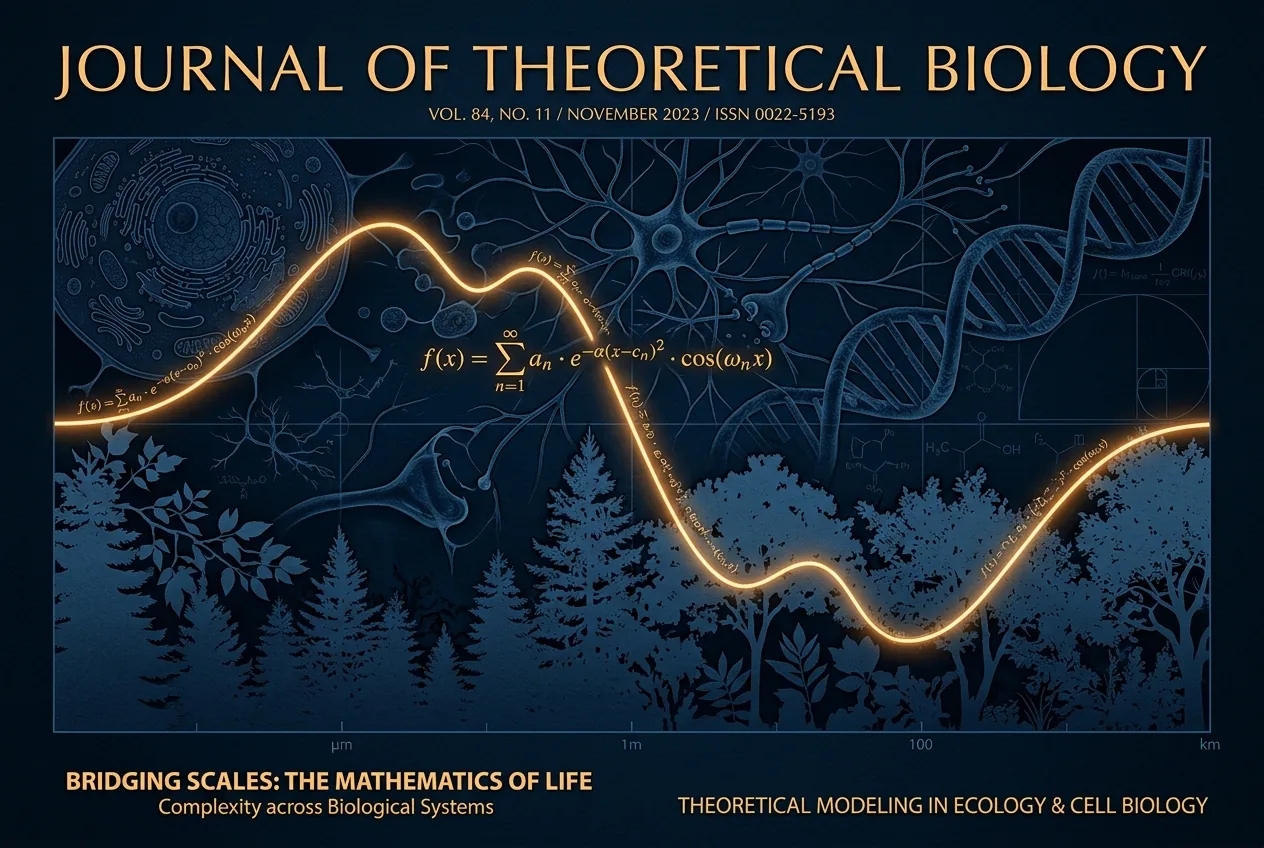
When Ignacio Peralta-Maraver and his colleagues at the University of Granada began scrubbing through decades of ecological data, they weren’t looking for a cage. They were looking for a pattern. What they found, after synthesising 30,000 performance measurements across 2,700 species, is a mathematical shackle that suggests the diversity of life on Earth is essentially running on the same hardware. From the way a bacterium divides in a petri dish to the speed at which a gazelle outruns a predator, every biological process appears to be tethered to a single, uncompromising curve: the Universal Thermal Performance Curve (UTPC).
For a century, the Darwinian narrative has been one of near-infinite plasticity. The thinking was simple: if the environment changes, life adapts. Natural selection acts as the ultimate engineer, iterating on genomes until a species finds a way to thrive in the heat of the Sahara or the cold of the Antarctic. But the UTPC suggests that biological engineering is not a blank cheque. Instead, life is governed by a hard thermodynamic ceiling that evolution cannot break, only negotiate. The research, published in the Proceedings of the National Academy of Sciences (PNAS), indicates that as temperature rises, biological performance follows a specific, asymmetric arc—climbing steadily to an optimum before a catastrophic, non-linear collapse.
This is not merely a curiosity for theoretical biologists; it is a fundamental problem for European industrial and climate strategy. If the biological world follows a fixed mathematical law rather than an infinitely adaptable one, our assumptions about how ecosystems—and the agricultural sectors that rely on them—will handle a warming planet require a cold-eyed reassessment. We have spent decades banking on the resilience of nature, but the math suggests that nature is playing with a very limited hand.
Can evolution actually outrun thermodynamics?
The tension at the heart of this discovery lies in the conflict between biological contingency and physical law. Biologists have long debated whether life is a series of accidents or a predictable outcome of physics. The UTPC argues for the latter. By rescaling performance data across the entire tree of life, the researchers found that despite the wild variety of shapes and sizes, the response to temperature is remarkably uniform. It follows an exponential scaling pattern where metabolic activity increases with heat until it hits a wall. This isn't a choice made by a species; it is a constraint imposed by the kinetic energy of molecules and the stability of proteins.
The "shackle" metaphor is earned. If every organism is bound to the same performance curve, it means that evolution cannot simply invent a new way to handle heat. It can shift its position on the curve, but it cannot change the shape of the curve itself. This is a significant blow to the idea of evolutionary rescue—the hope that rapid genetic shifts will allow species to keep pace with the current rate of global warming. If the curve is universal, the safety margins we thought existed are largely illusory. When an organism reaches the peak of its thermal optimum, it doesn't have a plateau to walk across; it has a cliff to fall off.
In the labs of Southern Europe, where this research was spearheaded, the implications are particularly sharp. Spain and France are already seeing the frontiers of this curve in real-time. Freshwater ecosystems, a primary focus for Peralta-Maraver’s team, are acting as the proverbial canaries. As water temperatures tick upward, the organisms within them aren't slowly slowing down; they are performing at peak capacity right until the moment their cellular machinery fails. This is the danger of an asymmetric curve: it rewards performance right up until the point of total system failure.
The high cost of a fixed biological budget
From a policy perspective, the UTPC acts as a biological debt ceiling. European climate adaptation strategies, such as those outlined in the EU Green Deal, often rely on the assumption that nature-based solutions—reforestation, soil health, and marine conservation—will provide a buffer against rising temperatures. However, if the underlying biology of these systems is governed by a fixed thermal limit, that buffer is far more fragile than the models suggest. We are essentially asking ecosystems to perform a task for which they lack the physical capability.
There is also an industrial angle that often gets lost in the talk of butterflies and trees. Europe’s burgeoning bio-economy—everything from synthetic biology to industrial fermentation—is essentially the art of putting biology to work. If the UTPC holds true, it defines the operating envelopes for every bioreactor on the continent. Engineers cannot simply "evolve" a strain of yeast to work at higher temperatures to save on cooling costs if that yeast is bound by the same universal thermal law as a blue whale. The physical limits of life are also the physical limits of bio-industrial efficiency.
This discovery forces a pivot in how we view risk. In the semiconductor industry, we talk about thermal throttling—when a chip slows down because it can't dissipate heat fast enough. The UTPC suggests that the entire biosphere is currently undergoing a massive, unplanned thermal throttling event. But unlike a CPU, which can be throttled indefinitely, biological systems that go over the edge of the curve tend to enter a state of irreversible decay. The "global constraint" mentioned by separate teams in Japan mirrors this finding: there is a structural limit to growth that no amount of nutrients or selective pressure can bypass.
Does this mean the end of the Darwinian fantasy?
Calling this a challenge to evolution theory isn't about saying Darwin was wrong; it’s about saying Darwin was incomplete. Natural selection is real, but it is a secondary force operating within a primary framework of physics. It’s the difference between a driver choosing how fast to go and the engine’s redline. You can drive however you like, but the redline is determined by the metallurgy of the cylinders. The UTPC is the redline for life on Earth.
Critics of the "universal law" approach point out that life is famously good at finding loopholes. Extremophiles living in deep-sea vents or frozen Alaskan tundra seem to suggest that the curve can be stretched. However, the Granada study’s strength lies in its sheer scale. By aggregating 30,000 data points, the noise of individual exceptions is drowned out by the signal of the universal rule. Most species don't live in the loopholes; they live on the curve. And for the vast majority of the planet's biomass, the curve is currently shifting into the danger zone.
The European research community, particularly those funded through Horizon Europe initiatives, is now tasked with integrating this "universal law" into broader climate models. The shift is from predicting *if* a species will survive to calculating *when* it will hit the thermal cliff. It is a more deterministic, and frankly more grim, way of looking at the world. It replaces the optimistic flexibility of biology with the rigid certainty of a physics equation.
Ultimately, the discovery of the UTPC represents a maturation of biology. It is moving away from being a descriptive science of "what is" toward a predictive science of "what must be." As we push the planet toward its thermal limits, we are finding that the organisms we share it with aren't just characters in a story of endless adaptation. They are components in a system with very real, very fixed operating parameters. Brussels can mandate carbon neutrality and Bonn can subsidise green tech, but the thermodynamics of a cell doesn't take instructions from a committee. We have found the speed limit of life; the problem is that we are already accelerating toward it.



Comments
No comments yet. Be the first!