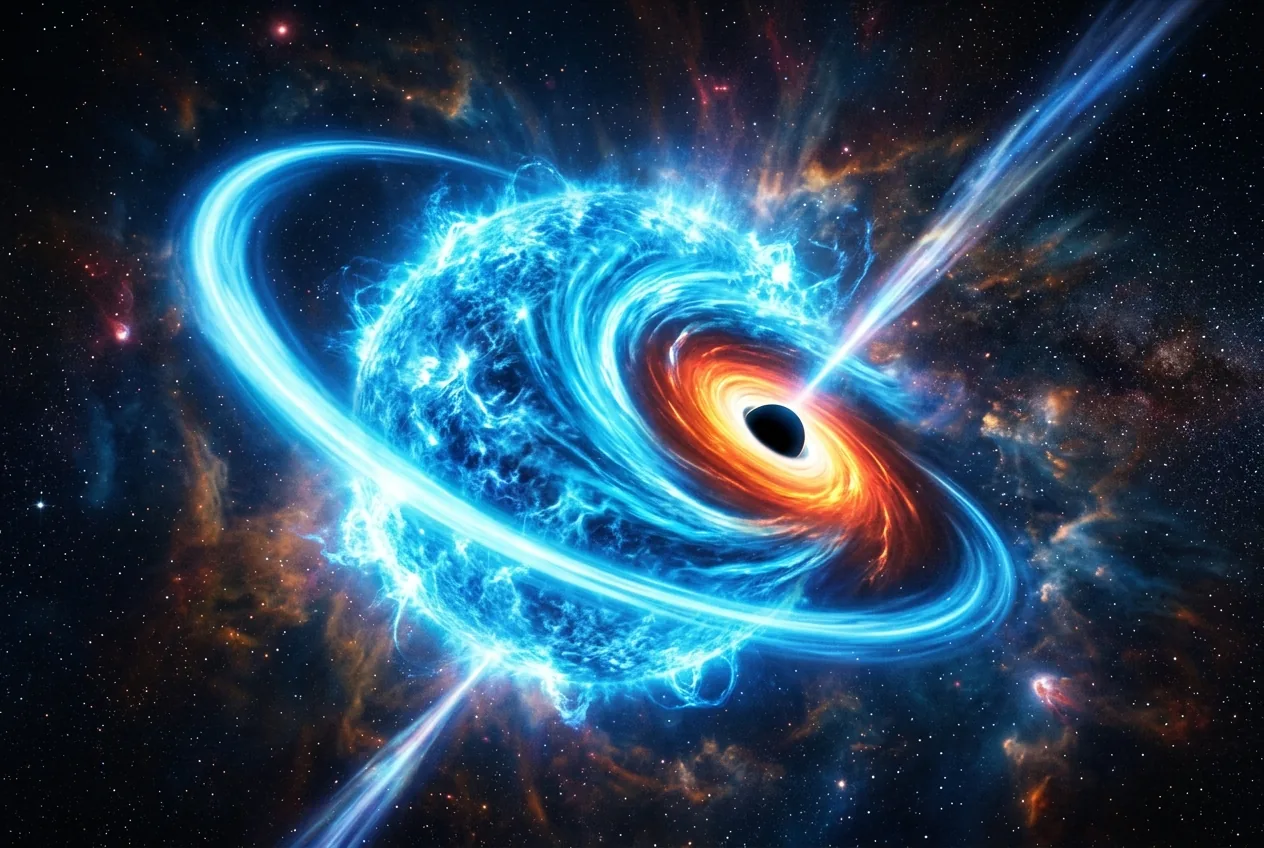
Luminous Fast Blue Optical Transients (LFBOTs) have spent the last decade behaving like the industry’s most annoying technical anomaly. They do not fit the established curves for stellar collapse. They are not standard supernovae, which rely on the slow radioactive decay of nickel-56 to stay bright. Instead, LFBOTs suggest a massive, sudden injection of energy from a central engine that is quickly smothered or exhausted. For years, the leading theories ranged from magnetars to intermediate-mass black holes, but a new synthesis of data from 14 separate events suggests a far more literal kind of cosmic collision: a compact object, such as a black hole or a neutron star, performing a fatal, high-speed dive into the heart of a bloated, dying star.
The Wolf-Rayet donor and the hungry guest
As the black hole sinks into the Wolf-Rayet star, it begins to 'eat' the surrounding stellar material at a rate that exceeds the Eddington limit, the theoretical maximum at which a star can radiate energy. This process generates powerful jets of plasma that tear through the star's remaining outer layers. The blue colour, which has baffled observers, is a direct indicator of temperature. While standard supernovae cool as they expand, LFBOTs remain searingly hot for the duration of the event. This suggests that we aren't just seeing an explosion, but the sustained heat of a central engine—the black hole—working its way through its meal in real-time.
The industrial race for transient data
While the physics of these 'blue flashes' is being debated in journals, the infrastructure required to find them is the subject of intense industrial competition in Europe. Transient astronomy—the study of things that go 'bang' and then disappear—is no longer the hobby of patient observers with telescopes. It is now a big-data problem. The European Space Agency (ESA) and its member states have invested heavily in the 'Gaia' mission, which has been operational for a decade. While Gaia is primarily a star-mapper, its 'Science Alerts' team in Cambridge and across the continent has become the de facto early-warning system for these events.
The challenge for European industrial policy is ensuring that our sensors can keep up with the sheer volume of data. The Vera C. Rubin Observatory in Chile, though a US-led project, represents the next generation of this hunt. It will survey the entire visible sky every few nights, generating 20 terabytes of data daily. European researchers are scrambling to build the 'brokers'—the AI-driven software stacks—that can sift through millions of alerts to find the one 'blue flash' buried in a sea of mundane stellar flickering. In Brussels, this is seen not just as a scientific pursuit, but as a testbed for high-speed data processing and sovereign sensor technology.
There is a quiet tension between the purely scientific goals of these missions and the industrial reality of who builds the hardware. Germany’s expertise in precision optics and X-ray sensors, exemplified by the eROSITA telescope, has provided critical cross-check data for LFBOTs. When an LFBOT flashes in the visible spectrum, eROSITA (until its current hiatus) would look for the X-ray 'glow' that confirms a black hole is involved. Without this multi-wavelength approach, LFBOTs remain mere curiosities rather than data points in a larger industrial-academic map.
Sifting through the sensationalist fog
Public interest in these flashes often gravitates toward more exotic explanations. Headlines frequently speculate about parallel universes or 'alien-hunting spacecraft' tracking interstellar objects like 3I/ATLAS. This sensationalism stems from a genuine 2019 anomaly where a gravitational wave signal was detected with a 'chirp' that didn't immediately match black hole merger models. However, the bridge between a weird signal and a 'parallel universe' is usually built by PR departments, not physicists. In the case of LFBOTs, the reality of a black hole deconstructing a Wolf-Rayet star is arguably more terrifying—and certainly more useful to our understanding of the universe—than the sci-fi alternatives.
The cost of cosmic curiosity
The study of LFBOTs eventually hits the same wall that every major European science project faces: procurement and longevity. The Gaia mission is aging. The eROSITA mission is caught in the crossfire of geopolitical tensions. While we have the theory of the 'black hole plunge,' confirming it requires more than just 14 data points. It requires a sustained commitment to wide-field surveying that doesn't always show an immediate return on investment for the taxpayer.
When we see a blue flash, we are seeing the end of a star's billion-year life in a matter of hours. It is a reminder of the volatility that exists in the 'quiet' reaches of space. But for those on the ground in Cologne or Brussels, the flash is also a reminder that the technology we use to watch the stars is often the same technology that will eventually define our industrial sovereignty in orbit. We watch the black hole eat the star because, in doing so, we learn how to build better sensors, better algorithms, and more resilient data networks.
Europe has the engineers to solve the LFBOT mystery. It just remains to be seen if the funding cycles can move as fast as the flashes they are meant to catch. For now, the 'blue flashes' remain a rare treat—a violent, beautiful anomaly that reminds us how much of the universe is still behaving in ways we didn't give it permission to. The data is clear, even if the bureaucratic path to the next telescope is not. The universe will keep flashing; we just have to decide if we can afford to keep the lights on and the cameras rolling.




Comments
No comments yet. Be the first!